
Open Access Publisher and Free Library
CRIME+CRIMINOLOGY.jpeg

CRIME

Violent-Non-Violent-Cyber-Global-Organized-Environmental-Policing-Crime Prevention-Victimization

Posts tagged forgeries
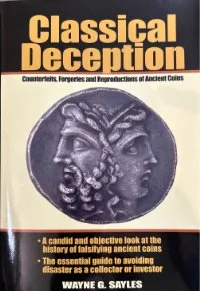
Classical Deception: Counterfeits, Forgeries and Reproductions of Ancient Coins

Wayne G. Sayles:


Classical Deception is a detailed and accessible exploration of the long history of counterfeit ancient coins and the methods by which they are produced, detected, and sometimes unwittingly circulated within the numismatic world. Designed for collectors, students of antiquity, and museum professionals alike, the book traces forgery practices from antiquity to the modern era, showing that imitations have accompanied genuine coinage for as long as coins have existed. Sayles examines a spectrum of deceptions — from ancient contemporary counterfeits meant to pass in daily commerce, to the sophisticated modern forgeries that challenge even seasoned experts.

A substantial portion of the book profiles well-known forgers, documenting their techniques, motives, and the specific pieces they produced. Sayles pays particular attention to the prolific work of modern reproduction artists, including Peter Rosa, whose replicas are widely encountered and often misunderstood by beginning collectors. More than 200 photographs allow readers to visually compare authentic coins with their deceptive counterparts, highlighting telltale markers in style, fabric, metallurgy, and die workmanship.

Sayles also introduces the scientific and observational tools available to detect fakes — from simple weight measurement and magnified study of surfaces to metallurgical testing, microscopy, and imaging technologies. Throughout, he emphasizes practical guidance: what warning signs to look for, how to assess provenance, and how to avoid costly errors in the marketplace.

Ultimately, Classical Deception serves both as a cautionary manual and as a historical study of ingenuity, fraud, and craftsmanship. It equips the reader to navigate the hazards of collecting while deepening appreciation for the authentic artistry of ancient coinage.

Read
Counterfeits on Darknet Markets: A measurement between Jan-2014 and Sep-2015

By: Felix Soldner, Bennett Kleinberg, and Shane D Johnson

Counterfeits harm consumers, governments, and intellectual property holders. They accounted for 3.3% of worldwide trades in 2016, having an estimated value of $509 billion in the same year. While estimations are mostly based on border seizures, we examined openly labeled counterfeits on darknet markets, which allowed us to gather and analyze information from a different perspective. Here, we analyzed data from 11 darknet markets for the period Jan-2014 and Sep-2015. The findings suggest that darknet markets harbor similar counterfeit product types as found in seizures but that the share of watches is higher and lower for electronics, clothes, shoes, and Tobacco on darknet markets. Also, darknet market counterfeits seem to have similar shipping origins as seized goods, with some exceptions, such as a relatively high share (5%) of dark market counterfeits originating from the US. Lastly, counterfeits on dark markets tend to have a relatively low price and sales volume. However, based on preliminary estimations, the original products on the surface web seem to be worth a multiple of the prices of the counterfeit counterparts on darknet markets. Gathering insights about counterfeits from darknet markets can be valuable for businesses and authorities and be cost-effective compared to border seizures. Thus, monitoring darknet markets can help us understand the counterfeit landscape better.

Crime Science (2023) 12:18

Download