Open Access Publisher and Free Library
CRIME+CRIMINOLOGY.jpeg

CRIME

Violent-Non-Violent-Cyber-Global-Organized-Environmental-Policing-Crime Prevention-Victimization

Posts in INCLUSION
Understanding the Illegal Wildlife Trade in Vietnam: A Systematic Literature Review

By Hai Thank Luong

As one of the earliest countries in the Southeast Asia region, Vietnam joined the CITES in 1994. However, they have faced several challenges and practical barriers to preventing and combating illegal wildlife trade (IWT) after 35 years. This first study systematically reviews 29 English journal articles between 1994 and 2020 to examine and assess the main trends and patterns of the IWT’s concerns in Vietnam. Findings show (1) slow progress of empirical studies, (2) unbalanced authorship between Vietnamese and non-Vietnamese conducting their projects, (3) weighting of wildlife demand consumptions in Vietnamese communities rather than investigating supply networks with high-profile traffickers, (4) lacking research in green and conservation criminology to assess the inside of the IWT, and (5) need to focus on potential harms of zoonotic transmission between a wild animal and human beings. The article also provides current limitations before proposing further research to fill these future gaps.

Laws 11: 64. https://doi.org/10.3390/laws 11040064 

download
The Opportunity in Crisis: How 2020's Challenges Present New Opportunities for Prosecutors

By Chesa Boudin   

As San Francisco District Attorney, I was elected in late 2019 on an ambitious platform focused on ending mass incarceration and decreasing  racial disparities in the criminal justice system. Little did I imagine that my first year in office would bring an acute national focus to the exact issues on which I had campaigned. Two phenomena have, thus far, largely defined the year 2020. First, the COVID-19 pandemic, which continues to have a grossly disparate impact on communities of color2 and on those living and working in prisons and jails. Second, a national Black Lives Matter movement grew in response to the murder of George Floyd—potentially the largest national movement in U.S. history—demanding police accountability and criminal justice reform with a focus on racial equity. The nation’s collective response to these developments—how the country navigates an unprecedented national health crisis and an unprecedented protest movement—will have lasting implications for myriad aspects of American life, including the criminal justice system. COVID-19 and the growth of the Black Lives Matter movement created a tremendous impetus for wide-ranging criminal justice reform, including decarceration and police accountability. Although some criminal justice jurisdictions have actively resisted change, and others have simply been unprepared for it, San Francisco was ready. After all, San Francisco voters had just elected me on explicit promises to deliver many of the reforms now in the national spotlight, and we were changemaking   

110 J. Crim. L. & Criminology Online 23 (2020).   

download
Crisis and Coercive Pleas

By Thea Johnson   

In the midst of the coronavirus pandemic, activists and advocates have rightly focused their attention on the immediate need to decrease the number of people in jails and prisons.1 Jails and prisons have been ravaged by the  virus and defendants are at real risk of illness or death in those spaces.2 But as the crisis continues and the backlog of criminal cases grows, defendants face additional risks. This essay focuses on one such risk: the heightened risk for coerced and false pleas during the crisis. The vehicle by which the criminal system resolves most criminal cases—the plea bargain —is ripe for abuse and overuse in the best of times. Unfortunately, now is far from the best of times, and as I outline here, there are several reasons why the usual risk factors for coercive plea bargaining are exacerbated during this public health crisis. Furthermore, despite recent efforts to reform the plea system, the pandemic risks entrenching many of the most negative characteristics of plea bargaining even more deeply. Quite simply, the coercive nature of plea bargaining will get worse in a system that is backlogged and unable to hold jury trials for several months. Many states are not counting the delays caused by the coronavirus toward a defendant’s speedy trial clock, which means the cases can remain active for long periods of time and without any risk to the prosecutor that the case will be dismissed for lack of prosecution. For a defendant in this backlogged system, with a case hanging over her head and a speedy trial clock without finality, the plea will be her only option. In such an environment, coercive pleas can and will flourish. This essay proceeds in three parts. Part I of the essay discusses the particular concerns related to coercive plea bargaining during the COVID-19 crisis. Part II offers solutions to these issues and suggests that this moment may provide opportunities for creative problem-solving capable of outlasting the virus. Finally, Part III discusses some silver linings of the crisis for the criminal system at large and the practice of plea bargaining in particular. Like many other recent pieces about the impact of coronavirus on the criminal justice system, this essay addresses the current crisis in the hopes that it will teach us important lessons about the system more broadly. By seeing some of the worst parts of the system exposed through COVID-19, we may be able to better meet future challenges and tackle some of the underlying daily injustices of the modern criminal process.  

110 J. Crim. L. & Criminology Online 1 (2020).

read/download
Poached: Inside The Dark World Of Wildlife Trafficking

By Rachel Love Nuwer

An intrepid investigation of the criminal world of wildlife trafficking--the poachers, the traders, and the customers--and of those fighting against it. Journalist Rachel Nuwer plunges the reader into the underground of global wildlife trafficking, a topic she has been investigating for nearly a decade. Our insatiable demand for animals--for jewelry, pets, medicine, meat, trophies, and fur--is driving a worldwide poaching epidemic, threatening the continued existence of countless species. Illegal wildlife trade now ranks among the largest contraband industries in the world, yet compared to drug, arms, or human trafficking, the wildlife crisis has received scant attention and support, leaving it up to passionate individuals fighting on the ground to try to ensure that elephants, tigers, rhinos, and more are still around for future generations.

New York: Da Capo Press, 2018. 384p.

read
The Last Fish Swimming: the Global Crime of Illegal Fishing

By Gohar Petrossian

Humans are deeply dependent on fishing―globally, fish comprise 15 percent of the protein intake for approximately 3 billion people, and 8 percent of the global population depends on the fishing industry as their livelihood. The global fishing industry is plagued by illegal fishing, however, and many highly commercial species, such as cod, tuna, orange roughy, and swordfish, are extremely vulnerable.

Through criminological analysis, The Last Fish Swimming emphasizes the importance of looking at specific environmental factors that make illegal fishing possible. It examines such factors as proximity to known ports where illegally caught fish can be landed without inspection (i.e., ports of convenience), fisheries monitoring, control and surveillance efforts, formal surveillance, and resource attractiveness in 53 countries that altogether represent 96 percent of the world's fish catch. The book calls upon the global community to address the illegal depletion of the world's fish stock and other similar threats to the world's food supply and natural environment in order to ensure the sustainability of the planet's fish and continuation of the legal fishing industry for generations to come.

Santa Barbara. Praeger. 2019. 191p.

read
Smugglersʼ Source: Japanʼ s Legal Ivory Market. An Analysis of Chinese Court Decisions of Ivory Illegally Exported from Japan

By Masayuki Sakamoto

Africaʼ s elephants continue to be poached for their ivory tusks. To combat the poaching crisis, and to support the Convention on International Trade in Endangered Species of Wild Fauna and Flora (CITES)ʼ s 1990 ban on international commercial ivory trade, nations and jurisdictions around the world have taken steps to close their domestic markets for ivory. By closing the market for ivory, governments send a strong signal that the trade in ivory and killing of elephants is unacceptable, streamline enforcement efforts by eliminating legal cover for illegal ivory, and support ivory demand reduction efforts. Nevertheless, one major consumer market remains open ‒ Japan. With an ivory stockpile of 244 tonnes, Japanʼ s domestic market is the worldʼ s largest and most significant legalized ivory market. Evidence indicates its ivory trade controls are porous, enabling the trade in illegal ivory and illegal ivory exports. At least 76 seizures of ivory from Japan were made between 2018 and 2020, mostly in China by Chinese authorities. To further examine illegal ivory export from Japan to China, the Japan Tiger and Elephant Fund (JTEF) turned to court cases in China, which could include more details than seizure data. JTEF identified court cases on illegal export of ivory from Japan into China, and analyzed them in order to contribute to evidence-based decision-making, constructive dialogue, and decisive outcomes from the Parties at the 19th Conference of the Parties (CoP19) to CITES,. In all, 49 public court decisions on 45 different cases between 2010 and 2019, published by the Government of China, were…..

  • identified and analyzed. Fifteen out of 45 cases occurred in 2018 and 2019, after Chinaʼ s domestic ivory market closure went into effect. In addition to summarizing basic information about each case, any information pertaining to the role of Japanʼ s legal market in illegal ivory export and information regarding the defining characteristics of transnational organized crime was assessed.  

Tokyo: Japan Tiger and Elephant Fund (JTEF) 2022. 88p.

download
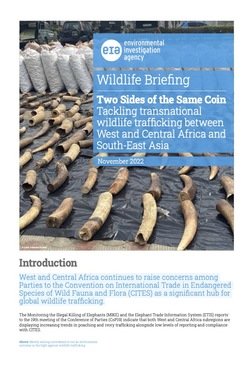
Two Sides of the Same Coin: Tackling transnational wildlife trafficking between West and Central Africa and South-East Asia

By The Environmental Investigation Agency (EIA)

West and Central Africa continues to raise concerns among Parties to the Convention on International Trade in Endangered Species of Wild Fauna and Flora (CITES) as a significant hub for global wildlife trafficking. This briefing highlights the parallel responsibilities and shortcomings of both West and Central Africa and South-East Asia in implementing their commitments under CITES and outlines what needs to happen to tackle transnational wildlife crime more effectively. At SC74, EIA raised these concerns in our briefing document Joint Responsibilities: The Nigeria- Vietnam wildlife trafficking corridor and compliance with CITES, which similarly highlighted the need for urgent action.

London; Washington, DC: EIA, 2022. 12p.

download
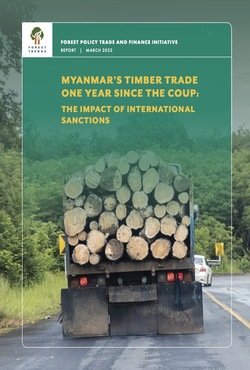
Myanmar’s Timber Trade One Year Since the Coup: The Impact of International Sanctions

By Forest Trends

On February 1st, 2021, the military launched a coup d'état against the newly re-elected government of Myanmar. Over the past year, the military junta has been accused of massive human rights violations, arresting more than 12,000 people, killing more than 1,500, and instigating a growing humanitarian crisis that has seen more than 400,000 internally displaced people (IDPs) (AAPP Burma 2022, UN News 2022). Compounding the impact of COVID-19, the military’s violence has destroyed Myanmar’s economy. Furthermore, the majority of society has engaged in a predominately non-violent Civil Disobedience Movement (CDM), including a boycott of companies with military links. Deprived of revenue, the junta has increasingly relied on revenue from natural resources to support their operations and their ongoing campaign to retain power, which has included escalation of armed conflict and attacks on civilians. While much international focus has been given to the revenues generated by the oil, gas, and mining sectors, the forest sector has in the past been an important source of revenue for Myanmar’s governments and entities associated with the military. This report reviews the timber sector’s role in the revenue now being generated for the current military regime.  

Washington, DC: Forest Trends, 2022. 42p.

download
Acts of Defiance: How US traders are ignoring sanctions to import conflict teak from Myanmar

By The Environmental Investigation Agency (EIA).

In February 2021, Myanmar’s democratically elected ruling party, the National League for Democracy, was overthrown by the Myanmar military in a coup d’état. In the months since the coup, the people of Myanmar (formerly Burma) have been subjected to a continued escalation of conflict and brutal human rights atrocities. To maintain its illegal regime and crush dissent, the military is dependent on a continual flow of hard currency. As for the previous regimes, natural resources provide a source of profit for the military, whereby the forests of Myanmar are defined by their monetary value and have been part of the military and economic elites’ profits and, in some cases, survival for decades.

London; Washington, DC: EIA, 2022. 16p.

download
Nature Crime: Understanding and Tackling a Key Threat to the Climate and Land Use Agenda

By Charles Victor Barber, Karen Winfield, and Rachael Petersen 

Nature crime1 occurs when individuals or criminal networks illegally exploit natural ecosystems to extract natural resources. Nature crimes include illegal logging, illegal mining, illegal fishing, illegal wildlife trade,2 and the illegal conversion of forests and wetlands for agriculture or other uses. These crimes are often associated with financial crime of various types, as well as labor and human violations and official corruption. The prevalence of nature crime and associated corruption and criminal behavior constitutes a serious barrier to progress in tackling climate change, slowing biodiversity loss, reducing the risk of future zoonotic pandemics, and achieving sustainable, peaceful, and equitable human development. The scale of the nature crime economy is immense. It is variably estimated to be the third- or fourth-largest illicit economy in the world (after drug trafficking and trade in counterfeit goods) with an annual value of as much as $281 billion, but this figure underestimates its indirect impacts: governments are deprived annually of some $7-12 billion in timber and fisheries revenues, while the indirect costs of undermining ecosystem services may be as high as $1-2 trillion per year (World Bank 2019a).  

San Francisco: Climate and Forests 2030, 2021. 30p.

download
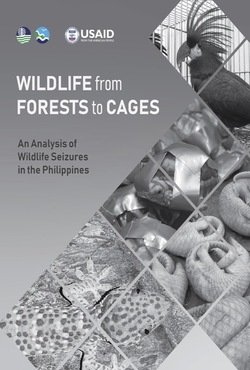
Wildlife from Forests to Cages: An Analysis of Wildlife Seizures in the Philippines

By Emerson Y. Sy

The illegal wildlife trade is one of the most lucrative transnational crimes in the world. Numerous wildlife are threatened with extinction due to overexploitation for food, medicine, and as pets. Although it is difficult to quantify the illegal wildlife trade due to its mostly clandestine nature, analyzing seizure data can indicate its magnitude. Wildlife seizure records from the DENR, PCSDS, and other sources for the period 2010–2019 were collated and analyzed to identify species threatened by the illegal wildlife trade, hotspots, and trafficking routes. The 10-year seizure dataset involved 511 incidents, 283 taxa, and 44,647 wildlife individuals. Reptiles (n = 16,237 individuals) and birds (n = 6,042) were the top seized live wildlife, while pangolin scales (>2,100 kg) had the most quantity and seizure frequency among derivatives. Intervention policies on the key source, transit, and destination locations were proposed to address illegal wildlife trade in the country.

Manila: USAID Philippines, 2021. 56p.

download
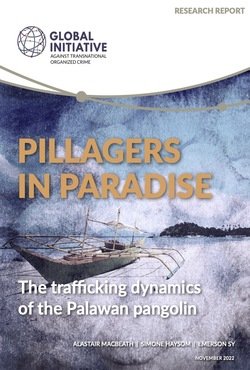
Pillagers in Paradise: The trafficking dynamics of the Palawan pangolin

By Alastair MacBeath, Simone Haysom, Emerson Sy

In recent years, several studies have raised alarm at the illicit trade pressure on the Philippines’ endemic pangolin species – the Palawan pangolin. Between 2018 and 2019, seizures of Palawan pangolins increased more than ninefold compared with the previous 18 years.1 Around 20 live pangolins have been ‘retrieved’ in and around Metro Manila, a several hundred kilometres boat ride away from their natural habitat, the province of Palawan – also known as the Philippines’ ‘last ecological frontier’. Recent studies have estimated that as many as 26 784 pangolins may be illegally hunted on the islands of Palawan per year,2 with much of the meat and most of the scales making their way to buyers based either in Manila or abroad, making this a national problem driven by international demand. In light of these indications of burgeoning illegal trade, this report was undertaken with three aims in mind: 1) to understand the broader context of drivers and factors that shape pangolin trafficking dynamics; 2) to shed light on the nature of networks driving the trade; and 3) to identify challenges and gaps in the state response. It is intended to complement work undertaken under the rubric of a broader project by the Zoological Society of London and six other organizations, namely 'Combating Palawan pangolin trafficking: Empowering community-based protection and proactive enforcement', funded by the UK Department for Environment, Food and Rural Affairs. The primary components of this project focus on community-based responses to illegal hunting, but also seek to improve…..

  • the government response at various levels of the trade chain. The report sets out how trafficking of the Palawan pangolin has grown over the last two decades, with what appears to be a sharp acceleration from around 2016. This rise has been linked both to shifts in the broader illicit economy in the Philippines, burgeoning links between pangolin consumer populations and the country, and global shifts in the patterns of illicit trade. We also describe the challenges facing the Filipino government agencies charged with responding to wildlife trafficking, which have created gaps in the state response that trafficking networks have profited from.  

Geneva: Global Initiative Against Transnational Organized Crime, 2022. 46p.

download
Japan’s Tireless Ivory Market: A Trader’s Haven Free of Strict Controls

By Masayuki Sakamoto

Africa’s elephants continue to be in crisis due to poaching for trading their ivory, and domestic markets for ivory have been closing worldwide to combat this crisis. The 18th meeting of the Conference of the Parties (CoP18) to the Convention on International Trade in Endangered Species of Wild Fauna and Flora (CITES) adopted a decision, aimed at promoting the implementation of the recommendation on the closure of domestic ivory markets included in Resolution Conf.10.10 amended at CoP17, which states “the Parties that have not closed their domestic markets for commercial trade in raw and worked ivory are requested to report to the Secretariat for consideration by the Standing Committee to CITES at its 73rd and 74th meetings on what measures they are taking to ensure that their domestic ivory markets are not contributing to poaching or illegal trade.” The Government of Japan (GoJ) submitted reports under the CITES Decision and insisted that “Japan has been implementing stringent measures to ensure that its domestic ivory market is not contributing to poaching or illegal trade”. Most importantly, Japan demonstrates a new business registration requiring ivory dealers to fulfill all requirements for registration and renew their registration every five years; a 100%-registration-mandate on whole tusks when they renew or initially receive their business registrations; maintenance of inventory data including transaction records and traceability information records for cut pieces; and, increased scrutiny of the registration of whole tusks by requiring the result of radiocarbon dating…..

  • However, GoJ’s claims of stringent market controls are flawed and unjustified. Firstly, according to the GoJ’s report, raw and worked ivory dealers must be registered. In this case, they must fulfill all requirements for registration, which requires renewal every five years. But, our analysis of the GoJ’s examination of eligibility of the business registration renewal indicates that businesses are being registered via a token examination with a lack of scrutiny by the competent authorities. Specifically, the reality of the examination of applications for business registration is that the competent authority has left it solely to the authorized private organization, even for the applications by kingpin dealers with track records of illegal trade engagement. Thus, it is obvious that the examination of business registration and renewal is in name only, and it has not exerted any effect on excluding problematic dealers. Secondly, GoJ insists ivory dealers must register all (whole) tusks in their possession when they renew or initially receive their business registrations. This approach is a countermeasure to the problem of unregulated unregistered whole tusks owned by the businesses; the Japanese domestic law requires whole tusks to be registered prior to transactions, however, exempts them from being registered as far as the owner does not intend to transfer them (even the case of tusks stocked by dealers for being consumed as raw material). Thus, it should be questioned whether the 100%-registration-mandate on whole tusks realized the goal of regulating the stockpile of registered dealers through the whole tusk registration or not. Our analysis indicates that registered dealers successfully evaded this requirement by cutting their whole tusks into pieces and then processing them into hanko beforehand. 

Japan: Japan Tiger and Elephant Fund, 2022. 24p.

download
Unveiling the Criminal Networks Behind Jaguar Trafficking in Bolivia

By The IUCN National Committee of The Netherlands

On behalf of the IUCN National Committee of the Netherlands (IUCN NL), Earth League International (ELI) conducted undercover investigations on jaguar poaching and trafficking in Bolivia. ELI investigated the criminal networks behind this illegal wildlife trade from 2018 to 2020 and unveiled the traffickers’ modus operandi and transport methods, routes and geographical hotspots. The investigations showed that the demand for jaguar parts comes from Asia and the trade is generally run by Chinese residents in Bolivia. The jaguar is the only member of the panthera family in the Americas and is by far the biggest cat on the continent. Scientists estimate there are between 130,000 and 208,000 jaguars left in the wild, mostly concentrated in the Amazon basin. The jaguar is classified by IUCN as ‘near threatened’. According to local experts, today there are an estimated 2,000-3,000 jaguars left in the wild in Bolivia.

Amsterdam: IUCN National Committee of The Netherlands, 2021. 24p.

download
The Criminal Networks Behind Jaguar Trafficking: Researching Crime Convergence to better understand an combat jaguar trafficking

By Andrea Crosta, Chiara Talerico, Allison Joseph, Liliana Jauregui, Marc Hoogeslag

  The jaguar (Panthera onca) is listed on CITES Appendix I and is classified on the IUCN Red List as ‘near threatened.’ Scientists estimate that the size of the global jaguar population varies greatly. A study by De la Torre et al (2018) estimated the global population of jaguars to be 64,000 individuals, while Jędrzejewski et al (2018) estimate that there are 173,000 (138,000±208,000) jaguars left in the wild, mostly concentrated in the Amazon basin. To tackle jaguar trafficking, more information on the trade's scale, nature and dynamics is needed. One of the objectives of ‘Operation Jaguar’ was exactly that. Operation Jaguar is a joint project between IUCN NL, International Fund for Animal Welfare (IFAW), and Earth League International (ELI) and is made possible by the Dutch Postcode Lottery. ELI has conducted undercover investigations on jaguar trafficking in Latin America as part of Operation Jaguar. Multiple missions have been undertaken to four Latin American countries: Bolivia, Suriname, Peru, and Ecuador. The focus of the intelligence-led operation was to unveil the central nodes, mechanisms, and structure of the entire criminal supply chain, with a bottom-up – top-down approach focusing on the illegal wildlife goods providers, the traders, the transporters, and the sellers in China. Through Operation Jaguar we have identified and investigated the most important jaguar trafficking networks in these four South American countries. ELI has researched the illegal wildlife supply chain to unveil the dynamics underneath jaguar trafficking in the region and identify the main players, trafficking routes, and destinations. Over the years more than a dozen trafficking networks operating regionally and internationally have been unveiled. Confidential Intelligence Briefs (CIBs) regarding these jaguar trafficking networks have been shared with several governmental and intergovernmental agencies.   

San Francisco: Earth League International, 2022. 19p.

download
Nautical Patrol and Illegal fishing Practices

By Stephen Kastoryano, Ben Vollaard

We uncover a hidden illegal fishing practice: the use of fishing nets with illegally small mesh size. The small mesh prevents nearly all fish of saleable size from escaping the net, but also traps a large number of fish which are too small to be sold on the market and are therefore discarded at sea. Our approach relies on readily available data on reported fish landings rather than on data from inspections, which are rare, and which tend to be anticipated by fishermen. We focus on bottom trawling, the world's most widely used fishing method. We exploit the fact that using illegally small mesh size strongly increases the share of small fish in the catch. Using quasi-random variation in nautical patrol as a source of variation in the incentive to comply, we show that in weeks without patrol the share of small fish in the landed catch is systematically larger than in adjacent weeks with patrol. Our results are in line with widespread use of illegally small mesh.

Bonn: The IZA Institute of Labor Economics, 2022. 53p.

download
Skin and Bones: Tiger Trafficking Analysis from January 2000–June 2022

By Ramacandra Wong, Kanitha Krishnasamy

Overall, whole tigers, dead and live, as well as a variety of tiger parts equal to a conservative estimate of 3,377 tigers were confiscated between January 2000 and June 2022 across 50 countries and territories, with data showing an increasing trend. According to Skin and Bones: Tiger Trafficking Analysis from January 2000–June 2022, the tigers and their parts were seized in 2,205 incidents, mostly in the 13 Tiger Range Countries (TRCs). India, home to more than half of the global wild tiger population, remains the top-ranked country with the most incidents and number of tigers confiscated. Data from the first half of 2022, the Year of the Tiger, stood out for several reasons: Indonesia, Thailand, and Russia recorded significant increases in the number of seizure incidents compared to the January-to-June period of the previous two decades.  This recent period was also particularly significant for Indonesia, home to the Critically Endangered Sumatran Tiger. It has already seized more tigers in the first half of 2022 (18 tigers) compared to all confiscations in 2021 (totalling 16 tigers). 

Selangor, Malaysia: TRAFFIC, Southeast Asia Regional Office, 2022. 52p.

download
Farmed or Poached? The trade of live Indonesian bird species in the Philippines

By Emerson Y. Sy, Josef Job G. Raymundo, Serene C.L. Chng

A new TRAFFIC study recorded more than 800 Indonesian birds¹ for sale online in the Philippines between January 2018 and December 2019. Since the survey, all 20 of the original groups have been deactivated by Facebook, but surveillance by the authors in January 2022 found 144 new active groups offering various Indonesian species for sale, which continues to date. Almost 1,300 Indonesian birds of at least 28 species were also confiscated from illegal trade in the Philippines between 2010 and 2020, according to the report Farmed or Poached? The trade of live Indonesian Bird Species in the Philippines. Scrutiny of international trade records uncovered discrepancies: a majority of the Indonesian bird species listed on CITES² exported from the Philippines had questionable or no records of legal import into the Philippines. The records show that the Philippines had severely underreported their imports of Indonesian bird species compared to the numbers reported by exporters. In some cases, the export of Indonesian birds from the Philippines took place before the first reported legal importation.

Selangor, Malaysia , TRAFFIC Southeast Asia Regional Office, 2022. 55p.

download
In Plane Sight: Wildlife Trafficking in the Air Transport Sector

By Mary Utermohlen and Patrick Baine

The report, In Plane Sight: Wildlife Trafficking in the Air Transport Sector, produced by C4ADS as part of the USAID Reducing Opportunities for Unlawful Transport of Endangered Species (ROUTES) Partnership, analyses global airport seizures of illegal wildlife and wildlife products from 2009 to 2017, finding trafficking instances in at least 136 countries worldwide. New data from 2017 shows a massive spike in rhino horn seizures, which nearly tripled from 2016 numbers. The seizure data indicate that wildlife traffickers moving ivory, rhino horn, reptiles, birds, pangolins, marine products, and mammals by air tend to rely on large hub airports all over the world. Collectively, these categories account for about 81 percent of all trafficked wildlife, according to the United Nations Office on Drugs and Crime (UNODC), and serve as indicators for broader trends within illicit wildlife trafficking. According to the In Plane Sight report, routes of wildlife products such as ivory, rhino horn and pangolin tend to flow from Africa to Asia, often transiting first through the Middle East and Europe. Wildlife traffickers carrying live animals, such as live birds and reptiles, generally rely on direct flights worldwide with different hotspots for wildlife trafficking in every region. China was by far the most common destination for all seized wildlife products between 2009 and 2017.

Washington, DC: C4ADS and The USAID Reducing Opportunities for Unlawful Transport of Endangered Species (ROUTES), 2018. 214p.

download
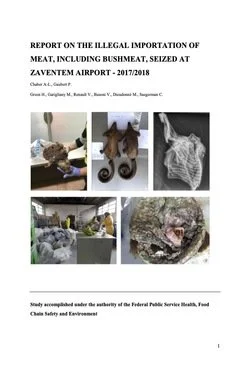
Report on the Illegal Importation of Meat, Including Bushmeat, Seized at Zaventem Airport - 2017-2018

By Anne-Lise Chaber, Philippe Gaubert, Claude Saegerman, Valéria Busoni, Mélodie Dieudonné, Harriet Green

The hunting for and consumption of bushmeat is traditional and vital for many communities around the world; it provides food and income as well as holding traditional value. Historically subsistence hunting was sustainable, however increased demand, improved access to forests and more efficient methods of hunting are resulting in unsustainable offtakes of wildlife. The growth in human population and ease with which people can move around the globe are causing an increase in demand, within range countries and internationally. Hunting unsustainably has the potential to cause a species to go extinct, locally or globally. The decrease or complete loss of a population has wider impacts on the ecosystem and so the people who depend on it. The international bushmeat trade is not fully understood and as such, it is unknown what impact this may be having on wildlife populations. This study aimed to gain a better understanding of the international bushmeat trade by estimating an average monthly weight of bushmeat being imported and determining which species are predominantly involved. Working with customs officers at Brussels airport, flights from Sub-Saharan Africa were targeted and all passengers’ luggage searched for both bushmeat and domestic meat (livestock). Visual identification, radiographs and genetic analysis were conducted to determine the species involved and any further information such as the age of the animal and hunting method used. Using the information of bushmeat seized and an estimate of the number of people entering Brussels from West and Central Africa each month, it was estimated that an average of 3.7 tonnes of bushmeat was being brought through Brussels airport each month. A range of species were identified, some of which were CITES listed. Some suggestions are made in order to reduce this importation by raising awareness on penalties and better enforcing those penalties. Besides, reinforcement of routine customs controls and more random schedules for specific actions of reinforced controls should be favoured by adequate budgets, allowing also a good, reiterated information and sensitization of custom’s officers. It would be justified that European budgets should be accorded for customs controls to Member States that are main and specific entry gates on the EU and its market. This would also allow the raising and presence of sniffling dogs to detect meat and other illegal products in passengers’ luggage, and the use of mini-technical devices to analyse DNA sequences on the spot.

Brussels: Federal Public Service Health, Food Chain Safety and Environment, 2018. 58p.

download