Open Access Publisher and Free Library
CRIME+CRIMINOLOGY.jpeg

CRIME

Violent-Non-Violent-Cyber-Global-Organized-Environmental-Policing-Crime Prevention-Victimization

Posts tagged philippines
Maritime Security in the Southern Philippines: Building Upon Gains Amid Evolving Threats

By John Bradford and Aaron Jed Rabena

Key Takeaways

The maritime security situation in the southern Philippines and neighbouring areas of Malaysia and Indonesia has greatly improved in recent years, thanks to coordinated government action.

The threats from terrorism and kidnapping have been reduced, but other forms of maritime criminal activity have become even more prominent, with smuggling and human trafficking emerging as the foremost concerns.

The Philippines, its neighbours, and its partners should leverage the positive momentum to build upon the gains, rather than shifting resources away.

The Bangsamoro peace process in the southern Philippines has travelled a rocky road in the decade since the agreement was signed between the national government and the area’s largest armed group, the Moro Islamic Liberation Front (MILF), in 2014. In October 2025, a series of court cases that derailed the first elections in the Bangsamoro Autonomous Region in Muslim Mindanao presented the latest bump – possibly a very consequential one. However, in the same decade, the maritime security situation has significantly improved in this area’s seas, which, as a matter of geography, history, and culture, are directly linked to the larger Philippines–Malaysia–Indonesia tri-border area (TBA).

A decade ago, the waters around the TBA were awash with banditry. The kidnapping of mariners and coastal residents was one of the most lucrative forms of crime. When eleven kidnapping incidents (nine successful) were documented over a nine-month period during 2016, alarm bells rang in the shipping community.

The cresting waves of maritime violence prompted Indonesia, Malaysia and the Philippines to begin coordinating air and maritime patrols under the auspices of the 2017 Trilateral Cooperative Arrangement. Since then, the Philippine government has arrested hundreds of suspects and engaged in clashes with members of maritime-savvy armed organisations, while also focusing on the region’s economic development. There have been no incidents of kidnapping at sea since January 2020.

Given the range of intense challenges the three nations face – especially in the maritime domain – it is both natural and appropriate that they may reorient resources towards other priorities. However, it would be a mistake to rest on their laurels. While the violence may have lessened, the TBA waters are still plagued by crime. It would be wiser to continue building on this success rather than easing the pressure, thereby allowing the criminals to reconstitute. 


Farmers of the Forest in Cages: The Online Trade of Hornbills in the Philippines.

By Josef Job G. Raymundo, Emerson Y. Sy, and Serene C.L. Chng

The Philippines has a rich hornbill diversity, but many species are found in a restricted range and threatened by habitat loss, hunting for wild meat and cultural objects, and the live bird trade.

This threat is reinforced by the discovery of 143 live hornbills from nine taxa for sale online from 2018-2022, reported in Farmers of the Forest in Cages: The Online Trade of Hornbills in the Philippines.

While the Luzon Tarictic Hornbill was the most recorded species in the study (73% of all individuals), five Endangered Visayas Tarictic Hornbill Penelopides panini were also offered for sale.

Two-thirds of traders recorded were in central Luzon and likely sourced wild hornbills within or from nearby provinces, said the report authors.

Seizure records during the same period showed a further 66 hornbills seized in 24 incidents.

TRAFFIC, Southeast Asia Regional Office, Petaling Jaya, Selangor, Malaysia, 2023. 24p.

Fighting Fakes, Contraband and Illicit Trade: Spotlight on The Philippines

By Transnational Alliance to Combat Illicit Trade (TRACIT)

The Philippines, with its strategic location in the heart of Southeast Asia and its dynamic economy, is one of the fastest-growing economies in Southeast Asia, and a leader in the Association of Southeast Asia Nations (ASEAN). However, the country’s position as a vital maritime gateway in the region, coupled with its robust economic activities, has rendered it susceptible to a spectrum of illicit practices. From counterfeit goods flooding local markets to the underground movement of smuggled products, the illegal wildlife trade, and the intricate networks of money laundering, the Philippines faces significant challenges in its ongoing battle against these illicit activities

New York: The Transnational Alliance to Combat Illicit Trade (TRACIT), 2023. 48p.

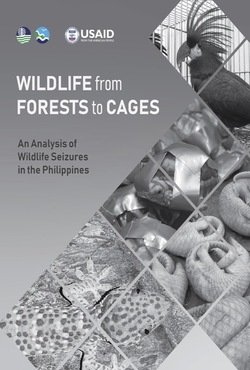
Wildlife from Forests to Cages: An Analysis of Wildlife Seizures in the Philippines

By Emerson Y. Sy

The illegal wildlife trade is one of the most lucrative transnational crimes in the world. Numerous wildlife are threatened with extinction due to overexploitation for food, medicine, and as pets. Although it is difficult to quantify the illegal wildlife trade due to its mostly clandestine nature, analyzing seizure data can indicate its magnitude. Wildlife seizure records from the DENR, PCSDS, and other sources for the period 2010–2019 were collated and analyzed to identify species threatened by the illegal wildlife trade, hotspots, and trafficking routes. The 10-year seizure dataset involved 511 incidents, 283 taxa, and 44,647 wildlife individuals. Reptiles (n = 16,237 individuals) and birds (n = 6,042) were the top seized live wildlife, while pangolin scales (>2,100 kg) had the most quantity and seizure frequency among derivatives. Intervention policies on the key source, transit, and destination locations were proposed to address illegal wildlife trade in the country.

Manila: USAID Philippines, 2021. 56p.

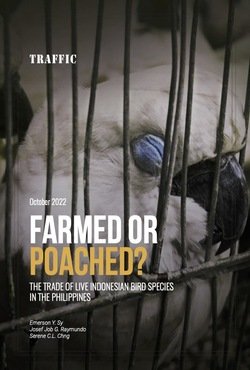
Farmed or Poached? The trade of live Indonesian bird species in the Philippines

By Emerson Y. Sy, Josef Job G. Raymundo, Serene C.L. Chng

A new TRAFFIC study recorded more than 800 Indonesian birds¹ for sale online in the Philippines between January 2018 and December 2019. Since the survey, all 20 of the original groups have been deactivated by Facebook, but surveillance by the authors in January 2022 found 144 new active groups offering various Indonesian species for sale, which continues to date. Almost 1,300 Indonesian birds of at least 28 species were also confiscated from illegal trade in the Philippines between 2010 and 2020, according to the report Farmed or Poached? The trade of live Indonesian Bird Species in the Philippines. Scrutiny of international trade records uncovered discrepancies: a majority of the Indonesian bird species listed on CITES² exported from the Philippines had questionable or no records of legal import into the Philippines. The records show that the Philippines had severely underreported their imports of Indonesian bird species compared to the numbers reported by exporters. In some cases, the export of Indonesian birds from the Philippines took place before the first reported legal importation.

Selangor, Malaysia , TRAFFIC Southeast Asia Regional Office, 2022. 55p.