
Open Access Publisher and Free Library
CRIMINAL JUSTICE.jpeg

CRIMINAL JUSTICE

CRIMINAL JUSTICE-CRIMINAL LAW-PROCDEDURE-SENTENCING-COURTS

Posts in England
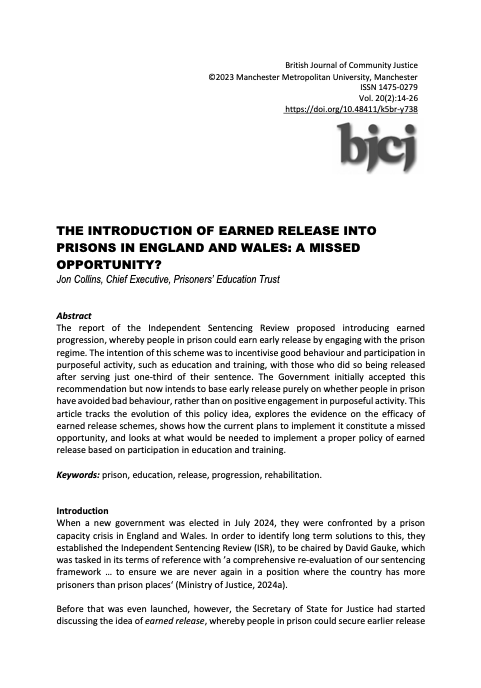
THE INTRODUCTION OF EARNED RELEASE INTO PRISONS IN ENGLAND AND WALES: A MISSED OPPORTUNITY?

When a new government was elected in July 2024, they were confronted by a prison capacity crisis in England and Wales. In order to identify long term solutions to this, they established the Independent Sentencing Review (ISR), to be chaired by David Gauke, which was tasked in its terms of reference with ’a comprehensive re-evaluation of our sentencing framework ... to ensure we are never again in a position where the country has more prisoners than prison places‘ (Ministry of Justice, 2024a).

Before that was even launched, however, the Secretary of State for Justice had started discussing the idea of earned release, whereby people in prison could secure earlier release

by participating in education, training or other positive activity. This idea quickly became arguably the most prominent element of the government’s plans for prison reform and central to the ISR.

This article will track the evolution of this policy idea, show how the current plans to implement it constitute a missed opportunity, and look at what would be needed to implement a proper policy of earned release based on participation in education and training.
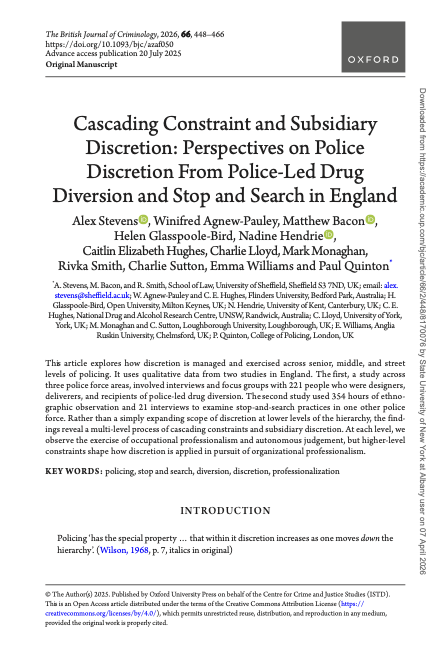
Cascading Constraint and Subsidiary Discretion: Perspectives on Police Discretion From Police-Led Drug Diversion and Stop and Search in England

By : Lex Stevens, Winifred Agnew-Pauley, Matthew Bacon, Helen Glasspoole-Bird, Nadine Hendrie, Caitlin Elizabeth Hughes, Charlie Lloyd, Mark Monaghan, Rivka Smith, Charlie Sutton 

This article explores how discretion is managed and exercised across senior, middle, and street levels of policing. It uses qualitative data from two studies in England. The first, a study across three police force areas, involved interviews and focus groups with 221 people who were designers, deliverers, and recipients of police-led drug diversion. The second study used 354 hours of ethnographic observation and 21 interviews to examine stop-and-search practices in one other police force. Rather than a simply expanding scope of discretion at lower levels of the hierarchy, the findings reveal a multi-level process of cascading constraints and subsidiary discretion. At each level, we observe the exercise of occupational professionalism and autonomous judgement, but higher-level constraints shape how discretion is applied in pursuit of organizational professionalism.