Open Access Free Library
CRIMINAL JUSTICE.jpeg

CRIMINAL JUSTICE

CRIMINAL JUSTICE-CRIMINAL LAW-PROCDEDURE-SENTENCING-COURTS

Posts in Release
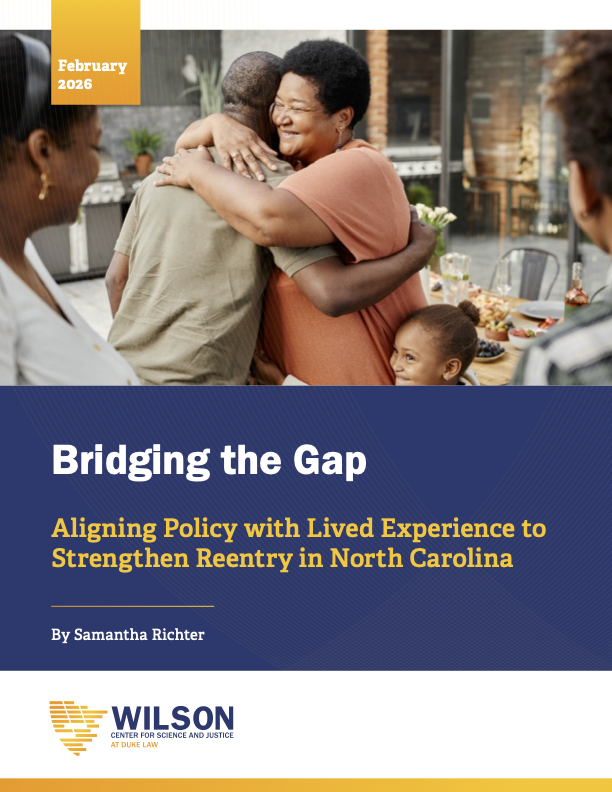
Bridging the Gap: Aligning Policy with Lived Experience to Strengthen Reentry in North Carolina

By Samantha Richter

A new report from the Wilson Center for Science and Justice at Duke Law draws on more than a dozen in-depth interviews with formerly incarcerated individuals across North Carolina to uncover the real experiences of people returning from prison and where the system falls short.

Based on interviews conducted across urban and rural counties, this report, Bridging the Gap: Aligning Policy with Lived Experience to Strengthen Reentry in North Carolina examines the experience of people navigating the transition from incarceration to community life and makes recommendations to strengthen the process. Each year, approximately 18,000 people return to North Carolina communities from state prisons. While the state has joined the national initiative to improve reentry success through Reentry 2030, participants in this report described reentry as a critical and vulnerable period, where fragmented services and limited planning times can undermine support, creating a gap between available services and what people need to successfully rebuild their lives.

“What we heard consistently is that reentry isn’t a short-term process,” said report author Samantha Richter (A.B. ‘25). “People need support that is personalized, coordinated, and sustained—and they need systems that listen to their experiences and respond to what helps them succeed.”

Key Findings

Five major themes emerged from participant interviews:

  1. Reentering community members need personalized, ongoing support: One-size-fits-all services often left participants feeling unsupported, while peer mentors with lived experience were described as especially effective.

  2. Location shapes access and opportunity: Urban areas offered more resources, while limited flexibility around release locations sometimes forced individuals back into environments that undermined their stability.

  3. System disconnects create difficulty in navigating resources: Even when resources existed, participants often struggled to access them due to confusion, poor communication, or lack of coordination between agencies

  4. Timely, attentive, and thorough pre-release planning is critical for success: Participants consistently emphasized that meaningful preparation requires more than the standard 30-day planning window

  5. Reentry services must support long-term stability: Participants repeatedly stressed that reentry challenges did not end in the first few weeks, and sustained support was necessary to build long-term stability.

Policy Recommendations

Grounded in participant experiences, the report outlines six priorities for policymakers and practitioners:

  1. Increase flexibility in release location

  2. Begin pre-release planning earlier and expand its scope

  3. Strengthen employment readiness and employer connections

  4. Expand targeted housing supports

  5. Improve continuity between prison and community-based services

  6. Invest in peer support programs led by people with lived experience

A tale of “second chances”: an experimental examination of popular support for early release mechanisms that reconsider long-term prison sentences

By Colleen M. Berryessa

Objectives This study examines US popular support for mechanisms that provide early release and “second chances” for individuals serving long-term prison sentences. Methods An experiment using a national sample of US adults (N=836). Results Data showed moderate, consistent levels of general support for using a range of commonly available “second chance” mechanisms that also extended to offenders convicted of both violent and non-violent offenses. Levels of support significantly varied by race, gender, and age. There was significantly more support for using certain mechanisms in response to the trafficking of serious drugs, which was fully mediated by participants’ views on the importance of the cost of incarceration. Conclusions Members of the public appear open and supportive to utilizing “second chance” mechanisms in a variety of contexts. Yet the cost of incarceration to taxpayers appears to particularly motivate increased public interest in using such mechanisms for offenders convicted of the trafficking of serious drugs.

Beyond Reasonable Doubt: Confronting the Wrongful Conviction Crisis in the State of Ohio

By Ohioans To Stop Executions

Ohio’s cap­i­tal pun­ish­ment sys­tem has come into sharp focus with the release of two reports that exam­ine four decades of the state’s death penal­ty record and draw stark­ly dif­fer­ent con­clu­sions about the future of Ohio’s death penal­ty. On March 30, Ohioans to Stop Executions (OTSE) pub­lished Beyond Reasonable Doubt: Confronting the Wrongful Conviction Crisis in the State of Ohio, doc­u­ment­ing the record of mis­takes and errors that result­ed in 12 exon­er­a­tions. “The death penal­ty in Ohio is a sys­tem defined more by its capac­i­ty for error than its pur­suit of jus­tice,” the report states, con­clud­ing, “It’s time for Ohio to end its death penal­ty.” Two days lat­er, out­go­ing Attorney General Dave Yost released his eighth and final Capital Crimes Report, call­ing the state’s years-long pause on exe­cu­tions “a mock­ery of the jus­tice sys­tem” and com­plain­ing that Ohio has pro­vid­ed death-sen­tenced pris­on­ers with “more than their fair share of due process.” AG Yost urges law­mak­ers to pass leg­is­la­tion that would allow exe­cu­tions to resume.

Beyond Reasonable Doubt cen­ters on data OTSE argues Ohioans can no longer ignore: since the state rein­stat­ed cap­i­tal pun­ish­ment in 1981, it has exe­cut­ed 56 peo­ple and exon­er­at­ed 12 oth­ers from death row — mark­ing one exon­er­a­tion for every five exe­cu­tions car­ried out. Collectively, OTSE notes that these 12 men lost 245 years of their lives to wrong­ful impris­on­ment. “It turns out that Ohio has a mas­sive wrong­ful con­vic­tion prob­lem, far worse than any­one imag­ined,” said Kevin Werner, Executive Director of OTSE. Mr. Werner added that “[a]ttempts to restart exe­cu­tions will result in the exe­cu­tions of inno­cent peo­ple, and no one wants that.”

In addi­tion to the 12 indi­vid­u­als who have been wrong­ful­ly sen­tenced to death, Beyond Reasonable Doubt iden­ti­fies an addi­tion­al 12 “shad­ow exon­er­a­tions,” or cas­es in which indi­vid­u­als faced cap­i­tal indict­ments and were sen­tenced to life in prison rather than death and were lat­er proven inno­cent. The same issues are present in both groups of 12 cas­es: pros­e­cu­to­r­i­al mis­con­duct, coerced tes­ti­mo­ny, false eye­wit­ness iden­ti­fi­ca­tions, and false or mis­lead­ing foren­sic evi­dence. “The records of the 24 men exon­er­at­ed after cap­i­tal indict­ments are no ‘suc­cess sto­ries’ of the legal sys­tem; they are indict­ments of it,” the report states. “They prove that in Ohio, the dif­fer­ence between a free man and a dead man is often noth­ing more than a lucky pub­lic records request or the per­sis­tence of postconviction counsel.”

THE INTRODUCTION OF EARNED RELEASE INTO PRISONS IN ENGLAND AND WALES: A MISSED OPPORTUNITY?

When a new government was elected in July 2024, they were confronted by a prison capacity crisis in England and Wales. In order to identify long term solutions to this, they established the Independent Sentencing Review (ISR), to be chaired by David Gauke, which was tasked in its terms of reference with ’a comprehensive re-evaluation of our sentencing framework ... to ensure we are never again in a position where the country has more prisoners than prison places‘ (Ministry of Justice, 2024a).

Before that was even launched, however, the Secretary of State for Justice had started discussing the idea of earned release, whereby people in prison could secure earlier release

by participating in education, training or other positive activity. This idea quickly became arguably the most prominent element of the government’s plans for prison reform and central to the ISR.

This article will track the evolution of this policy idea, show how the current plans to implement it constitute a missed opportunity, and look at what would be needed to implement a proper policy of earned release based on participation in education and training.