
Open Access Publisher and Free Library
CRIMINAL JUSTICE.jpeg

CRIMINAL JUSTICE

CRIMINAL JUSTICE-CRIMINAL LAW-PROCDEDURE-SENTENCING-COURTS

Posts in Inclusion
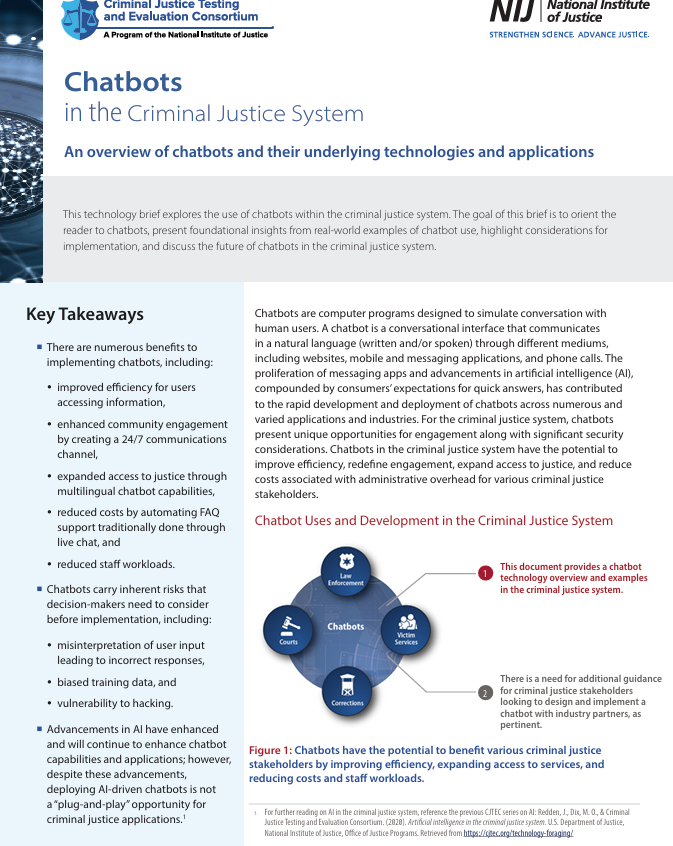
Chatbots in the Criminal Justice System An overview of chatbots and their underlying technologies and applications

By Camello, M. L., Houston-Kolnik, J. D., & Planty, M

This technology brief explores the use of chatbots within the criminal justice system. The goal of this brief is to orient the reader to chatbots, present foundational insights from real-world examples of chatbot use, highlight considerations for implementation, and discuss the future of chatbots in the criminal justice system  

  Key Takeaways ¡ There are numerous benefits to implementing chatbots, including: Ÿ improved efficiency for users accessing information, Ÿ enhanced community engagement by creating a 24/7 communications channel, Ÿ expanded access to justice through multilingual chatbot capabilities, Ÿ reduced costs by automating FAQ support traditionally done through live chat, and Ÿ reduced staff workloads. ¡ Chatbots carry inherent risks that decision-makers need to consider before implementation, including: Ÿ misinterpretation of user input leading to incorrect responses, Ÿ biased training data, and Ÿ vulnerability to hacking. ¡ Advancements in AI have enhanced and will continue to enhance chatbot capabilities and applications; however, despite these advancements, deploying AI-driven chatbots is not a “plug-and-play” opportunity for criminal justice applications

Research Triangle Park, NC:RTI International, 2021. 15p.  

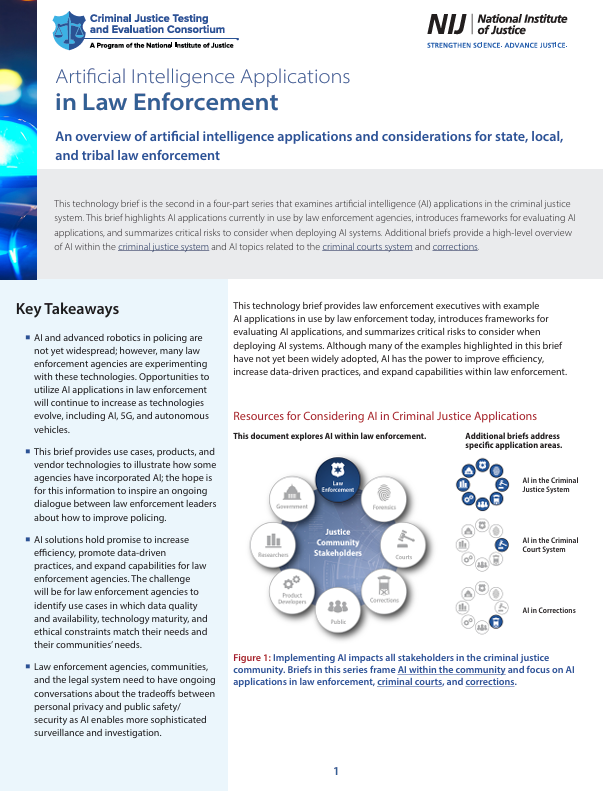
Artificial Intelligence Applications in Law Enforcement. An overview of artificial intelligence applications and considerations for state, local, and tribal law enforcement

By Redden, J., Aagaard,B., Taniguchi, T  

 This technology brief is the second in a four-part series that examines artificial intelligence (AI) applications in the criminal justice system. This brief highlights AI applications currently in use by law enforcement agencies, introduces frameworks for evaluating AI applications, and summarizes critical risks to consider when deploying AI systems. Additional briefs provide a high-level overview of AI within the criminal justice system and AI topics related to the criminal courts system and corrections.   

  Key Takeaways ¡ AI and advanced robotics in policing are not yet widespread; however, many law enforcement agencies are experimenting with these technologies. Opportunities to utilize AI applications in law enforcement will continue to increase as technologies evolve, including AI, 5G, and autonomous vehicles. ¡ This brief provides use cases, products, and vendor technologies to illustrate how some agencies have incorporated AI; the hope is for this information to inspire an ongoing dialogue between law enforcement leaders about how to improve policing. ¡ AI solutions hold promise to increase efficiency, promote data-driven practices, and expand capabilities for law enforcement agencies. The challenge will be for law enforcement agencies to identify use cases in which data quality and availability, technology maturity, and ethical constraints match their needs and their communities’ needs. ¡ Law enforcement agencies, communities, and the legal system need to have ongoing conversations about the tradeoffs between personal privacy and public safety/ security as AI enables more sophisticated surveillance and investigation

Criminal Justice Testing (and Evaluation Consortium, 2020. 10p.

Pretrial Risk Assessments in North Carolina

By The University of North Carolina at Chapel Hill, School of Government, Criminal Justice Innovation Lab

In North Carolina, thirty-seven of the state’s 100 counties offer some kind of pretrial supervision and support services. The National Association of Pretrial Services Agencies identifies two primary roles of pretrial services agencies. First, to assist judicial officers in making informed release decisions that promote court appearance and public safety. And second, to offer supervision and support options for individuals who require oversight while on pretrial release. These options can include services such as court date reminders, check-ins with staff, electronic monitoring, and providing referrals to community service providers. Numerous North Carolina counties use pretrial risk assessments to assist judicial officers in making informed release decisions. As used here, the term pretrial risk assessment refers to tools that are designed to predict the likelihood that someone will appear in court and remain arrest-free while on pretrial release. This briefing paper provides information about the use of pretrial risk assessments in North Carolina, including the types of assessments being used and how they are implemented. We also share lessons learned from stakeholders about implementation. This information was gathered as part of a larger partnership between the UNC School of Government Criminal Justice Innovation Lab (the Lab) and the North Carolina Pretrial Services Association (NCPSA) to assess the feasibility of research on the impact of pretrial services.

Durham, NC: The University of North Carolina at Chapel Hill, School of Government, Criminal Justice Innovation Lab: December 2024, 15p.