Open Access Publisher and Free Library
CRIMINAL JUSTICE.jpeg

CRIMINAL JUSTICE

CRIMINAL JUSTICE-CRIMINAL LAW-PROCDEDURE-SENTENCING-COURTS

Posts tagged law enforcement strategies
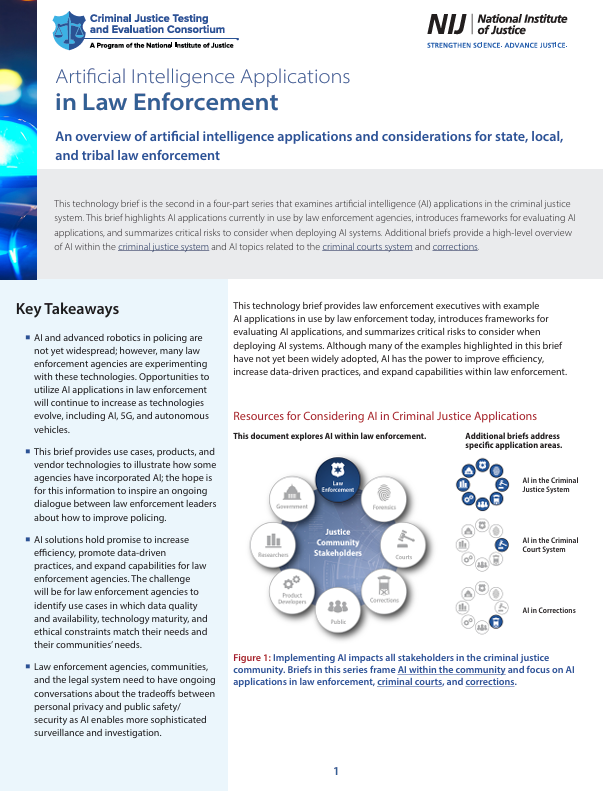
Artificial Intelligence Applications in Law Enforcement. An overview of artificial intelligence applications and considerations for state, local, and tribal law enforcement

By Redden, J., Aagaard,B., Taniguchi, T  

 This technology brief is the second in a four-part series that examines artificial intelligence (AI) applications in the criminal justice system. This brief highlights AI applications currently in use by law enforcement agencies, introduces frameworks for evaluating AI applications, and summarizes critical risks to consider when deploying AI systems. Additional briefs provide a high-level overview of AI within the criminal justice system and AI topics related to the criminal courts system and corrections.   

  Key Takeaways ¡ AI and advanced robotics in policing are not yet widespread; however, many law enforcement agencies are experimenting with these technologies. Opportunities to utilize AI applications in law enforcement will continue to increase as technologies evolve, including AI, 5G, and autonomous vehicles. ¡ This brief provides use cases, products, and vendor technologies to illustrate how some agencies have incorporated AI; the hope is for this information to inspire an ongoing dialogue between law enforcement leaders about how to improve policing. ¡ AI solutions hold promise to increase efficiency, promote data-driven practices, and expand capabilities for law enforcement agencies. The challenge will be for law enforcement agencies to identify use cases in which data quality and availability, technology maturity, and ethical constraints match their needs and their communities’ needs. ¡ Law enforcement agencies, communities, and the legal system need to have ongoing conversations about the tradeoffs between personal privacy and public safety/ security as AI enables more sophisticated surveillance and investigation

Criminal Justice Testing (and Evaluation Consortium, 2020. 10p.
Police Use Of Deadly Force In New York State: A Report To Governor Mario M. Cuomo

Richard J. Condon Commissioner Division Of Criminal Justice Services

Police Use of Deadly Force in New York State: A Report to Governor Mario M. Cuomo (1985) offers one of the earliest systematic examinations of how and why lethal force was deployed by law enforcement across the state during a period of intense public scrutiny. Commissioned at a time when debates over police accountability, training standards, and civil rights were gaining national prominence, the report evaluates legal frameworks, departmental policies, and patterns of police–citizen encounters to assess the necessity and proportionality of deadly force incidents. Drawing on case reviews, agency surveys, and statistical analyses, it seeks to identify structural weaknesses and propose reforms aimed at reducing unnecessary violence and strengthening public trust.

Viewed from today’s perspective, the report stands as an important precursor to contemporary discussions about policing and the appropriate limits of state power. In the decades since its publication, nationwide movements such as Black Lives Matter, advances in data transparency, increased availability of video evidence, and evolving constitutional standards have intensified scrutiny of deadly force practices. Modern debates continue to revolve around issues the 1985 report identified early on: the need for clear and consistent use‑of‑force policies, robust training in de‑escalation, improved data collection, and stronger mechanisms of accountability. As current policymakers and communities grapple with how to balance public safety, civil liberties, and equitable treatment, this historical report offers valuable insight into the longstanding nature of these challenges and the enduring need for thoughtful, evidence‑based reform.

If you'd like, I can also turn this into a full foreword, integrate it into a larger document, or tailor the tone for academic, policy, or public audiences.

NY. Division Of Criminal Justice Services. 1985. p.273.

Planning, Implementing, and Assessing Law Enforcement Responses to Homelessness  

By Emily Rogers.  Katie Holihen, et al.

Homelessness is a growing crisis in America, increasing by 12% between 2022 and 2023 alone. While there are a range of ideas about how to address this issue, in many places across the country, law enforcement officers are still typically the default first responders to these kinds of community concerns. This publication details how communities can strategically plan for and assess their law enforcement homelessness response efforts, using a shared vision, a logic model, and regular assessments to determine if the response is achieving its intended goals. It also discusses the importance of expanding the knowledge base of law enforcement practices and strategies to establish a set of national standards for effective and successful homelessness responses.

New York: The Council of State Governments Justice Center, 2025. 29p.