Open Access Publisher and Free Library
CRIMINAL JUSTICE.jpeg

CRIMINAL JUSTICE

CRIMINAL JUSTICE-CRIMINAL LAW-PROCDEDURE-SENTENCING-COURTS

Posts in Legal Profession
Trauma in the courtroom: The role of prior trauma exposure and mental health on stress and emotional responses in jurors

By Matthew Brooks, Jessica Glynn, Hannah Fawcett, Aminah Barnes, Rachael Carew, David Errickson, Maria Livanou

Objectives

Prior research indicates that jury duty can be distressing for some jurors. This study examined: (1) the influence of prior trauma characteristics (type, exposure, time since trauma), medical fear and mental health difficulties on stress and emotional responses during a mock trial and 1 week later; and (2) associations between early stress reactions during a trial on subsequent stress and emotional reactivity after exposure to skeletal evidence and 1 week later.

Methods

Mock jurors (n = 180) completed baseline self-report mental health measures, read a summary of a murder case and were then exposed to graphic skeletal evidence. Stress and/or emotional responses were collected at baseline, after reading the case summary, before and after viewing the skeletal evidence and 7 days post-trial.

Results

Participants reported a wide range of prior traumatic experiences, with nearly half reporting pre-existing mental health difficulties. Average traumatic stress symptoms tripled from baseline to follow-up, with 44% of participants meeting PTSD-type criteria 7 days later. Medical fear and mental health difficulties were positively associated with some stress and/or emotional responses throughout the trial, with mixed findings concerning trauma characteristics, stress and emotional reactivity. Initial stress and emotional responses to case evidence were linked to later stress and emotional reactions, after accounting for pre-existing trauma and mental health characteristics.

Conclusions

Past trauma experiences, mental health difficulties and immediate stress responses during a trial can exacerbate emotional and stress reactions. Addressing the psychological impacts of pre-existing trauma symptoms could improve juror well-being during this important civic duty
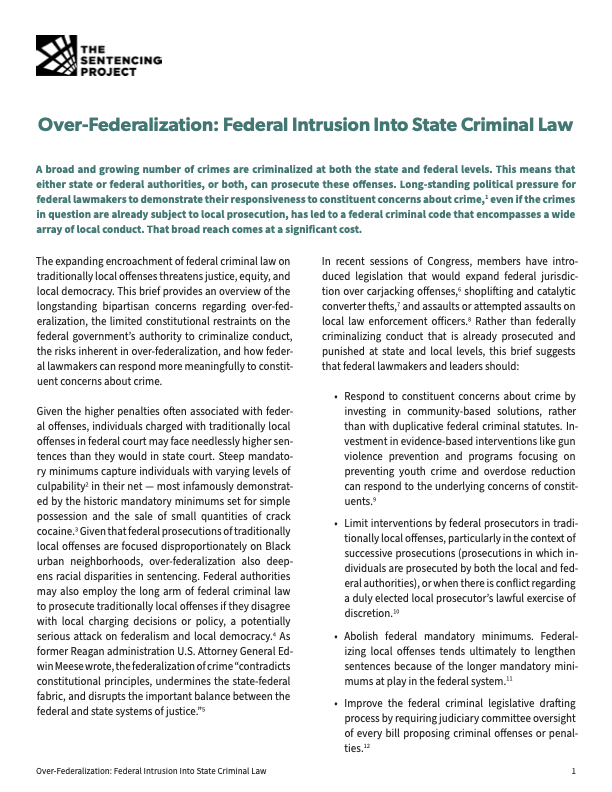
Over-Federalization: Federal Intrusion Into State Criminal Law 

By Liz Komar

A broad and growing number of crimes are criminalized at both the state and federal levels. This means that either state or federal authorities, or both, can prosecute these offenses. Long-standing political pressure for federal lawmakers to demonstrate their responsiveness to constituent concerns about crime,1 even if the crimes in question are already subject to local prosecution, has led to a federeral criminal code that encompasses a wide array of local conduct. That broad reach comes at a significant cost

Trump v. Biden Judges

By Stephen J. Choi, Mitu Gulati

Curious about the merits of judges Donald Trump appointed in his first term as president, we looked in an earlier study at the performance during 2020 to mid-2023 of the judges Trump appointed as compared to those appointed by other presidents. On a set of three measures--productivity, quality and independence--the Trump judges performed as well, if not better, than judges appointed by Presidents Obama and Bush. As for President Biden's appointees, they did systematically worse than the Trump appointees. Biden judicial selections were, at the time we did our prior study, however, new judges. Maybe, we wondered, these judges would do better on our measures a year or two hence? What follows are our preliminary results on that question. Our short answer is that Trump judges continue to dominate the Biden judges. 

Blasé: Deviant Lawyers and the Denial of Discrimination

By Swethaa Ballakrishnen

Using 60 interviews with a range of minority law students and early career legal professionals (primarily differentiated by race, gender identity, religion, and disability), this Article illuminates the cruciality of empirical Critical Race Theory to understand individual deviance within the legal profession and develops a framework – blasé – for considering interactional violence that is not legally or socially cognizable as discrimination but still causes harm. These data reveal that discrimination was minimized and denied to varying degrees for all minority respondents. However, for genderqueer respondents whose identities had not achieved a high degree of sociolegal legibility, these denials had low contestability and were often without contrition. Unlike microaggressions which might have resonance in common cultural parlance as operationalizations of structural violence, what distinguishes blasé discrimination, I argue, is the ordinariness of the act in interactional parlance alongside its relative unlikeliness to be seen as problematic when confronted. It is this possibility of defense and justification in the face of being challenged that makes blasé and its ambiguous parameters worthy of our attention in identity jurisprudence. This exploration of the blasé response to discrimination sheds light on the opportunities available for revealing structural inequalities when analysis begins from the perspectives of peripheral actors.