Open Access Publisher and Free Library
CRIMINAL JUSTICE.jpeg

CRIMINAL JUSTICE

CRIMINAL JUSTICE-CRIMINAL LAW-PROCDEDURE-SENTENCING-COURTS

Posts in UK
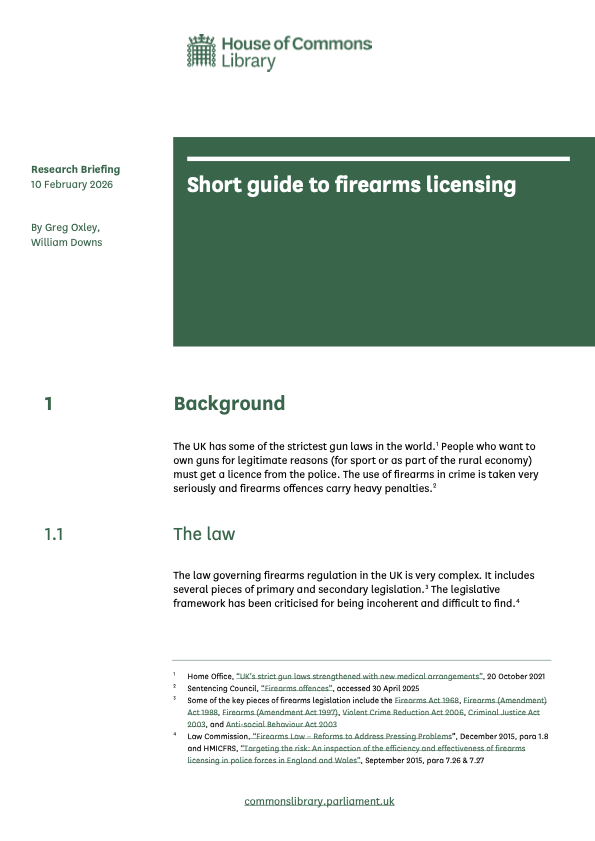
Short guide to firearms licensing

By Greg Oxley and William Downs

The UK has some of the strictest gun laws in the world. People who want to own guns for legitimate reasons (for sport or as part of the rural economy) must get a licence from the police. The use of firearms in crime is taken very seriously and firearms offences carry heavy penalties.The law on firearmsThe law governing firearms regulation in the UK is very complex. It includes several pieces of primary and secondary legislation. The legislative framework has been criticised for being incoherent and difficult to find.The Law Commission (the independent body responsible for reviewing the law) published a review of firearms law in 2015 and recommended it be codified so that the legislation is clear, consistent and can be understood by ordinary people. It also recommended several key terms be defined by new legislation. Part 6 of the Policing and Crime Act 2017 went some way to implementing the Law Commission’s recommendations to define key terms but stopped short of codifying the law.The Home Office maintains a collection of resources relating to firearms licensing, including the Statutory guidance for police on firearms licensing which helps police chiefs carry out checks when assessing someone’s suitability to own firearms or become a registered firearms dealer and the Home Office guide to firearms licensing law which is designed to educate the police, gun owners and the public about firearms law.

Trauma in the courtroom: The role of prior trauma exposure and mental health on stress and emotional responses in jurors

By Matthew Brooks, Jessica Glynn, Hannah Fawcett, Aminah Barnes, Rachael Carew, David Errickson, Maria Livanou

Objectives

Prior research indicates that jury duty can be distressing for some jurors. This study examined: (1) the influence of prior trauma characteristics (type, exposure, time since trauma), medical fear and mental health difficulties on stress and emotional responses during a mock trial and 1 week later; and (2) associations between early stress reactions during a trial on subsequent stress and emotional reactivity after exposure to skeletal evidence and 1 week later.

Methods

Mock jurors (n = 180) completed baseline self-report mental health measures, read a summary of a murder case and were then exposed to graphic skeletal evidence. Stress and/or emotional responses were collected at baseline, after reading the case summary, before and after viewing the skeletal evidence and 7 days post-trial.

Results

Participants reported a wide range of prior traumatic experiences, with nearly half reporting pre-existing mental health difficulties. Average traumatic stress symptoms tripled from baseline to follow-up, with 44% of participants meeting PTSD-type criteria 7 days later. Medical fear and mental health difficulties were positively associated with some stress and/or emotional responses throughout the trial, with mixed findings concerning trauma characteristics, stress and emotional reactivity. Initial stress and emotional responses to case evidence were linked to later stress and emotional reactions, after accounting for pre-existing trauma and mental health characteristics.

Conclusions

Past trauma experiences, mental health difficulties and immediate stress responses during a trial can exacerbate emotional and stress reactions. Addressing the psychological impacts of pre-existing trauma symptoms could improve juror well-being during this important civic duty

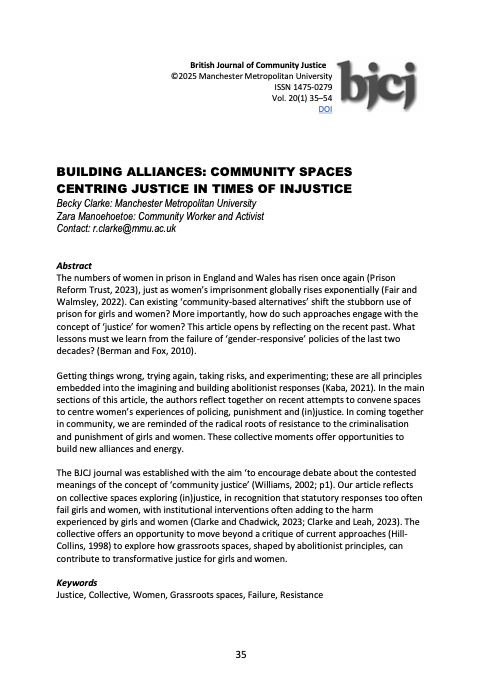
Building Alliances: Community spaces centring justice in times of injustice 

By  Becky Clarke and Zara Manoehoetoe

The numbers of women in prison in England and Wales has risen once again (Prison Reform Trust, 2023), just as women’s imprisonment globally rises exponentially (Fair and Walmsley, 2022). Can existing ‘community-based alternatives’ shift the stubborn use of prison for girls and women? More importantly, how do such approaches engage with the concept of ‘justice’ for women? This article opens by reflecting on the recent past. What lessons must we learn from the failure of ‘gender-responsive’ policies of the last two decades? (Berman and Fox, 2010). Getting things wrong, trying again, taking risks, and experimenting; these are all principles embedded into the imagining and building abolitionist responses (Kaba, 2021). In the main sections of this article, the authors reflect together on recent attempts to convene spaces to centre women’s experiences of policing, punishment and (in)justice. In coming together in community, we are reminded of the radical roots of resistance to the criminalisation and punishment of girls and women. These collective moments offer opportunities to build new alliances and energy. The BJCJ journal was established with the aim ‘to encourage debate about the contested meanings of the concept of ‘community justice’ (Williams, 2002; p1). Our article reflects on collective spaces exploring (in)justice, in recognition that statutory responses too often fail girls and women, with institutional interventions often adding to the harm experienced by girls and women (Clarke and Chadwick, 2023; Clarke and Leah, 2023). The collective offers an opportunity to move beyond a critique of current approaches (HillCollins, 1998) to explore how grassroots spaces, shaped by abolitionist principles, can contribute to transformative justice for girls and women.

Improving Remand Decisions in the Magistrates’ Courts .Recommendations based on JUSTICE research evidence and stakeholder consultation

By JUSTICE (UK)

Despite the recommendations made in JUSTICE’s 2023 research paper on pre-trial remand decision-making in the Magistrates Court little substantive progress has been made to address the challenges identified. This report presents a targeted set of recommendations to address persistent issues in pre-trial remand decision-making within the Magistrates’ Courts of England and Wales. The proposals are designed to (i) ensure custodial remand is genuinely used as a last resort, (ii) enhance the quality and lawfulness of decisions, (iii) reduce unnecessary pre-trial detention, and (iv) foster a fairer justice system. The recommendations within this latest report are informed by a combination of quantitative data and qualitative evidence gathering, and have been tested through discussions with key individual and organisational stakeholders. Improving Diversity and Accessibility in the Magistracy a. The current lack of diversity in the magistracy undermines the perceived legitimacy and the quality of decision making. b. Structural barriers to joining and remaining in the magistracy should be removed, including simplifying the application process and eliminating the requirement for employer references at the pre-selection stage. c. Enhanced data collection on recruitment and attrition is required to identify obstacles faced by underrepresented groups, with the aim of building a magistracy that better reflects the communities it serves