
By Nikos Passas, Stratos Georgoulas, Christos Kouroutzas, Dimitris Paraskevopoulos
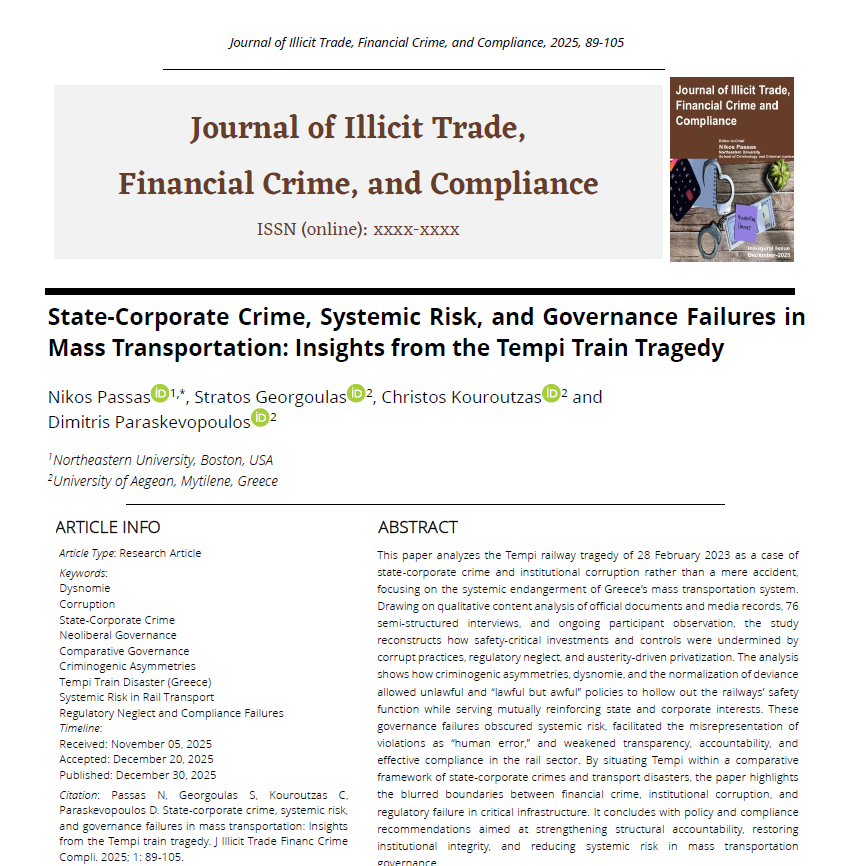
This paper analyzes the Tempi railway tragedy of 28 February 2023 as a case of state-corporate crime and institutional corruption rather than a mere accident, focusing on the systemic endangerment of Greece’s mass transportation system. Drawing on qualitative content analysis of official documents and media records, 76 semi-structured interviews, and ongoing participant observation, the study reconstructs how safety-critical investments and controls were undermined by corrupt practices, regulatory neglect, and austerity-driven privatization. The analysis shows how criminogenic asymmetries, dysnomie, and the normalization of deviance allowed unlawful and “lawful but awful” policies to hollow out the railways’ safety function while serving mutually reinforcing state and corporate interests. These governance failures obscured systemic risk, facilitated the misrepresentation of violations as “human error,” and weakened transparency, accountability, and effective compliance in the rail sector. By situating Tempi within a comparative framework of state-corporate crimes and transport disasters, the paper highlights the blurred boundaries between financial crime, institutional corruption, and regulatory failure in critical infrastructure. It concludes with policy and compliance recommendations aimed at strengthening structural accountability, restoring institutional integrity, and reducing systemic risk in mass transportation governance.
Journal of Illicit Trade, Financial Crime, and Compliance, vol. 1, 205.
