Open Access Publisher and Free Library
CRIMINAL JUSTICE.jpeg

CRIMINAL JUSTICE

CRIMINAL JUSTICE-CRIMINAL LAW-PROCDEDURE-SENTENCING-COURTS

Posts in Criminal Justice
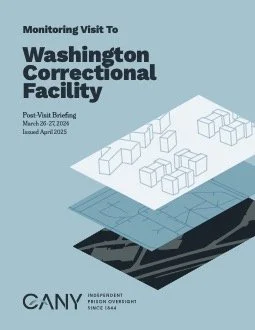
Post-Visit Briefing: Monitoring Visit to Washington Correctional Facility (March 26–27, 2024)

By The Correctional Association of New York (CANY)

The Correctional Association of New York (CANY) has released a report on Washington Correctional Facility, a medium-security prison for men located in Washington County, NY. The report details findings from interviews with incarcerated individuals, analysis of administrative data, meetings with staff, and observations made by CANY during a monitoring visit in March 2024.Key findings include:

73% of incarcerated individuals interviewed reporting witnessing or experiencing verbal, physical, or sexual abuse.

The facility had a 21% vacancy rate in January 2024, which resulted in high rates of mandatory overtime and reduced operations, such as limited access to recreation for incarcerated individuals.

Grievance filing rates were lower than other medium-security prisons. No individuals interviewed reported that they felt the grievance process was fair.

Many incarcerated people reported positive experiences with vocational (e.g., welding, custodial maintenance) and academic programs. The facility administration expressed concern about low rates of attendance.

New York: Correctional Association of New York, 2025. 66p
download
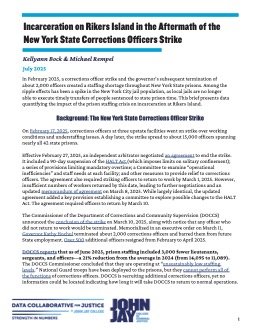
Incarceration on Rikers Island in the Aftermath of the New York State Corrections Officers Strike

By Kellyann Bock & Michael Rempel

Following a statewide corrections officer strike in February 2025 and the termination of over 2,000 officers, New York State prisons have been unable to accept timely transfers of people sentenced to state time. This brief analyzes the resulting surge in the “state-ready” population on Rikers Island—those awaiting transfer to prison—which rose more than eight-fold from 101 to 875 people from February to June 2025. As of the end of June 2025, these individuals accounted for 11% of the total jail population and are responsible for 89% of February-to-June 2025 jail population growth. In short, the jail population would have changed little in the first half of 2025 if not for the ripple effects of the corrections officer strike.

New York : Data Collaborative for Justice, 2025. 7p.

download
Minimal Impact: Analyzing State Sentencing Reforms and Racial Disparities in Selected State Prison Populations

By Georgia State University, the Crime and Justice Institute, and the Council on Criminal Justice

Over the past 20 years, most American states have adopted a wide range of changes to their criminal sentencing statutes. The goals of the reforms varied. Some targeted certain offenses for greater or lesser penalties. Others aimed to cut correctional costs, expand alternatives to incarceration, and reduce recidivism. Few laws were enacted explicitly to reduce racial and ethnic disparities. Still, many policymakers hoped they would do just that, and the starkly disproportionate incarceration of Black people has been a central component of the national conversation about criminal justice reform.

New York: Council on Criminal Justice, 2024.

download
Literature and Epistemic Injustice: Power and Resistance in the Contemporary Novel

By Sarah Colvin

A vital resource for anyone interested in literature and politics, this is the first in-depth study of epistemic injustice as a concept for literary studies. Focusing on contemporary fiction in an age of post-truth, it shows how eight novels set in different global contexts reveal epistemic injustice as an authoritarian practice and offer an aesthetics of resistance. Epistemic injustice valorises the thinking of those in power while suppressing other people’s knowledge; it declares some people omniscient and others targets for violence. This book tracks how the novels make tangible its strategic use and effects while suggesting – in their form as well as their content – that something else is possible. Bridging political philosophy and literary analysis in clear prose, this study offers exciting new stimuli for reading groups and general readers as well as for students of literature.

Oxford: Routledge, 2025. 258p.

download
Global Trends in Law Enforcement - Theory and Practice

By Stamatakis, Nikolaos

Global Trends in Law Enforcement - Theory and Practice is a thought-provoking collection of studies that define contemporary policing on a global scale. As the world becomes increasingly interconnected, law enforcement agencies face unprecedented challenges, from rapidly advancing technology to the complexities of transnational crime. This comprehensive volume brings together diverse perspectives from leading scholars and practitioners, offering a rich tapestry of insights that illuminate the evolving landscape of law enforcement. The present book is an indispensable resource for academics, practitioners, policymakers, and students seeking a deep understanding of the rapidly evolving world of law enforcement. As a definitive guide to global trends, Global Trends in Law Enforcement - Theory and Practice paves the way for a new era of informed and effective policing in an interconnected world.

London: IntechOpen, 2024.

download
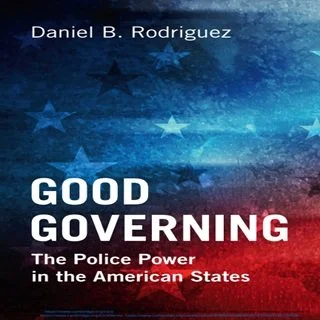
Good Governing 

By Rodriguez, Daniel B. 

Good Governing: The Police Power in the American States is a deep historical and legal analysis of state police power, examining its origins in the founding period of the American public through the 20th century. The book reveals how American police power was intended to be a broad, but not unlimited, charter of regulatory governance, designed to implement key constitutional objectives and advance the general welfare. It explores police power's promise as a mechanism for implementing successful regulatory governance and tackling societal ills, while considering key structural issues like separation of powers and individual rights. This insightful book will shape understanding of the neglected state police power, a key part of constitutional governance in the U.S.

Cambridge, UK: Cambridge University Press, 2024. 

download
Community Vigilantes in Metropolitan Kano 1985-2005 

By Rasheed Olaniyi

Kano is a city where a multi-layered form of community policing was established in the era of the rollback of the state in social provisioning in the midst of ever-increasing armed banditry and crime. Between 1985 and 2005, vigilante groups were established in almost all the neighbourhoods of Kano with the support of the traditional authority and community leaders. However, government interference, political instrumentalisation and inadequate support undermined its critical rote. Part of the rationale for the Police Community Relations Committee (PCRC) in Sabongari lies not in the efficacy of such initiative in reducing the incidence of crime but to confer a sense of identity, control of crime and security. The contradiction in PCRC could be located in the pathological fixation of police on corruption, which alienated and depressed the public from providing valuable information for crime control. The activities of vigilante groups and Hisba have reduced the high rate of juvenile delinquency in metropolitan Kano. The litmus test for Hisba in the implementation of Sharia law would be how it could reconcile the social diversity in a multicultural society such as Kano to ensure security and social harmony. The study concludes that the gap between different forms of vigilante groups, conflicting political motivations and the near discordant relations with the police, produced a dysfunctional mechanism for crime control.

Ibadan: IFRA-Nigeria: 2005

download
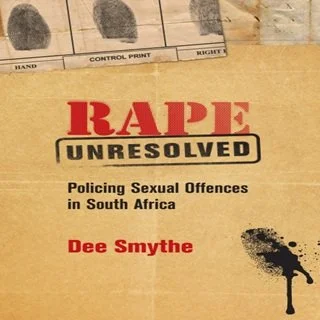
Rape Unresolved: Policing Sexual Offences in South Africa

By Dee Smythe

More than 1 000 women are raped in South Africa every day. Around 150 of those women will report the crime to the police. Fewer than 30 of the cases will be prosecuted and no more than 10 will result in a conviction. This translates into an overall conviction rate of 4–8 per cent of reported cases. What happens to all the other cases?

Rape Unresolved is concerned with the question of police discretion and how its exercise shapes the criminal justice response to rape in South Africa. Through a detailed, qualitative review of rape dockets and victim statements, as well as interviews with detectives, prosecutors, magistrates and rape counsellors, the author provides key insights into police responses to rape.

A complex picture emerges, of myths and stereotypes, of skills deficits, of disengagement by police as well as victims. Responsibility for the investigation of the cases – and their ultimate failure – is shifted onto the complainants, who must constantly prove their commitment to the criminal justice process in order to be taken seriously.

The vast majority of rape victims who approach the criminal justice system in South Africa do not receive justice or protection. This book uncovers the fault line between the state’s rhetorical commitment to addressing sexual violence through legal guarantees and the actual application of these laws.

Cape Town: University of Cape Town, 2022. 

download
Command and Persuade: Crime, Law, and the State across History

By Peter Baldwin

Why, when we have been largely socialized into good behavior, are there more laws that govern our behavior than ever before?

Levels of violent crime have been in a steady decline for centuries—for millennia, even. Over the past five hundred years, homicide rates have decreased a hundred-fold. We live in a time that is more orderly and peaceful than ever before in human history. Why, then, does fear of crime dominate modern politics? Why, when we have been largely socialized into good behavior, are there more laws that govern our behavior than ever before? In Command and Persuade, Peter Baldwin examines the evolution of the state's role in crime and punishment over three thousand years.

Baldwin explains that the involvement of the state in law enforcement and crime prevention is relatively recent. In ancient Greece, those struck by lightning were assumed to have been punished by Zeus. In the Hebrew Bible, God was judge, jury, and prosecutor when Cain killed Abel. As the state's power as lawgiver grew, more laws governed behavior than ever before; the sum total of prohibited behavior has grown continuously. At the same time, as family, community, and church exerted their influences, we have become better behaved and more law-abiding. Even as the state stands as the socializer of last resort, it also defines through law the terrain on which we are schooled into acceptable behavior. 

Cambridge, MA: MIT Press, 2021

download
Getting Away with Murder Obstacles to Police Accountability

Edited by Wornie Reed

Despite the national attention police violence gained and the calls for police reform following the murder of George Floyd in 2020, police officers are killing more people each year.1 Police killed at least 1,173 people in 2024.2 Although half of the people shot and killed by police are white, black Americans are shot at a disproportionate rate. Hispanic people are also killed at a disproportionate rate. One reason this assault on citizens continues is that very few roadblocks have been put in the way of excessive violent policing. While any policing reform is beneficial, many reforms being discussed and enacted are unlikely to significantly reduce police use of excessive force. Many critical issues in policing affect African American people. This book addresses several of them. The Black Lives Matter protests in the United States and around the world were primarily about the excessive use of force by police against African American people. This excessive use of force includes homicides. In the U.S., police kill black people at more than twice the rate they kill white people, and black people are 30 percent more likely than white people to be unarmed when killed.3 Of all the police killings documented between 2013 and 2019, one data source, Mapping Police Violence, found only 1 percent of cases led to a conviction of a police officer.4 Many members of the public andsome elected officials have argued that the excessive use of force by the police could be curtailed if more officers were held accountable for their actions, primarily their actions against innocent citizens. The authors of the papers in this series subscribe to that view and discuss some significant reasons why and how police are not held accountable for their excessive use of force. 

Blacksburg, VA, Virginia Tech Publishing, 2025. 98p.

download
Critical Perspectives on Predictive Policing: Anticipating Proof?

Edited by Vasilis Galis, Helene O.I. Gundhus, and Antonis Vradis

Taking a critical approach, this book advances understanding of the social, legal and ethical aspects of digitalisation in law enforcement and the reliance on data-driven tools to predict and prevent crime. It shows how the proliferation of data analytics challenges citizens’ rights, at a time when what counts as ‘safety’ or ‘policing’ is being fundamentally transformed.

Cheltenham, UK · Northampton, MA; Edward Elgar, 2025.

download
Adapting to Climate Change in Modern Policing: The Rise of the “Eco-Cop”

By Anna Matczak

This open access brief explores the profoundly accelerating impact of climate change on law enforcement globally. Drawing on the concept of climatisation, it examines how, on one hand, rising temperatures, extreme weather events, resource scarcity, and sustainability transitions pose new challenges for the evolving role of law enforcement in a changing climate. On the other, these developments also present opportunities to adapt and transform the ways the police do policing. This book builds on the author’s earlier research into the impact of climate change on police work. It combines interdisciplinary research and 23 expert interviews to systematize current knowledge in the field. The aim is to provide a comprehensive understanding of how climate change intersects with policing at societal, organizational, and individual levels. This volume is ideal for policymakers, practitioners, and researchers working at the intersection of climate change and policing.

Cham: Springer Nature, 2025

download
Evaluation of Video First Response (VFR) to Non-Emergency Domestic Abuse Calls for Service Technical Report September 2025 

By Ella White, Abbie Foulger, Katie Beacham and Sarah Colover. Oli Hutt and Alex Stacey 

Video first response (VFR) is a virtual police response to eligible non-emergency domestic abuse calls for service that uses video conferencing software. The evaluation of VFR aimed to understand the impact of the initial police response to domestic abuse calls being conducted via video. The quality and victim perceptions of the initial police VFR and criminal justice outcomes were compared with an in-person, business as usual response (BAU). The research involved two pilot forces, with a randomised control trial in one force and a quasi-experiment in the other. The research compared data from police systems, case file reviews, a victim survey, and interviews with officers and stakeholders. Meta-analysis The meta-analysis aimed to provide an aggregated assessment of the outcome measures from:  the two pilot forces in this evaluation  the evaluation of rapid video response (RVR) conducted in Kent Police in 2021 The meta-analysis found:  Time taken to both respond to and resolve a call for service was significantly faster for VFR, compared to BAU.  Differences in arrest rates between VFR and BAU cases were not statistically significant. However, the meta-analysis found a statistically significant difference between the pilot studies. This reflects the mixed results between pilot studies. The Kent pilot found a significantly higher arrest rate in VFR cases. The West Yorkshire pilot found a significantly higher arrest rate in BAU cases. The West Midlands pilot found that VFR cases had a similar arrest rate to BAU, with no statistical difference between them.  No statistically significant difference was found in victim satisfaction between the VFR cases and BAU overall.Findings from the VFR evaluation Impact on quality of initial police response  VFR response can speed up response times – response times increased significantly in both forces.  VFR may affect whether or not an incident is ‘crimed’. In one force, more BAU cases were reported as a crime than VFR cases, while the other force showed no difference. High levels of missing data may have affected these findings.  VFR may improve the quality of risk assessment. Appropriately detailed risk assessment forms were significantly more likely in VFR conditions in one of the pilot forces. The other force showed no difference between VFR and BAU.  The findings were mostly in favour of VFR victims having more positive safeguarding outcomes. In both forces, case file review data suggested that more safeguarding referrals were made in VFR cases, compared to BAU cases. In one force, the case file review found that information on support services was more likely to be shared with victims who had a VFR response compared to those who had a BAU response. In the other force, the victim survey found that more BAU victims said they were referred to an independent domestic violence adviser (IDVA) compared to VFR victims. However, the sample size was small for both the case file review and victim survey. Impact on criminal justice outcomes  Arrest rate and time taken to arrest differed in the pilot forces. For one force, VFR had a similar arrest rate to BAU cases, with VFR having a shorter time to arrest compared to BAU. In the other force, the arrest rate was higher for BAU, which also had a shorter time to arrest compared to VFR.  In both forces, VFR cases had a similar charge rate and outcome 16 rate (victim chooses not to support, or withdraws support for, further police action) to BAU.  

College of Policing. college.police.uk. September 2025

download
Community Solutions to Prevent Gun Violence Strengthening Research and Evaluation to Build Safer Neighborhoods

By Ileana Mendoza,and Cierren Edmondson

For far too long, law enforcement has been the primary response to the gun violence epidemic in the United States. However, an institution built and sustained through coercive control and violence cannot be expected to bring healing to communities, nor can it address the social conditions that lead people to choose gun violence as a means to an end. Addressing community-level gun violence requires a public health-based approach that centers the community and addresses the root causes of gun violence. Through evidence-based, public health strategies, Community Violence Intervention and Prevention Initiatives (CVIPI) provide a comprehensive and compassionate alternative for addressing and preventing gun violence. This issue brief highlights the need for community-driven strategies, examines the current challenges in evaluating CVIPI e orts and argues that e ective evaluation must involve community partnerships and focus on the experiences of program participants and violence intervention and prevention specialists (VIPs).This focus on CVIPI comes at a critical moment. Communities are still experiencing gun violence while simultaneously facing shrinking budgets for prevention and public health initiatives. Staggering cuts to Department of Justice (DOJ) funding, the looming expiration of American Rescue Plan Act (ARPA) funds in 2026 and the dismantling of the White House O ce of Gun Violence Prevention threaten the future of CVIPI. Without federal funding and a dedicated o ce to coordinate and champion CVIPI, these programs may be faced with the decision to scale-back operations or shut down. These converging realities make it clear that the time to rigorously evaluate, strengthen, and sustain CVIPI is now. Doing so can ensure these strategies not only survive current funding gaps, but also become a permanent fixture in the nation’s approach to prevent and intervene in gun violence.

West Hollywood, CA,: Center for Policing Equity, 2025. 17p.

download
Carceral Citizenship in Post-Protest Nicaragua: Political Imprisonment and Civil Death

By Julienne Weegels University of Amsterdam

This paper demonstrates how the extension and intensification of penal power across Nicaragua following the 2018 protests has produced particular experiences of carceral citizenship. In order to fully understand these experiences, it is necessary to take into account that states can enforce carceral citizenship (and its restrictions, benefits, and duties) not only legally, but also extralegally. As such, I examine the tenets of carceral citizenship in relation to the country’s hybrid carceral system, conceptualizing how such citizenship may be produced and policed. Following from this, I elicit how political prisoners are acted upon by (para)state actors and excluded from prison’s co-governance arrangements, which pushes some of them to engage in (dis)organizing practices of their own. Following them into their post-release lives, I examine the tight ‘transcarceral grip’ they are subjected to. This produces a state of de facto civil disenfranchisement, understood by ex-carcelados as “civil death.” In spite of their predicament, however, released political prisoners continue to organize in the face of the Sistema and the violations it has committed (and continues to commit). 

EUROPEAN REVIEW OF LATIN AMERICAN AND CARIBBEAN STUDIES, No. 116 (2023): July-December, pp. 163-183

download
Taxation and Incarceration in Guatemala: Prisons, Protection Rackets, and Citizenship

By Anhony Wayne Fontes

This article explores the making of carceral citizenship in Guatemala through an ethnographic analysis of la talacha – informal prison taxation schemes. Taxation is a key technology of citizenship. Tax enforcement mechanisms, the distribution of tax burdens, citizens’ willingness to pay, and their expectations of what they should get in return all make taxation an essential lens through which to understand state formation and citizens’ perceptions of and relations with one another. In Guatemala, where organized crime competes with and subsumes state institutions in ways that profoundly impact everyone, the state is only one of many entities claiming the right to tax, at turns competing and colluding with its underworld. These blurred dynamics are hyper-distilled in the country’s prison system, where state-prisoner networks tax the imprisoned population in the name of collective survival and elite profits. Based on extended ethnographic fieldwork behind bars, I show how la talacha sets the terms of carceral citizenship by organizing prisoner-state co-governance, reifying the prison’s socioeconomic hierarchies, and shaping inmates' relationships with the world beyond the prison. 

EUROPEAN REVIEW OF LATIN AMERICAN AND CARIBBEAN STUDIES No. 116 (2023): July-December, pp. 105-123

download
The Transition from Prison to Community

By Alia Nahra, David Knight and Bruce Western

High US incarceration rates in the 1990s and early 2000s produced large cohorts of men and women who left prison and returned, disproportionately, to low-income communities of color. Called reentry, the transition from prison to community is a process of social integration where formerly incarcerated people establish, with variable success, a foundation of material security, and connections to major social institutions such as the family and the labor market. This literature review summarizes research on reentry, examining its demographic dimensions, the legal and policy environment, and research on families, housing, health, incomes, and criminal desistance. The review indicates that criminalization and punishment in the reentry process stymie social integration, while support from family and social policy is socially integrative. Research also indicates large racial inequalities where, besides the racial disparity in incarceration, the severity of incarceration and the obstacles to social integration are greater for Black men and women leaving prison

RSF: The Russell Sage Foundation Journal of the Social Sciences 11(3): 174–229.

download
The Fallout from Criminal Justice System Contact

By Hedwig Lee, Alexandra Gibbons, Garrett Baker and Christopher Wildeman

Twenty-five years ago, Bruce Western and Katherine Beckett (1999) provided the seed of what would come to be a novel area of inquiry: the consequences of the carceral state for inequality. In this article, we review in four stages the last twenty-five years of research on the fallout from criminal justice system contact. In the first stage, we describe the contours of the carceral state to highlight how prevalent each level of criminal justice contact is today relative to earlier historical eras and to each other and how unequally distributed these levels of criminal justice contact are by race, ethnicity, and class. In the second stage, we consider the questions often left unaddressed in prior work, including our own prior work: why might we expect racial differences in the effects of criminal justice contact, and are there racial differences in the effects of criminal justice contact? In the third stage, we provide a discussion of the datasets and methods used to consider these relationships. In the fourth stage, we consider the direct and vicarious effects of contact with the police, experiencing prison or jail incarceration, and being placed on community supervision using evidence spanning several disciplines. By providing a review that is exhaustive in terms of levels of criminal justice contact, limitations of data and methods, and the existence of race-specific effects, we offer a comprehensive description of the state of scientific research on the scope and scale of criminal justice contact and its collateral consequences for inequality in the United States. 

” RSF: The Russell Sage Foundation Journal of the Social Sciences 11(3): 174–229.

download
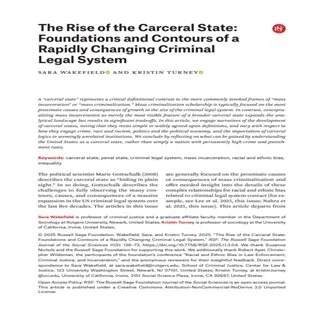
The Rise of the Carceral State: Foundations and Contours of a Rapidly Changing Criminal Legal System

By Sara Wakefield and Kristin Turney

A “carceral state” represents a critical definitional contrast to the more commonly invoked frames of “mass incarceration” or “mass criminalization.” Mass criminalization scholarship is typically focused on the most proximate causes and consequences of growth in the size of the criminal legal system. In contrast, conceptualizing mass incarceration as merely the most visible feature of a broader carceral state expands the analytical landscape but results in significant tradeoffs. In this article, we engage narratives of the development of carceral states, noting that they resist simple or widely agreed-upon definitions, and vary with respect to how they engage crime, race and racism, politics and the political economy, and the importation of carceral logics to seemingly unrelated institutions. We conclude by reflecting on what can be gained by understanding the United States as a carceral state, rather than simply a nation with persistently high crime and punishment rates. 

RSF: The Russell Sage Foundation Journal of the Social Sciences 11(3): 136–73.

download
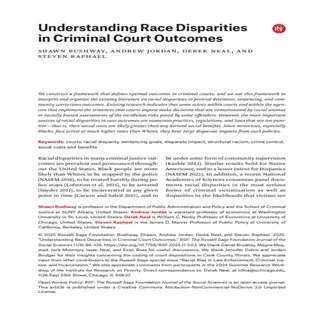
Understanding Race Disparities in Criminal Court Outcomes

By Shawn Bushway, Andrew Jordan, Derek Neal and Steven Raphael

We construct a framework that defines optimal outcomes in criminal courts, and we use this framework to interpret and organize the existing literature on racial disparities in pretrial detention, sentencing, and community corrections outcomes. Existing research indicates that some actors within courts and within the agencies that implement the sentences that courts impose make decisions that are contaminated by racial animus or racially biased assessments of the recidivism risks posed by some offenders. However, the most important sources of racial disparities in case outcomes are numerous practices, regulations, and laws that are too punitive—that is, their social costs are likely greater than any derived social benefits. Since minorities, especially Blacks, face arrest at much higher rates than Whites, they bear large disparate impacts from such policies.

RSF: The Russell Sage Foundation Journal of the Social Sciences 11(3): 86–135.2025. 

download