Open Access Publisher and Free Library
HUMAN RIGHTS.jpeg

HUMAN RIGHTS

Human Rights-Migration-Trafficking-Slavery-History-Memoirs-Philosophy

Posts in Human Rights Violation
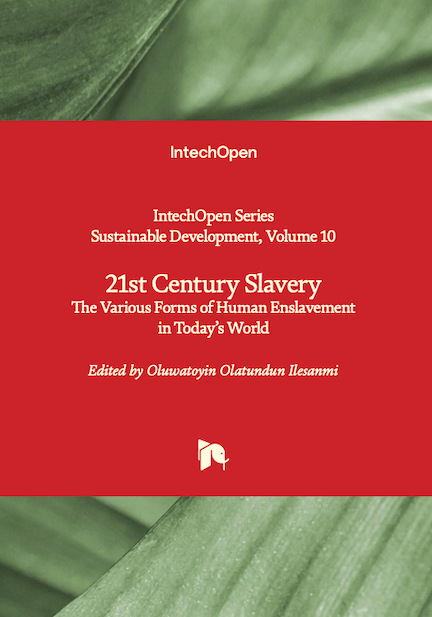
21st Century Slavery:  

The Various Forms of Human Enslavement in Today's World

By Usha Iyer-Raniga (Editor), Oluwatoyin Olatundun Ilesanmi (Editor)

More than 46 million people are currently victims of 21st-century slavery globally, most of whom are women and children. This book, 21st Century Slavery - The Various Forms of Human Enslavement in Today’s World provides a comprehensive overview of modern-day slavery, also known as contemporary slavery, neo-slavery, institutional slavery, and numerous other terms. It includes eight chapters that highlight human trafficking and explain and explore the act of recruiting, harbouring, transporting, providing, or obtaining a person for compelled labour or commercial sex acts using force, fraud, or coercion. The book discusses the recruitment, transportation, transfer, harbouring, and receipt of persons by improper means (such as force, abduction, fraud, or coercion) for an improper purpose including forced labour or sexual exploitation. It concludes that the world must not accept slavery in the 21st century. This volume is a useful resource on modern slavery for all academics interested in humanitarian and development studies across the globe and to all policymakers and governments of nations who are pushing for the elimination of all forms of slavery in their nationhood.

Strategies Against Human Trafficking: The Role of the Security Sector

By Cornelius Friesendorf (Ed.)

In 2000, the international community adopted the United Nations Convention against Transnational Organized Crime and the Protocol to Prevent, Suppress and Punish Trafficking in Persons, especially Women and Children. Since then, 124 countries have ratified the Protocol, and many of these have adopted legal instruments to help them in the fight against trafficking. Yet the scourge persists. Millions of people worldwide—men, women and children—continue to be exploited for their labour, for sexual purposes, for their organs. Security sector personnel are well-placed to assist in the fight against human trafficking: by identifying victims; investigating networks; disrupting operations; and prosecuting traffickers. Moreover, trafficking, like many crimes, flourishes where the rule of law is weak, such as in post-conflict situations. Restoring security based on the rule of law can reduce vulnerability to human trafficking and other types of organised crime. Strategies Against Human Trafficking: The Role of the Security Sector provides practical guidance on how practitioners in the security sector can take measures against modern-day slavery. Two points stand out. First, policy and intervention depend on evidence. Thus far, the fight against human trafficking has been handicapped by a lack of data. UNODC is working with governments and social scientists to fill this void. In 2009 we published the first Global Report on Trafficking in Persons. But the picture remains impressionistic. Security sector professionals can provide the information needed to profile victims and identify traffickers. The second major point highlighted in this study is the need for cooperation. This fight is a shared responsibility. It requires inter-agency cooperation among law enforcement personnel as well as trans-national cooperation. It also depends on effective joint work among a wide range of stakeholders, including criminal justice experts, the private sector, civil society, and concerned citizens. Disjointed efforts—however well-meaning—will have little impact on sophisticated criminal networks. This publication offers strong recommendations on how to make cooperation work. 

Vienna and Geneva, National Defence Academy and Austrian Ministry of Defence and Sports Rossauer Lände 1, 1090 Wien in co-operation with Geneva Centre for the Democratic Control of Armed Forces September 2009. 514p.   

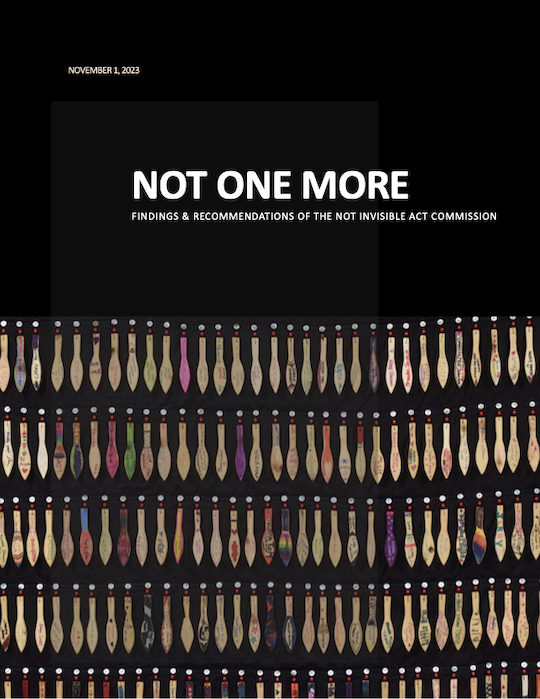
Not One More: Findings and Recommendations of the Not Invisible Act Commission

By The Not Invisible Act Commission

There is a crisis in Tribal communities. A crisis of violence, a crisis of abuse, and a crisis of abject neglect affecting Indian Women & Men, Indian Children, and Indian Elders. The federal government must act now; not tomorrow; not next week; not next month; and not next year. Once and for all, the federal government must end its systematic failure to address this crisis and react, redress, and resolve this. We call on the federal government to declare a Decade of Action & Healing to address the crisis of missing, murdered, and trafficked Indian people. -- The Not Invisible Act Commissioners _____________________________________________________________________________ With each passing day, more and more American Indian and Alaska Native (AI/AN) persons are victimized due to inadequate prevention and response to the MMIP and HT crisis. Our recommendations encompass actions that must be undertaken without delay to provide AI/AN people and communities with the same sense of safety and security that other communities in the United States take for granted. The United States government’s failure to fulfill its trust responsibilities to Tribal nations, coupled with historic policies that sought to disconnect AI/AN people from their land, language, and culture, have given rise to a public health, public safety, and justice crisis in Tribal communities. The crisis is most notably reflected in the federal government’s failure to effectively prevent and respond to the violence against AI/AN people, particularly in the context of missing, murdered, and trafficked AI/AN people. Despite the best efforts of many individuals across law enforcement (LE), the judiciary, and social services, long-standing institutional failures must be acknowledged and addressed. Calls for action and funding to address these issues have been made repeatedly.1 Although there has been a growing awareness of the high rates of missing, murdered, and trafficked AI/AN people in recent years, and several federal initiatives have been launched,2 addressing the needs in Tribal communities continues to generally be underprioritized by the federal government. Until this changes, violence against AI/AN individuals and on Indian and Alaska Village lands will persist. The Commission believes that the circumstances that have created the crisis of MMIP and HT are not intractable. In fact, to see them so is to continue the unjust past. With resolve and an appropriate investment of resources, these issues can, and must, be effectively addressed. While it is imperative that the federal government take immediate and concerted action, thescale and severity of this issue, and the need for long-term healing and justice, also demand a comprehensive and sustained response. Therefore, we call upon the federal government to declare a Decade of Action and Healing dedicated to addressing this crisis effectively for future generations. Such a declaration would underscore the urgency of the matter and signify a long-term commitment to combatting the deeply rooted issues that perpetuate continued violence against AI/AN individuals and supporting individuals and communities in their healing as they seek justice. This Decade of Action and Healing must involve partnership with Tribal communities, Tribal governments, and relevant organizations, focusing on improving safety, prevention, justice, support services, and healing for AI/AN communities through increased funding, policy reform, action-oriented programs, and training and technical assistance.

Washington, DC: U.S. Department of the Interior and the Department of Justice, 2025. 212p.

Gross Human Rights Violations in Washington State: Enforced Disappearance and Refoulement

By The Center for Human Rights, The Henry M. Jackson School of International Studies, University of Washington,

This report reviews local involvement in gross human rights abuses against immigrants, focusing on forced disappearance and refoulement. Its findings reveal that the connections between Washington state and these crimes are broader and deeper than has been previously known.

They are broader because there are many more cases of Washingtonians being subjected to forced disappearance at the hands of the U.S. federal government than was previously known. Thus far we have documented:[1]

  • seven migrant Washingtonians who were expelled by U.S. Immigration and Customs Enforcement (ICE) to El Salvador’s notorious megaprison CECOT, in violation of a federal court order;[2]

  • six Washingtonians who were sent by ICE to Guantánamo Bay without access to counsel or information to their families;[3]

  • one Washingtonian who was expelled by ICE to South Sudan, where he had no personal ties, following attempts to remove him in violation of a federal court order;[4]

  • two families who were held incommunicado in Customs and Border Protection (CBP) facilities for weeks within our own state;

  • and a very broad—so broad as to be unmeasurable under current conditions—universe of migrants who are being deported daily without access to any real form of due process, under conditions which may constitute refoulement.

And they are deeper because many more of our institutions, public and private, are involved in facilitating the forced disappearances of our neighbors than was previously known. These include:

  • Seattle-Tacoma International Airport and King County International Airport (Boeing Field), both of which provide the infrastructure through which deportations happen daily;

  • Washington State’s Department of Corrections, which collaborates with ICE in the detention of migrants completing a prison sentence;

  • Signature Aviation, a private company providing fuel and support to private charter flights operating for ICE at King County International Airport;

  • and the Washington State Investment Board (WSIB), which invests the retirement funds of our public employees in the very businesses that brutalize our neighbors.

Complicity in forced disappearance is not a minor matter. When committed systematically against a civilian population, forced disappearance is considered a crime against humanity under international law. All institutions—federal, state and local; public and private—and all individuals are called to take active measures to avoid complicity in the networks that produce such violations. Our central purpose in publishing this report is to make all Washingtonians witness to what is happening on our watch, in the hopes that we might come together in new ways to stop these abuses.

Seattle:  Center for Human Rights, The Henry M. Jackson School of International Studies, University of Washington,, 2025. 

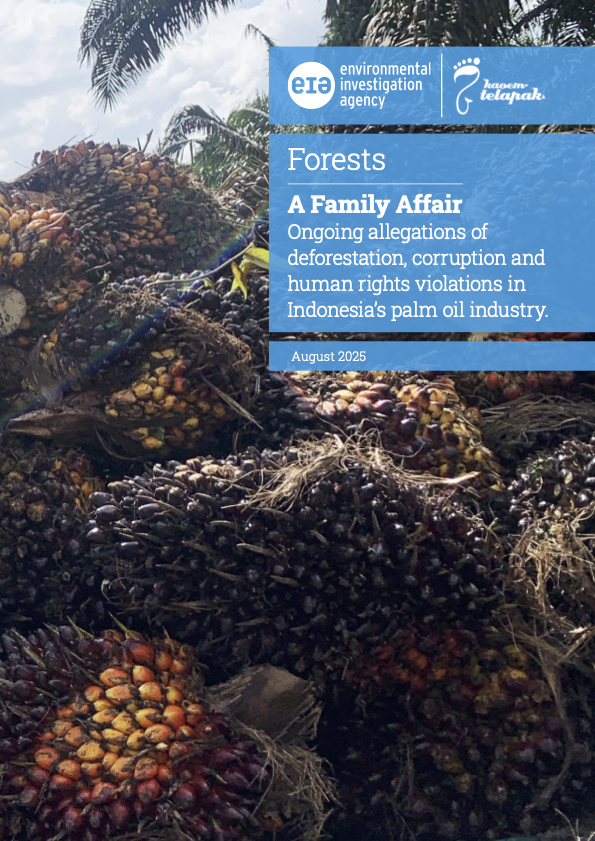
A Family Affair Ongoing allegations of deforestation, corruption and human rights violations in Indonesia’s palm oil industry

By Kaoem Telapak and Environmental Investigation Agency UK 

Indonesia is the world’s largest producer of palm oil, a substance used in thousands of everyday items including food stuffs, cleaning products, shampoo and as a biofuel. 

Indonesian exports of palm oil and related products were worth almost $28 billion in 2024. The Fangiono family, through various family members, is linked to a multitude of palm oil companies in Indonesia. This report outlines the most urgent and ongoing alleged violations by these companies, as of 2025. The companies featured have been accused of deforestation, landgrabs, corruption, operating without proper permits and conflicts with local and indigenous people, with evidence suggesting these are continuing and even expanding issues. Cases studies span Sumatra, Kalimantan and Papua – regions which not only represent different ecological zones but also host distinct indigenous populations and present different legal and political challenges. The family is led by its patriarch – known by his first name, Martias – who was convicted in 2007 of obtaining palm oil permits through bribery and corruption. He was fined more than $38 million and jailed for one-and-a-half years. Today, the Fangiono family operates several major corporate groups, including First Resources, FAP Agri and Ciliandry Anky Abadi, with Martias’ relatives having key positions in these groups. However, there have been numerous reports by NGOs over the years exposing the opaque corporate layers of the family’s companies and alleging control of a network of shadow companies accused of dubious practices, such as deforestation and violating communities’ rights. Such charges have been largely denied by First Resources and FAP Agri, both of which have sustainability policies. But some prominent brands, including Unilever and PepsiCo, are reported to have suspended sourcing palm oil from them due to such allegations. In this report, Kaoem Telapak (KT) and the Environmental Investigation Agency (EIA) outline how the number of companies linked to the family continues to grow and present ongoing allegations of illegal activities, human rights violations and environmental destruction connected with them, while asking how they can continue to act with impunity. 

London: EIA, 2025. 44p.