
Open Access Publisher and Free Library
HUMAN RIGHTS.jpeg

HUMAN RIGHTS

Human Rights-Migration-Trafficking-Slavery-History-Memoirs-Philosophy

Posts tagged Risks
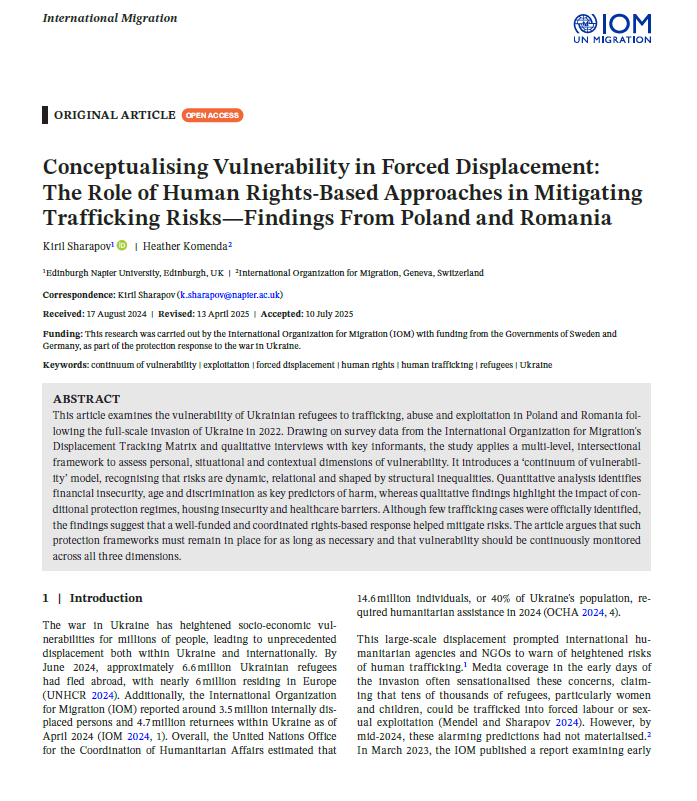
Conceptualising Vulnerability in Forced Displacement: The Role of Human Rights‐Based Approaches in Mitigating Trafficking Risks—Findings From Poland and Romania

By Kiril Sharapov, Heather Komenda

This article examines the vulnerability of Ukrainian refugees to trafficking, abuse and exploitation in Poland and Romania following the full-scale invasion of Ukraine in 2022. Drawing on survey data from the International Organization for Migration's Displacement Tracking Matrix and qualitative interviews with key informants, the study applies a multi-level, intersectional framework to assess personal, situational and contextual dimensions of vulnerability. It introduces a ‘continuum of vulnerability’ model, recognising that risks are dynamic, relational and shaped by structural inequalities. Quantitative analysis identifies financial insecurity, age and discrimination as key predictors of harm, whereas qualitative findings highlight the impact of conditional protection regimes, housing insecurity and healthcare barriers. Although few trafficking cases were officially identified, the findings suggest that a well-funded and coordinated rights-based response helped mitigate risks. The article argues that such protection frameworks must remain in place for as long as necessary and that vulnerability should be continuously monitored across all three dimensions.


International Migration
Volume 63, Issue 5

September 2025
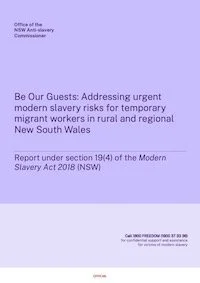
Be Our Guests: Addressing Urgent Modern Slavery Risks For Temporary Migrant Workers in Rural and Regional New South Wales

By James Cockayne, Sophia Kagan, Fiona Ng

This report highlights significant modern slavery risks faced by temporary migrant workers in agriculture, horticulture and meat processing in rural and regional NSW. The modern slavery risks identified include debt bondage, deceptive recruiting, forced labour and, in extreme cases, servitude, sexual servitude and even human trafficking. The report examines significant vulnerabilities faced by both Pacific workers and backpackers concerning working conditions, wages and entitlements; accommodation, transport and living conditions; gendered violence and healthcare access and isolation and social marginalisation. It also highlights growing indicators that the burden of supporting these exploited migrant workers is falling on local communities and community service providers that are not adequately resourced for this task.

Recommendations 

  1. Urgently initiate a trauma-informed and worker-centred investigation of modern slavery risks faced by Pacific Australia Labour Mobility workers and other temporary migrant workers working in agriculture, horticulture and meat processing in rural and regional NSW.

  2. Ensure relevant NSW Government frontline agencies undertake suitable training in modern slavery, as envisaged by section 19(3)(a) of the Modern Slavery Act 2018.

  3. Advocate for the Federal Government to review the visa settings and protection requirements for temporary migrant workers in the PALM and Working Holiday Makers programs.

  4. Complement the work of the new Migrant Workers Centre to be established in NSW, with regional migrant centre hubs.

  5. Ensure funding and support to local actors, including to create a more active role in the monitoring of conditions and support to temporary migrant workers.

Office of the NSW Anti-slavery Commissioner, 2024. 33p.