Open Access Publisher and Free Library
HUMAN RIGHTS.jpeg

HUMAN RIGHTS

Human Rights-Migration-Trafficking-Slavery-History-Memoirs-Philosophy

Posts in Migration
Becoming a Smuggler: Migration and Violence at EUExternal Borders

By Karolina Augustovaa, Helena Carrapicob, and Jelena Obradović-Wochnik

Migrants’ involvement in smuggling increases alongside restricted cross-border movement and violent borders, yet this dynamic is usually examined from migrants’ position as clients.In this article, we move away from migrants and smugglers as two separate roles and question migrants’ aspirations to and experiences of resorting to smuggling networks as workers in the context of EU land borders, where direct violence is used daily to fight cross-border crime. By doing so, we move furtherthe examination of fluid relations in smuggling provisions and the way they are intertwined with care and exploitation, asshaped and circumscribed by violent borders. The article illus-trates the intersections between border violence and migrants active involvement in smuggling by drawing on the case studyof an anonymised Border Town and multi-site, multi-author fieldwork from Serbia and Bosnia. By questioning migrants experiences of shifting roles from clients to service providers,and by taking into account their work in smuggling provision,we show that, in a situation of protracted vulnerability orche-strated by border violence, state and law enforcement, the categories – “migrant” and “smugglers” – can blur.Introduction I am a smuggler. Without smugglers, no people would reach Europe, not evenme’, said Mula, while sitting in a train station. Mula, like dozens of other people around him, travelled through the ‘Balkan Route’ to attempt hisjourney across the increasingly violent borders with the EU states, such asCroatia. However, Mula had no money, and the only way to pay for clandes-tine transport was using his own labour as a smuggler, as he called himself.A blurring of clients and perpetrators in organised crime is not a new phenomenon (Lo Iacono 2014). Same patterns of fluid relations also takeplace in smuggling, an activity recognised in policy terms as impersonal organised crime; a feature that, however, often lacks in human smuggling

GEOPOLITICS2023, VOL. 28, NO. 2, 619–640
download
Tacking towards freedom? Bringing journeys out of slavery into dialogue with contemporary migration

By Angelo Martins Junior & Julia O’Connell Davidson

Antislavery actors evoke the history of the transatlantic slave trade in campaigns to mobilise action to address the suffering experienced by contemporary migrants described as ‘victims of trafficking’. That framing has been picked up by state actors who present measures to supress unauthorised migration per se as necessary to protect migrants from a ‘modern-day slave trade’. Yet the parallel between trafficking and the slave trade is undermined by the fact that people who today are described as ‘trafficked’, as much as those described as ‘smuggled’, actively wish to travel and do so in the hope that by moving, they will secure greater freedoms. This article therefore asks whether there are similarities between the journeys of contemporary unauthorised migrants and those of enslaved people who fled from slavery in the Atlantic World, and if so, why. Bringing data from historical sources on slave flight into dialogue with data on the journeys of contemporary sub-Saharan African migrants to Europe and Brazil, it identifies a number of experiential parallels, and argues that for those concerned with migrants’ rights, enslaved people’s fugitivity potentially offers a more fruitful point of historical comparison than does the slave trade.

Journal of Ethnic and Migration Studies, Volume 48, 2022 - Issue 7

download
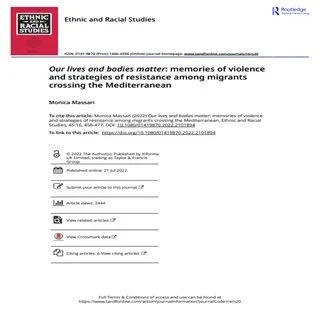
Our Lives and Bodies Matter: Memories of Violence and Strategies of Resistance Among Migrants Crossing the Mediterranean

By Monica Massari

This article addresses the counter-effects of the politics of externalization of European frontiers in Libya through a qualitative analysis of a case study concerning a group of Somali asylum-seekers who, after being held and tortured in Libyan detention centres, managed to cross the Mediterranean and arrived in Italy where they accidentally met and, thus, pressed charges against their torturer. Based on the information provided in the judicial files containing their testimonies, which led to the first recognition by a European court of the unbearable forms of violence suffered by migrants in Libya, this article offers a critical reflection on the implications of migration control enforcement promoted at the EU’s borders on the European civil and political community. Moreover, it provides a reflection on the challenges raised for migration studies by survivors’ testimonies on the wider implications of subjective experiences and biographical narratives in illuminating emerging domains of social responsibility and political action.

Ethnic and Racial Studies, Volume 45, 2022 - Issue 16

download
“They Accused Me of Trying to Go to Europe” Migration Control Abuses and EU Externalization in Mauritania

By Human Rights Watch

Whether fleeing conflict or risks of persecution in their countries, escaping poverty, or seeking a better life, increasing numbers of migrants and asylum seekers have taken the “Atlantic Route” from Africa’s northwest coast towards Spain’s Canary Islands since 2020, with more arriving by boat in 2024 than ever before. In Mauritania, a key transit country along the route, authorities have cracked down on irregular migration while the European Union and Spain have ramped up efforts to outsource or “externalize” migration controls. “They Accused Me of Trying to Go to Europe” documents abuses by Mauritanian security forces against migrants, asylum seekers, and people accused of migrant smuggling between 2020 and early 2025. Based on interviews with over 200 people, including over 100 migrants and asylum seekers, the report documents violence, arbitrary arrests, extortion, racist treatment, inhumane detention, and collective expulsions to Mauritania’s land borders with Mali and Senegal, where people have been exposed to risks in remote border areas – including due to active armed conflict in Mali. The report also traces the extent and impact of the externalization of border controls and migration management by the EU and Spain in Mauritania, including increased funding and other support to Mauritanian security forces, despite abuses. It highlights deaths and disappearances in the Atlantic due, in part, to inadequate search-andrescue, and reveals the negative impacts of Mauritania’s interceptions and forced returns of migrant boats, supported by the EU and Spain. Human Rights Watch calls on Mauritania to respect migrants’ rights, building recent efforts to begin to address concerns, and calls on Spain and the EU to ensure human rights monitoring of funded projects and set criteria for suspending funding if rights violations continue.  

New York: HRW, 2025. 160p.

download
The New Jim Crow: Unmasking Racial Bias in AI Facial Recognition Technology within the Canadian Immigration System

By Gideon Christian

Facial recognition technology (FRT) is an artificial intelligence (AI)-based biometric technology that utilizes computer vision to analyze facial images and identify individuals by their unique facial features. This sophisticated AI technology uses advanced computer algorithms to generate a biometric template from a facial image. The biometric template contains unique facial characteristics represented by dots, which can be used to match identical or similar images in a database for identification purposes. The biometric template is often likened to a unique facial signature for each individual.

A significant rise in the deployment of AI-based FRT has occurred in recent years across the public and private sectors of Canadian society. Within the public sector, its application encompasses law enforcement in criminal and immigration contexts, among many others. In the private sector, it has been used for tasks such as exam proctoring in educational settings, fraud prevention in the retail industry, unlocking mobile devices, sorting and tagging of digital photos, and more. The widespread use of AI facial recognition in both the public and private sectors has generated concerns regarding its potential to perpetuate and reflect historical racial biases and injustices. The emergence of terms like “the new Jim Crow” and “the new Jim Code” draws a parallel between the racial inequalities of the post-US Civil War Jim Crow era and the racial biases present in modern AI technologies. These comparisons underscore the need for a critical examination of how AI technologies, including FRT, might replicate or exacerbate systemic racial inequities and injustices of the past.

This research paper seeks to examine critical issues arising from the adoption and use of FRT by the public sector, particularly within the framework of immigration enforcement in the Canadian immigration system. It delves into recent Federal Court of Canada litigation relating to the use of the technology in refugee revocation proceedings by agencies of the Canadian government. By delving into these legal cases, the paper will explore the implications of FRT on the fairness and integrity of immigration processes, highlighting the broader ethical and legal issues associated with its use in administrative processes.

The paper begins with a concise overview of the Canadian immigration system and the administrative law principles applicable to its decision-making process. This is followed by an examination of the history of integrating AI technologies into the immigration process more broadly. Focusing specifically on AI-based FRT, the paper will then explore the issues of racial bias associated with its use and discuss why addressing these issues is crucial for ensuring fairness in the Canadian immigration process. This discussion will lead to a critical analysis of Federal Court litigation relating to the use of FRT in refugee status revocation, further spotlighting the evidence of racial bias in the technology's deployment within the immigration system.

The paper will then proceed to develop the parallels between racial bias evident in contemporary AI-based FRT (the “new” Jim Crow) and racial bias of the past (the “old” Jim Crow). By focusing on the Canadian immigration context, the paper seeks to uncover the subtle, yet profound ways in which AI-based FRT, despite its purported neutrality and objectivity, can reinforce racial biases of the past. Through a comprehensive analysis of current practices, judicial decisions, and the technology's deployment, this paper aims to contribute to the ongoing dialogue about technology and race. It challenges the assumption that technological advancements are inherently equitable, urging a re-evaluation of how these tools are designed, developed, and deployed, especially in sensitive areas such as refugee status revocation, where the stakes for fairness and equity are particularly high.

69 McGill Law Journal 441 (October 2024)

download
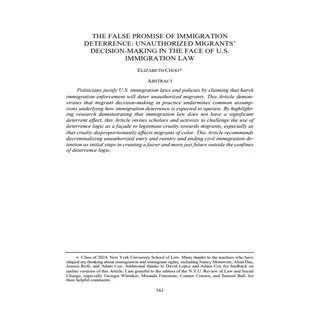
The False Promise of Immigration Deterrence: Unauthorized Migrants’ Decision-Making in the Face of U.S. Immigration Law

By Elizabeth Choo

Politicians justify U.S. immigration laws and policies by claiming that harsh immigration enforcement will deter unauthorized migrants. This Article demonstrates that migrant decision-making in practice undermines common assumptions underlying how immigration deterrence is expected to operate. By highlighting research demonstrating that immigration law does not have a significant deterrent effect, this Article invites scholars and activists to challenge the use of deterrence logic as a façade to legitimate cruelty towards migrants, especially as that cruelty disproportionately affects migrants of color. This Article recommends decriminalizing unauthorized entry and reentry and ending civil immigration detention as initial steps in creating a fairer and more just future outside the confines of deterrence logic.

  N.Y.U. REVIEW OF LAW & SOCIAL CHANGE [Vol. 48:161, 2025.


download
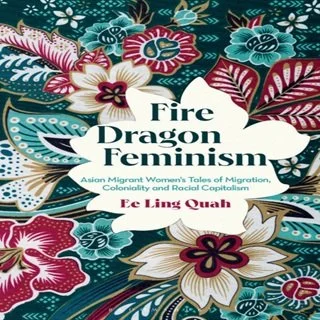
Fire Dragon Feminism: Asian Migrant Women's Tales of Migration, Coloniality and Racial Capitalism

By Quah Ee Ling

Featuring stories of early settler and contemporary Asian migrant women in Asia-Pacific region, Fire Dragon Feminism discusses Asian migrant women’s encounters with coloniality and racial capitalism at their workplace and in their everyday life. Centring anti-colonial, anti-racist feminist philosophies and strategies, this open access book introduces 'fire dragon feminism' - a migrant feminist strand that aims to blow flames at colonial, racial capitalist and neoliberal structures and build solidarities for more just and sustainable futures. Based on in-depth interviews with 40 Asian migrant employees in Australian universities, the book examines how Asian migrant women are implicated and complicit in white race-making projects while being subjected to racialisation and marginalisation simultaneously. Fire Dragon Feminism presents a historicised and sociological discussion of the contradictions, trade-offs, complicities and refusals in the Asian migrant women’s tales of migration, coloniality and racial capitalism. The author ends the book with a celebration of anti-colonial, anti-racist grassroots feminist activisms.

London: Bloomsbury Academic, 2025. 


download
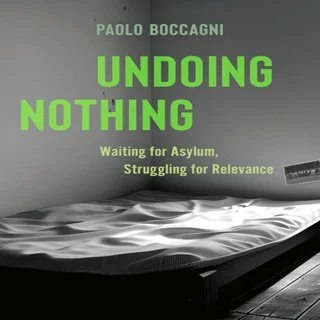
Undoing Nothing: Waiting for Asylum, Struggling for Relevance

By Boccagni, Paolo

What does everyday life look like for young men who flee to Europe, survive, and are then assigned temporary housing? Hypersurveillance or parallel normality, irrelevance, or even nothingness? Based on four years of ethnographic research, Undoing Nothing recounts the untold story of Italian asylum seekers’ struggles to produce relevance—that is, to carve out meaning, control, and direction from their legal and existential liminality. Their ways of inhabiting space and time rest on a deeply ambivalent position: together and alone, inside and outside, absent and present. Their racialized bodies dwell in their assigned residence while their selves inhabit a suspended translocal space of moral economies, nightmares, and furtive dreams. This book illuminates a distinctly modern form of purgatory, offering both a perceptive critique of state responses to the so-called refugee crisis and nuanced psychological portraits of a demographic rarely afforded narrative depth and grace. “Undoing Nothing is an exceptional book. It moves us away from dramatic and sensational descriptions of refugee predicaments and toward a detailed and perceptive analysis of the ways people navigate and manage their lives in the interstices between being stuck and in motion, surviving and aspiring.”

Oakland, CA: University of California Press, 2025. 228p

download
Migration and Citizenship: Legal Status, Rights and Political Participation

Edited by Rainer Bauböck

Citizenship is frequently invoked both as an instrument and goal of immigrant integration. Yet, in migration contexts, citizenship also marks a distinction between members and outsiders based on their different relations to particular states. A migration perspective highlights the boundaries of citizenship and political control over entry and exit as well as the fact that foreign residents remain in most countries deprived of core rights of political participation. This book summarizes current theories and empirical research on the legal status and political participation of migrants in European democracies.

Amsterdam: Amsterdam University Press, 2006. 128p.

download
Do My Rights Matter? The Mistreatment of Unaccompanied Children in CBP Custody (October 2020)

By Jennifer Anzardo Valdes, et al.

For years, thousands of children have made the difficult decision to flee from their countries with the hope of securing safety and security in the United States. Their reasons for fleeing vary but there are common themes. Many of these children are seeking protection from human trafficking, targeted gang violence in the form of assaults, kidnappings, or extortions, as well as domestic violence and child abuse.

In 2019 alone, Customs and Border Protection (CBP) detained over 76,000 children. As part of our investigation into the treatment of unaccompanied children and conditions at the facilities at the border, we interviewed and provided legal services to 9,417 of them.

This report is based on these unaccompanied children’s testimonies of being detained at US detention facilities along the southern border. Children were detained in horrific conditions way beyond the 72 hours allowed under US law. Children described being held in frigid rooms, sleeping on concrete floors, being fed frozen food, with little or no access to medical care. Too often, they were subjected to emotional, verbal, and physical abuse by CBP officers.

Miami: Americans for Immigrant Justice,2020 74p.

download
The role of smuggling in shaping migrants’ journeys, finances and risks in the Central Sahel, Burkina Faso, Mali, Niger

By Thibaut Girault

This paper looks at the role of smugglers in facilitating migrant movement amid the worsening political and security situation in Mali, Burkina Faso and Niger. Findings reveal that migrants rely on smugglers to bypass occasional border restrictions between members of the Economic Community of West African States (ECOWAS) and to navigate increasingly dangerous routes within Mali, Burkina Faso, and Niger—three countries that formed the Alliance of Sahel States (ASS) in 2023. This reliance on smugglers also comes with significant risks, including greater exposure to exploitation, debt, and corruption— vulnerabilities that are particularly pronounced for women.

The research is based on the responses of 2,674 migrants surveyed by 4Mi between May and August 2024 in Niger, Mali, and Burkina Faso. It compares the experiences of migrants who used smuggler services (n=1,550) with those who did not (n=1,124) to better understand the relationship between smuggler use and migrants’ routes, journey costs, and protection risks.

London/Denmark: Mixed Migration Centre, 2025. 17p.

download
Climate, Crime and Exploitation: THE GENDERED LINKS BETWEEN CLIMATE-RELATED RISK, TRAFFICKING IN PERSONS AND SMUGGLING OF MIGRANTS/ Policy Brief

By The United Nations Office on Drugs and Crime (UNODC) and Global Action to Prevent and Address Trafficking in Persons and the Smuggling of Migrants (GLO.ACT)

At least 3 billion people live in contexts highly exposed to the impacts of climate change19 and yet more to non-climatic environmental degradation and disaster. Even if the world meets the currently improbable target of limiting global warming to 1.5 C degrees set out in the Glasgow Climate Pact, extreme weather and environmental degradation will see the deterioration of ecosystems and loss of biodiversity depended on by billions. In climate vulnerable countries, children and future generations, women, the poor (among whom the majority are women), and Indigenous Peoples, are disproportionately impacted.

The international community is expanding its response and financing. Mitigation measures aim to limit the damage by reducing and removing carbon, using regulation (like emissions limits) and technology (like carbon sinks). Adaptation measures seek to help people survive sudden-onset disasters and reconstitute livelihoods undermined by slow-onset processes that degrade soils, rivers and forests.

Additional factors threaten to exacerbate climate damage and undermine mitigation and adaptation strategies. Environmental crimes accelerate the destruction of natural resources and undermine the resilience of affected populations. The economic damage of COVID-19 has intensified competition for resources, increased the precarity of people on low incomes and with insecure migration statuses, and reduced the capacity of states to respond, as does the conflict and instability seen in some climate-vulnerable countries, such as those in the Sahel. Conflict and instability undermine adaptation measures.

This brief explores how climate change, climate-re- lated events, and crimes that affect the environment (environmental crimes) influence trafficking in persons (TIP) and smuggling of migrants (SOM), with special consideration of gender. It draws on expert interviews and a desk review to explore three key questions:

The effects of climate change, climate-related events, and environmental crime on TIP and SOM, and in particular its effects on women, in Part 1. Climate, movement and vulnerability.

How business practices shape exposure to TIP and SOM risk, in Part 2. Climate, industry and exploitation.

Current and emerging responses among policymakers, law enforcement, and civil society, in Part 3. Legal, policy and criminal justice responses.

The case of Bangladesh, a climate vulnerable and origin country for TIP and SOM, and a pioneer in adaptation, in Part 4. Environment and vulnerability in Bangladesh.

The paper concludes with Part 5. Framing the response and lists recommendations.

The analysis takes a human rights-based approach, integrating the United Nations Office on Drugs and Crime (UNODC) human rights and gender equality toolkit, which provides practical ways of integrating the protection of rights outlined in the United Na- tions Convention against Transnational Organized Crime (UNTOC) and sibling protocols on TIP and SOM into programmatic approaches. In particular, that approaches to countering TIP and SOM should not affect rights outlined under international human rights laws, including the 1951 Refugee Convention.

Vienna: UNODC, 2022. 55p.

download
Criminal Law & Migration Control: Recent History & Future Possibilities

By Jennifer M. Chacón

Immigration enforcement in the United States has undergone a revolutionary transformation over the past three decades. Once episodic, border-focused, and generally confined to the efforts of a relatively small federal agency, immigration enforcement is now exceedingly well-funded and integrated deeply into the everyday policing of the interior United States. Not only are federal immigration agents more numerous and ubiquitous in the interior, but immigration enforcement has been integrated into the policing practices of state and local officials who once saw their purview as largely distinct from that of federal immigration enforcement agents. This essay briefly explains these developments, from shortly before the passage of the Immigration Reform and Control Act of 1986 through the present day, and assesses their consequences. It includes a brief discussion of the ways states and localities have responded to federal enforcement trends, whether through amplification or constraint.

Daedalus, Winter 2022, at 121.

download
Silence of the Innocents: Undocumented Immigrants’ Underreporting of Crime and their Victimization

By Stefano Comino, Giovanni Mastrobuoni, Antonio Nicolò

Do undocumented migrants under report crimes to the police in order to avoid being deported? And do criminals exploit such vulnerability? We address these questions using victimization surveys and administrative data around the 1986 U.S. immigration amnesty. The amnesty allows us to solve two major identification issues that have plagued this literature: migrants’ legal status is endogenous and unobserved.

The results show that the reporting rate of undocumented immigrants is 17 percent, which limits the immigrants’ ability to protect some of their fundamental human rights. However, right after the 1986 amnesty, which disproportionately legalized individuals of Hispanic origin, crime victims of Hispanic origin show enormous improvements in reporting behavior. The implied increase in the reporting rate by amnesty applicants is close to 20 percentage points.

Journal of Policy Analysis and ManagementVolume 39, Issue 4, Sep 2020, Pages879-1288

download
he effect of immigration enforcement on crime reporting: Evidence from Dallas

By Elisa Jácome

Mistrust between immigrants and the police may undermine law enforcement’s ability to keep communities safe. This paper documents that immigration policies affect an individual’s willingness to report crime. I analyze the 2015 Priority Enforcement Program, which focused immigration enforcement on individuals convicted of serious crimes and shifted resources away from immigration-related offenses. I use data from the Dallas Police Department that include a complainant’s ethnicity to show that the number of violent and property crimes reported to the police by Hispanics increased by 4 percent after the introduction of PEP. These results suggest that reducing enforcement of individuals who do not pose a threat to public safety can potentially improve trust between immigrant communities and the police.

Journal of Urban Economics, 2022

download
MAPPING MIGRANT CHILDREN IN DETENTION

By Ben Orlebeke and Cory Shindel

In recent years, administrative policies seeking to roll back protections for immigrant and refugee children and families have had devastating impacts and only highlighted the unique needs and vulnerabilities of children in U.S. immigration custody. Efforts to restore, expand, and reimagine processes that prioritize children’s rights and well-being have never been more critical. With the generous support of the Four Freedoms Fund, Kids in Need of Defense (KIND) undertook a project to map the different types of facilities in which children are detained in the U.S. immigration system to inform efforts to create a system centered in children’s best interests, rights, and unique needs. This brief is excerpted from that project. Many thanks to the Four Freedoms Fund for making this project possible, and to Ben Orlebeke and Cory Shindel (KIND)

Washington, DC: Kids in Need of Defense (KIND), 2021. 13p.

download
ICE Cannot Effectively Monitor the Location and Status of All Unaccompanied Alien Children After Federal Custody.

By U.S. Department of Homeland Security, Office of Inspector General

We incorporated the formal comments provided by your office. The report contains four recommendations aimed at improving ICE’s ability to monitor the location and status of unaccompanied alien children. Your office concurred with all four recommendations. Based on information provided in your response to the draft report, we consider recommendations 1 through 4 open and resolved. Once your office has fully implemented the recommendations, please submit a formal closeout letter to us within 30 days so that we may close the recommendations. The memorandum should be accompanied by evidence of completion of agreed-upon corrective actions.

Each year, hundreds of thousands of UACs enter the United States illegally. Public concern for the safety of UACs has continued as the U.S. media has reported on trafficking, exploitation, forced labor, and other criminal activities. ICE is responsible for managing and monitoring the immigration cases of these children once they are released from DHS’ custody. We conducted this audit to determine ICE’s ability to monitor the location and status of UACs once released or transferred from DHS and HHS’ custody

Washington DC: OFFICE OF INSPECTOR GENERAL U.S. Department of Homeland Security , 2025. 27p.

download
Unaccompanied Alien Children: An Overview

By William A. Kandel

The number of unaccompanied alien children (UAC, unaccompanied children) apprehended at the Southwest border between U.S. ports of entry while attempting to enter the United States without authorization has increased substantially over the past decade. Apprehensions numbered 8,041 in FY2008 and reached a then-record of 68,541 in FY2014. Since FY2014, apprehensions have fluctuated considerably, ranging from a low of 30,557 in FY2020 to a high of 149,093 in FY2022. Since FY2021, they have exceeded 130,000 each year. In the first 10 months of FY2024, apprehensions of UAC numbered 87,475. UAC are children under age 18 who lack both lawful immigration status in the United States, and a parent or legal guardian in the United States, or a parent or legal guardian in the United States who is available to provide care and physical custody. U.S. policy on UAC treatment and processing is guided by the Flores Settlement Agreement of 1997, the Homeland Security Act of 2002, and the Trafficking Victims Protection Reauthorization Act (TVPRA) of 2008. Children from the Northern Triangle countries—El Salvador, Guatemala, and Honduras—and increasingly from other countries dominate what was previously an almost entirely Mexican migrant flow. The TVPRA permits most Mexican children to be voluntarily returned to Mexico. In contrast, children from all other countries may enter the United States and are placed in formal removal immigration proceedings, during which they may apply for relief or protection from removal. Consequently, the shift in origin-country composition has affected both federal spending and the federal agencies responsible for unaccompanied children. The Department of Homeland Security (DHS), Department of Health and Human Services (HHS), and Department of Justice (DOJ) share responsibility for UAC processing, treatment, placement, and immigration case adjudication. DHS’s Customs and Border Protection (CBP) apprehends and detains UAC arrested at the border. DHS’s Immigration and Customs Enforcement (ICE) handles custody transfer and repatriation, apprehends UAC in the U.S. interior, and represents the government in removal proceedings. HHS’s Office of Refugee Resettlement (ORR) coordinates care and placement of UAC in appropriate custodial settings. DOJ’s Executive Office for Immigration Review (EOIR) adjudicates UAC removal cases. The Obama, Trump, and Biden Administrations, as well as Congress, have taken steps since 2014 to respond to the general increase in UAC apprehensions. During the 2014 surge, the Obama Administration opened the first large temporary shelters, initiated programs to address root causes of child migration, and created the Central American Minors (CAM) Refugee and Parole Program. The Trump Administration instituted policies to reduce illegal migrant flows and limit who could apply for asylum. It discontinued the CAM program and implemented an agreement between ORR and DHS to share biometric and immigration status information about children as well as sponsors and any adults in their households. In 2020, HHS’s Centers for Disease Control and Prevention (CDC) exercised its authority under U.S. Code Title 42 (public health) that temporarily allowed CBP to promptly expel UAC at the border. The Biden Administration has faced record high UAC apprehension levels. It has excepted unaccompanied children from Title 42 expulsions, revoked the ORR-DHS information-sharing agreement, employed numerous temporary influx facilities, and reactivated the CAM program. It also issued a final rule implementing the Flores Agreement and formalizing UAC policies in regulation. Congress has responded by providing funding for UAC-related activities in response to annual, supplemental, and emergency appropriations requests. Current UAC policy issues facing Congress include the provision of post-release follow-up and services, the prevalence of child labor violations, legal representation for children in immigration proceedings, and potential incentives for child migration created by the TVPRA.

Washington, DC: Congressional Research Service, 2024. 56p.

download
The Effect of Workplace Raids on Academic Performance: Evidence from Texas

By Sofia Avila

Workplace raids are visible and disruptive immigration enforcement operations that can result in the detention of hundreds of immigrants at one time. Despite concerns about the impact of raids on children’s well-being, there is limited research on how these tactics affect their academic performance. Using school-level testing data from 2015 to 2019, I compare changes in the performance of Hispanic students in schools close to a workplace raid to white students in the same schools and Hispanic students at control schools. I find exposure to a raid lowered the scores and passing rates of Hispanic students in standardized tests taken 40 days after the operation. I further find that students in schools closer to the raid experienced more pronounced drops in performance, but I do not detect strong evidence that performance decreases were caused by interruptions to schooling. These findings provide new evidence on the spillover effects of workplace raids, underscoring the potential role of immigration enforcement in generating disparities in Hispanic children’s educational outcomes.

Sociological Science 11: 258-296 2024.

download
Sanctuary policies reduce deportations without increasing crime

By David K Hausman

The US government maintains that local sanctuary policies prevent deportations of violent criminals and increase crime. This report tests those claims by combining Immigration and Customs Enforcement (ICE) deportation data and Federal Bureau of Investigation (FBI) crime data with data on the implementation dates of sanctuary policies between 2010 and 2015. Sanctuary policies reduced deportations of people who were fingerprinted by states or counties by about one-third. Those policies also changed the composition of deportations, reducing deportations of people with no criminal convictions by half-without affecting deportations of people with violent convictions. Sanctuary policies also had no detectable effect on crime rates. These findings suggest that sanctuary policies, although effective at reducing deportations, do not threaten public safety.

Proc Natl Acad Sci U S A. 2020 Nov 3;117(44):27262-27267.

download