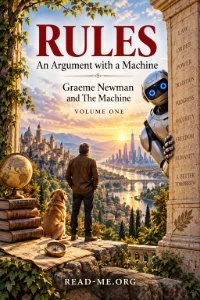
by Graeme Newman and the Machine
Why do we need rules? Who makes them? Who benefits from them? And what happens when we begin to question them?
Rules: An Argument with The Machine is a unique collection of short stories exploring one of the most fundamental features of human society: rules.
From ancient villages to futuristic cities, from courts of law to battlefields, from schools and prisons to utopian experiments, these stories examine the rules that govern our lives and the consequences of obeying, bending, or breaking them.
But this is more than a collection of stories.
Each story began as a collaboration between author Graeme Newman and an artificial intelligence. The Machine produced a story. The author responded, sometimes agreeing, often challenging, and occasionally mocking the machine's tendency toward optimism, redemption, and tidy moral conclusions. The result became an ongoing conversation about law, justice, power, morality, freedom, authority, conformity, and human nature itself.
As the stories unfold, a second narrative emerges:
Can society exist without rules?
Can rules exist without injustice?
And can a machine ever understand the messy realities of human life?
Part philosophical inquiry, part social commentary, part literary experiment, Rules: An Argument with a Machine invites readers to join a lively debate between human skepticism and artificial optimism.
The stories may not provide definitive answers. But they ask questions worth arguing about.
In This Volume
In the beginning: The origins of rules and morality
The rise of rulers and authority
Law, punishment, and social control
Rule worshippers and rule breakers
Utopias, dystopias, and "Ruletopia"
The continuing dialogue between a human author and his machine co-author
For readers interested in social issues, criminal justice, political thought, philosophy, artificial intelligence, and the strange ways stories can illuminate the human condition.
Read-Me.Org Inc. New York-Philadelphia-Australia. 2026. p.192.