
Open Access Free Library
SOCIAL SCIENCES.jpeg

SOCIAL SCIENCES

Social sciences examine human behavior, social structures, and interactions in various settings. Fields such as sociology, psychology, anthropology, and economics study social relationships, cultural norms, and institutions. By using different research methods, social scientists seek to understand community dynamics, the effects of policies, and factors driving social change. This field is important for tackling current issues, guiding public discussions, and developing strategies for social progress and innovation.

Posts in Punishment
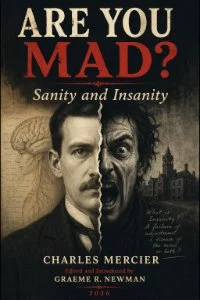
Are You Mad?

by Charles Mercier (Author), Graeme Newman (Editor) Format: Paperback

What is insanity? A disease of the mind? A disorder of the brain? Or a failure of human beings to adjust to the world around them?

First published in 1901, Charles Mercier's Sanity and Insanity remains one of the most provocative and accessible explorations of mental disorder ever written. Rejecting superstition, moral condemnation, and simplistic medical explanations, Mercier sought to understand insanity scientifically—through the relationships among the brain, the mind, behavior, heredity, and the social environment.

In this classic work, Mercier argues that insanity is not merely a collection of strange thoughts or unusual beliefs. Rather, it is a disorder of the individual's ability to adjust to life's circumstances. Drawing on psychiatry, psychology, law, biology, and philosophy, he examines questions that remain central today:

  • What distinguishes sanity from insanity?

  • How are mind and brain related?

  • What role does heredity play in mental illness?

  • Why do stress, trauma, and life changes trigger mental breakdowns?

  • How should society understand responsibility, crime, and mental disorder?

This new edition, edited and introduced by distinguished criminologist Graeme R. Newman, places Mercier's ideas in historical and scientific context. The introduction examines Mercier's influential theories of heredity and mental illness in light of contemporary psychiatric genetics, showing both where he anticipated modern science and where later discoveries have transformed our understanding of mental disorder.

Part history, part psychology, and part philosophy of mind, Are You Mad? offers modern readers a fascinating window into the origins of scientific psychiatry and the enduring debate over what it means to be sane.

For students, scholars, clinicians, criminologists, and anyone interested in the history of mental health, this remarkable work remains as challenging and relevant today as when it first appeared more than a century ago.

Read-Me.Org Inc. New York-Philadelphia-Australia. 2026. 286p.

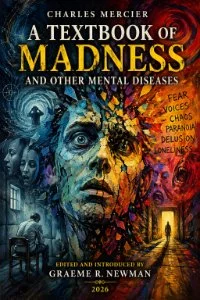
A Textbook of Madness

by Charles Mercier (Author), Graeme Newman (Author)

What is madness? How does reason fail? When does unusual behavior become mental illness? And what responsibilities do society, medicine, and the law have toward those whose minds are disordered?

Originally published in the early twentieth century, Charles Mercier's A Textbook of Madness and Other Mental Diseases is one of the most influential and intellectually ambitious works in the history of psychiatry. A pioneering psychiatrist and leading authority on insanity, Mercier sought to do more than describe mental illness—he attempted to explain its nature, causes, classification, and relationship to human conduct.

Rejecting the conventional view that insanity is simply a disorder of thought, Mercier argued that madness is fundamentally a disorder of conduct. Through careful observation and analysis, he developed a comprehensive theory linking desire, will, feeling, thought, and memory to the ways individuals function in society. His groundbreaking hierarchical model of the mind anticipated many modern concerns with judgment, self-control, insight, and behavioral regulation.

This new edition features an extensive introduction by renowned criminologist Graeme R. Newman, placing Mercier's work within the context of modern psychiatry, psychology, criminology, neuroscience, and forensic mental health. Newman explores the enduring relevance of Mercier's ideas and their continuing influence on debates surrounding mental illness, criminal responsibility, social control, and human behavior.

Inside this volume, readers will discover:

  • Mercier's pioneering definition of insanity as a disorder of conduct

  • A detailed hierarchical theory of mental functioning

  • Early classifications of mental illness and their historical development

  • Analyses of delusions, hallucinations, dementia, paranoia, mania, and melancholia

  • Discussions of crime, punishment, and criminal responsibility

  • The legal treatment of insanity in Britain during the early twentieth century

  • Insights into the social, biological, and psychological causes of mental disorder

  • A scholarly introduction connecting Mercier's theories to contemporary research

Part historical document, part psychiatric treatise, and part philosophical inquiry into the nature of human behavior, A Textbook of Madness and Other Mental Diseases remains an essential work for students and scholars of psychiatry, psychology, criminology, law, sociology, and the history of medicine.

More than a century after its first publication, Mercier's enduring questions continue to resonate: What is sanity? What is madness? And how should society respond when the boundaries between them become uncertain?

An indispensable classic of psychiatric thought, now available in a modern scholarly edition.

Read-Me.Org Inc. New York-Philadelphia-Australia. 2026. 218p.

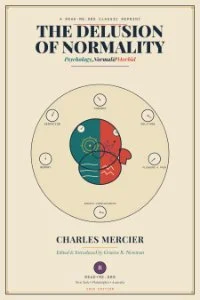
The Delusion of Normality: Psychology-Normal and Morbid

by Charles Mercier (Author), Graeme Newman (Author)

In 1901, the physician and alienist Charles Mercier set out to do something almost nobody had attempted: build one complete theory of mind that covered sanity and insanity alike, on the theory that you cannot understand madness until you understand the ordinary mind it departs from. The result is this book — four hundred pages of sustained, systematic ambition, mapping sensation, thought, will, memory, pleasure, pain, and the sense of self as a single connected machine, with delusion treated not as a foreign invasion of the mind but as ordinary belief, strained past its working tolerance.

It is a genuinely strange book to read now, and that is exactly why it's worth reading. Mercier's nervous system runs on "motion," flowing through tissue like steam through pipework — a mechanical metaphor pushed further than the science of the day could really support. He proposes scrapping the syllogism in favor of six modes of reasoning entirely his own invention, argued with total seriousness across a hundred pages, and it persuaded almost nobody. His system did not outlast the decade. And yet buried inside the wreckage of that system is a genuinely durable idea: that delusion sits on a continuum with everyday belief, rather than in a category of its own — a claim psychiatry spent most of the twentieth century arguing its way back to.

This new edition presents Mercier's text in full, extensively cleaned of over a century of accumulated OCR and scanning damage, with British-Victorian spelling and phrasing left exactly as written. A new critical introduction by Graeme R. Newman situates the book against its contemporaries — it appeared eleven years after William James's Principles of Psychology and just before Freud reached English readers — and reads it honestly: neither a lost masterpiece nor a curiosity, but a serious system that got some of the biggest questions in psychiatry wrong in interesting ways, and one genuinely important thing right early.

What's inside:

  • The complete original text of Mercier's 1901 classic, unabridged

  • A new critical introduction assessing Mercier's system against James, Freud, and the psychiatry that followed

  • Extensive restoration of scan-damaged passages, with any unrecoverable material left honestly marked rather than guessed at

  • Six major sections: Sensation, Thought, Volition, Memory, Pleasure and Pain, and Subject-Consciousness

Companion volume: How to Run a Lunatic Asylum, Mercier's 1894 administrative manual, applies the same systematizing temperament at the scale of the institution rather than the mind.

For readers who enjoy:

  • The history of psychiatry and psychology before Freud

  • Victorian and Edwardian systems of thought — ambitious, confident, and often wrong in illuminating ways

  • Primary sources that reward a critical rather than a reverent reading

Read-Me.Org Inc. New York-Philadelphia-Australia. 2026. 397p.

Narratives and destigmatization: the case of criminal record stigma in the labor market

By David J. Harding, Maria S. Smith, Da Eun Jung, Stephanie Luna-Lopez & Amanda Glazer

Sociologists use the concept of narrative as an analytical tool and theoretical concept to understand the stories that people tell and their role in social and cultural life. A key tenet of prior research on narratives is their capacity to shape the audience’s understanding and evaluation of the narrator. In this mixed-method study, we investigate the role of narratives in destigmatization through the case of criminal record stigma in the labor market. Based on evidence from a survey experiment in which people with managerial experience were randomly assigned to job applicants with different narratives, we show that evaluations differ across reentry narratives. Drawing on prior theorizations and qualitative interviews with employers, we identify and describe three processes through which narratives impact evaluation and destigmatization: moral justification, social affinity signaling, and information salience.

American Journal of Cultural Sociology, 2025, 33p.