
Open Access Free Library
SOCIAL SCIENCES.jpeg

SOCIAL SCIENCES

Social sciences examine human behavior, social structures, and interactions in various settings. Fields such as sociology, psychology, anthropology, and economics study social relationships, cultural norms, and institutions. By using different research methods, social scientists seek to understand community dynamics, the effects of policies, and factors driving social change. This field is important for tackling current issues, guiding public discussions, and developing strategies for social progress and innovation.

Posts in Violent Crime
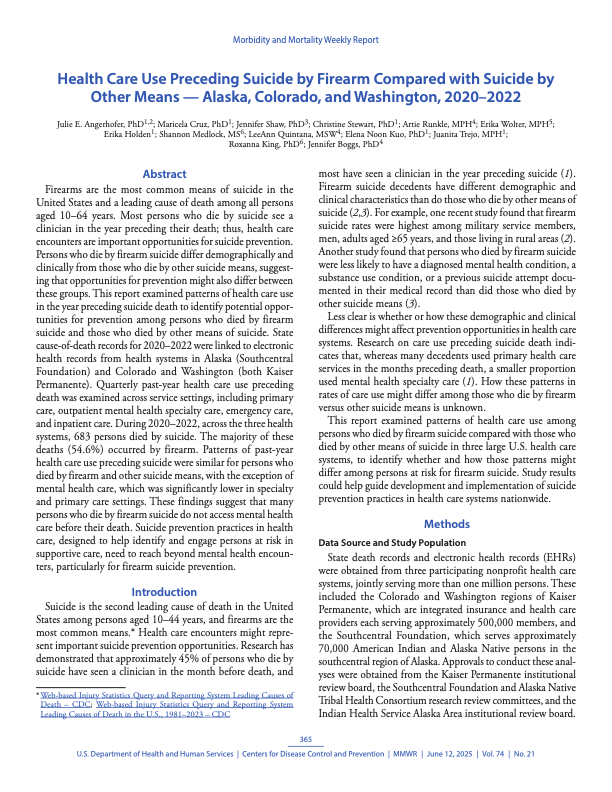
Health Care Use Preceding Suicide by Firearm Compared with Suicide by Other Means

By Julie E. Angerhofer; Maricela Cruz, Jennifer Shaw, Christine Stewart,  Artie Runkle, Erika Wolter, et al.

Firearms are the most common means of suicide in the United States and a leading cause of death among all persons aged 10–64 years. Most persons who die by suicide see a clinician in the year preceding their death; thus, health care encounters are important opportunities for suicide prevention. Persons who die by firearm suicide differ demographically and clinically from those who die by other suicide means, suggest ing that opportunities for prevention might also differ between these groups. This report examined patterns of health care use in the year preceding suicide death to identify potential oppor tunities for prevention among persons who died by firearm suicide and those who died by other means of suicide. State cause-of-death records for 2020–2022 were linked to electronic health records from health systems in Alaska (Southcentral Foundation) and Colorado and Washington (both Kaiser Permanente). Quarterly past-year health care use preceding death was examined across service settings, including primary care, outpatient mental health specialty care, emergency care, and inpatient care. During 2020–2022, across the three health systems, 683 persons died by suicide. The majority of these deaths (54.6%) occurred by firearm. Patterns of past-year health care use preceding suicide were similar for persons who died by firearm and other suicide means, with the exception of mental health care, which was significantly lower in specialty and primary care settings. These findings suggest that many persons who die by firearm suicide do not access mental health care before their death. Suicide prevention practices in health care, designed to help identify and engage persons at risk in supportive care, need to reach beyond mental health encoun ters, particularly for firearm suicide prevention. 

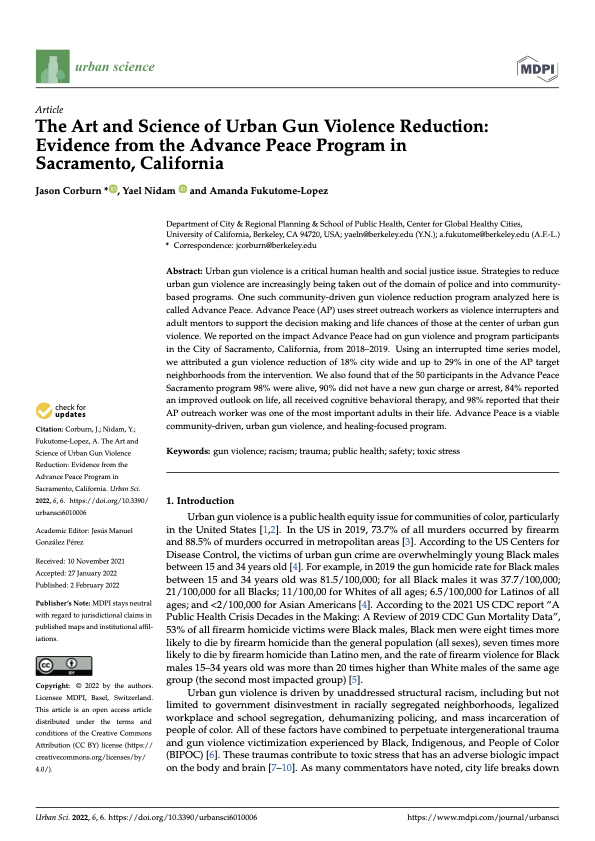
The Art and Science of Urban Gun Violence Reduction: Evidence from the Advance Peace Program in Sacramento, California

By Jason Corburn, Yael Nidam and Amanda Fukutome-Lopez

Urban gun violence is a critical human health and social justice issue. Strategies to reduce urban gun violence are increasingly being taken out of the domain of police and into community-based programs. One such community-driven gun violence reduction program analyzed here is called Advance Peace. Advance Peace (AP) uses street outreach workers as violence interrupters and adult mentors to support the decision making and life chances of those at the center of urban gun violence. We reported on the impact Advance Peace had on gun violence and program participants in the City of Sacramento, California, from 2018–2019. Using an interrupted time series model, we attributed a gun violence reduction of 18% city wide and up to 29% in one of the AP target neighborhoods from the intervention. We also found that of the 50 participants in the Advance Peace Sacramento program 98% were alive, 90% did not have a new gun charge or arrest, 84% reported an improved outlook on life, all received cognitive behavioral therapy, and 98% reported that their AP outreach worker was one of the most important adults in their life. Advance Peace is a viable community-driven, urban gun violence, and healing-focused program.

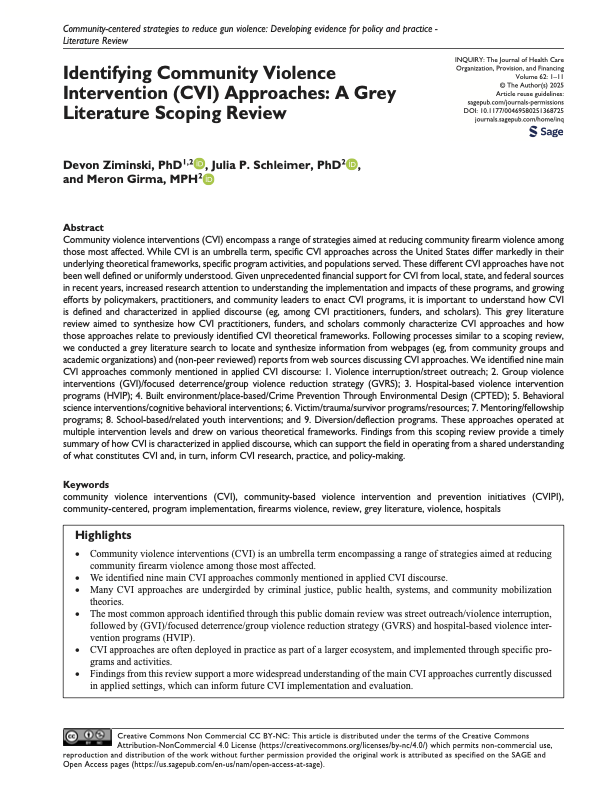
Identifying Community Violence Intervention (CVI) Approaches: A Grey Literature Scoping Review 

Community violence interventions (CVI) encompass a range of strategies aimed at reducing community firearm violence among those most affected. While CVI is an umbrella term, specific CVI approaches across the United States differ markedly in their underlying theoretical frameworks, specific program activities, and populations served. These different CVI approaches have not been well defined or uniformly understood. Given unprecedented financial support for CVI from local, state, and federal sources in recent years, increased research attention to understanding the implementation and impacts of these programs, and growing efforts by policymakers, practitioners, and community leaders to enact CVI programs, it is important to understand how CVI is defined and characterized in applied discourse (eg, among CVI practitioners, funders, and scholars). This grey literature review aimed to synthesize how CVI practitioners, funders, and scholars commonly characterize CVI approaches and how those approaches relate to previously identified CVI theoretical frameworks. Following processes similar to a scoping review, we conducted a grey literature search to locate and synthesize information from webpages (eg, from community groups and academic organizations) and (non-peer reviewed) reports from web sources discussing CVI approaches. We identified nine main CVI approaches commonly mentioned in applied CVI discourse: 1. Violence interruption/street outreach; 2. Group violence interventions (GVI)/focused deterrence/group violence reduction strategy (GVRS); 3. Hospital-based violence intervention programs (HVIP); 4. Built environment/place-based/Crime Prevention Through Environmental Design (CPTED); 5. Behavioral science interventions/cognitive behavioral interventions; 6. Victim/trauma/survivor programs/resources; 7. Mentoring/fellowship programs; 8. School-based/related youth interventions; and 9. Diversion/deflection programs. These approaches operated at multiple intervention levels and drew on various theoretical frameworks. Findings from this scoping review provide a timely summary of how CVI is characterized in applied discourse, which can support the field in operating from a shared understanding of what constitutes CVI and, in turn, inform CVI research, practice, and policy-making.

INQUIRY: The Journal of Health Care Organization, Provision, and Financing Volume 62: 1–11

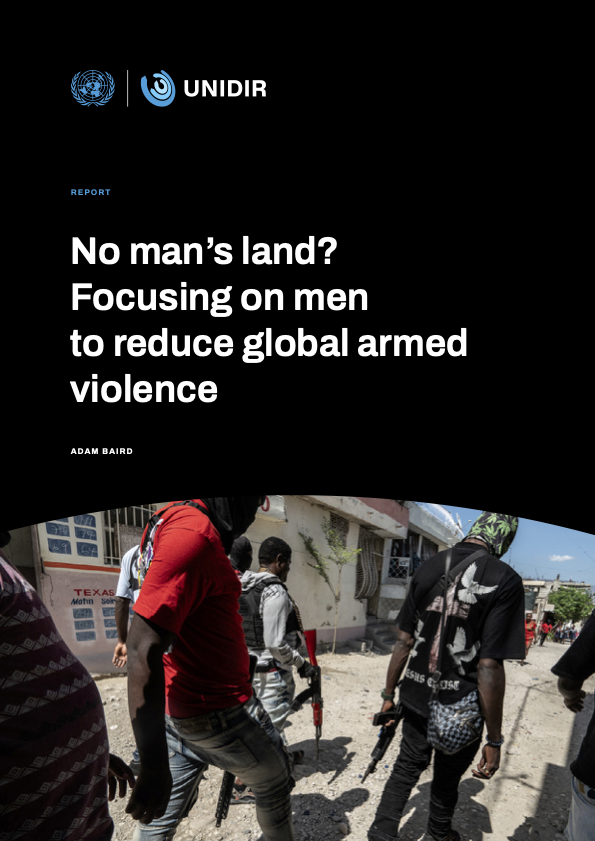
“No man’s land? Focusing on Men to Reduce Global Armed Violence”, 

By Adam Baird

Globally, 90% of firearms homicides are committed by men, and men also make up the vast majority of the victims. The highest rates of homicide are mainly found in cities in the Americas (including the Caribbean) and southern Africa, mainly in cities. “Men killing men” disproportionately affects young people in the Global South who live in precarious economic circumstances. This has been the consistent demographic of lethal armed violence for decades.

If men are at the centre of the global armed violence epidemic, it clearly has something to do with their gender. The report explains that when frustrated young men in contexts of persistent poverty gain easy access to small arms and ammunition, it creates a significant risk of an epidemic of lethal violence. This prompts the question: What work is being undertaken with men using a masculinities focus to prevent armed violence? The answer, in short, is none. Efforts to reduce armed violence that do not consider masculinities  will only have a limited effect.

The report suggests that greater debate about this issue is required and that the United Nations can lead progress by developing initiatives in collaboration with Member States, academia and civil society partners. However, to achieve this goal, greater advocacy, political support and funding are vital. 

UNIDIR, Geneva, 2025. 36p.

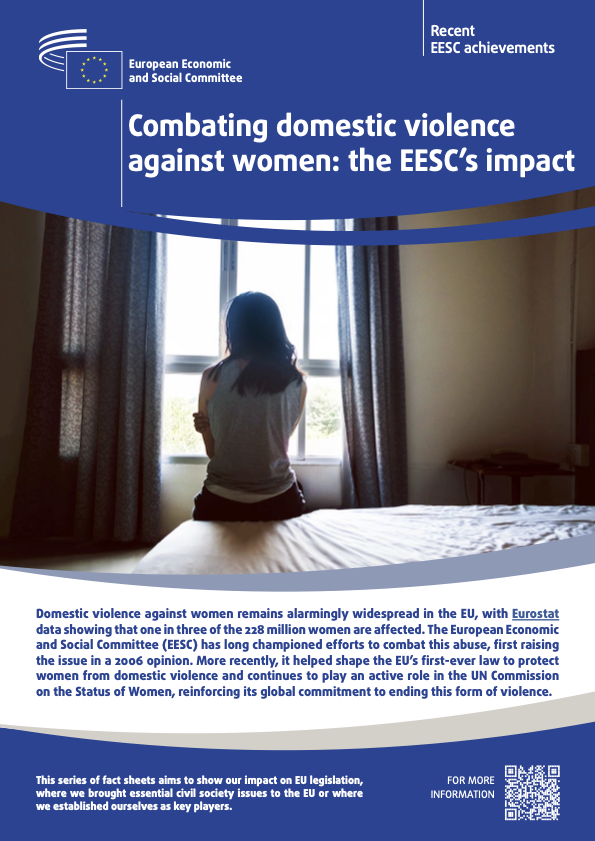
Combating Domestic Violence Against Women: The EESC’s impact

Domestic violence against women remains alarmingly widespread in the EU, with Eurostat data showing that one in three of the 228 million women are affected. The European Economic and Social Committee (EESC) has long championed efforts to combat this abuse, first raising the issue in a 2006 opinion. More recently, it helped shape the EU’s first-ever law to protect women from domestic violence and continues to play an active role in the UN Commission on the Status of Women, reinforcing its global commitment to ending this form of violence.

The first ever EU-wide legislation to fight violence against women and domestic violence.

In 2024, the EU adopted the first ever law to combat violence against women. The EESC directly contributed to this EU directive, which incorporated key provisions of our opinion:

  • a comprehensive definition of violence: the directive criminalises various forms of violence against women, such as female genital mutilation and cyber violence, aligning with the EESC’s call for a broad definition;

  • adopting an intersectional approach: the directive acknowledges the greater vulnerability of certain groups, including women with disabilities and migrant women, and calls for tailored support measures;

  • enhanced support services: the directive provides for specialised support services for victims, in line with the EESC’s emphasis on comprehensive victim support.

In addition, the EU set up the 116 016 EU-wide helpline number for victims of violence against women.

The EU directive not only criminalises various forms of violence, but also provides for the creation of victim support services and mandatory training for law enforcement, along with preventive measures such as awareness campaigns and educational programs. It also ensures cross-border cooperation and protection for victims, with legal procedures that are harmonised across EU Member States.

Member States will have until 14 June 2027 to transpose the directive into their national law and policy.

Strengthening EU measures:

The EESC recently adopted a further opinion, which identifies shortcomings in the directive and seeks to further strengthen EU-wide measures. It calls for:

  • a broader definition of violence against women (institutional violence, prostitution, chemical submission, pornography, etc.);

  • violence against women to be added to the list of EU crimes;

  • comprehensive sexuality education at all stages of education;

  • specific focus on women with disabilities and other vulnerable groups.

Taking action on the global stage

The Committee’s participation in the 69th session of the UN Commission on the Status of Women (UNCSW) provided an opportunity to reiterate the EESC’s position and recommendations on the issue of equality of women and the fight against gender-based violence. The EESC called for the direct involvement of civil society organisations in shaping national and regional plans to end violence against women. The political declaration adopted at the end of the session reaffirmed the global commitment to gender equality, including the commitment to end gender-based violence.

Looking ahead

The EESC remains committed to combating domestic violence and violence against women in general. It will continue its efforts to have newly emerging forms of violence recognised in the EU, such as ‘sexual digital forgeries’ or ‘deepfakes’. In June 2025, the EESC also adopted a resolution on Supporting the Declaration of principles for a gender-equal society, backing the European Commission’s Roadmap for Women’s Rights. This will guide the Committee’s policy agenda on gender equality in the long term.

  European Economic and Social Committee, 2025. 2p.