Open Access Publisher and Free Library
SOCIAL SCIENCES.jpeg

SOCIAL SCIENCES

Social sciences examine human behavior, social structures, and interactions in various settings. Fields such as sociology, psychology, anthropology, and economics study social relationships, cultural norms, and institutions. By using different research methods, social scientists seek to understand community dynamics, the effects of policies, and factors driving social change. This field is important for tackling current issues, guiding public discussions, and developing strategies for social progress and innovation.

Posts in social sciences
The Gilded Years

By Karin Tanabe

Passing meets The House of Mirth in this “utterly captivating” (Kathleen Grissom, New York Times bestselling author of The Kitchen House) historical novel based on the true story of Anita Hemmings, the first black student to attend Vassar, who successfully passed as white—until she let herself grow too attached to the wrong person.

Since childhood, Anita Hemmings has longed to attend the country’s most exclusive school for women, Vassar College. Now, a bright, beautiful senior in the class of 1897, she is hiding a secret that would have banned her from admission: Anita is the only African-American student ever to attend Vassar. With her olive complexion and dark hair, this daughter of a janitor and descendant of slaves has successfully passed as white, but now finds herself rooming with Louise “Lottie” Taylor, the scion of one of New York’s most prominent families.

Though Anita has kept herself at a distance from her classmates, Lottie’s sphere of influence is inescapable, her energy irresistible, and the two become fast friends. Pulled into her elite world, Anita learns what it’s like to be treated as a wealthy, educated white woman—the person everyone believes her to be—and even finds herself in a heady romance with a moneyed Harvard student. It’s only when Lottie becomes infatuated with Anita’s brother, Frederick, whose skin is almost as light as his sister’s, that the situation becomes particularly perilous. And as Anita’s college graduation looms, those closest to her will be the ones to dangerously threaten her secret.

Set against the vibrant backdrop of the Gilded Age, an era when old money traditions collided with modern ideas, Tanabe has written an unputdownable and emotionally compelling story of hope, sacrifice, and betrayal—and a gripping account of how one woman dared to risk everything for the chance at a better life.

Sydney, Australia. Simon and Schuster. 2022. 382p.

read
The Lost Pianos of Siberia

By Sophy Roberts

From acclaimed journalist Sophy Roberts, a journey through one of the harshest landscapes on earth―where music reveals the deep humanity and the rich history of Siberia


Siberia’s story is traditionally one of exiles, penal colonies and unmarked graves. Yet there is another tale to tell.

Dotted throughout this remote land are pianos―grand instruments created during the boom years of the nineteenth century, as well as humble, Soviet-made uprights that found their way into equally modest homes. They tell the story of how, ever since entering Russian culture under the westernizing influence of Catherine the Great, piano music has run through the country like blood.

How these pianos traveled into this snow-bound wilderness in the first place is testament to noble acts of fortitude by governors, adventurers and exiles. Siberian pianos have accomplished extraordinary feats, from the instrument that Maria Volkonsky, wife of an exiled Decembrist revolutionary, used to spread music east of the Urals, to those that brought reprieve to the Soviet Gulag. That these instruments might still exist in such a hostile landscape is remarkable. That they are still capable of making music in far-flung villages is nothing less than a miracle.

The Lost Pianos of Siberia is largely a story of music in this fascinating place, fol-lowing Roberts on a three-year adventure as she tracks a number of different instruments to find one whose history is definitively Siberian. Her journey reveals a desolate land inhabited by wild tigers and deeply shaped by its dark history, yet one that is also profoundly beautiful―and peppered with pianos.

NY. Grove Press. 2020. 410p.

read
In the Name of Rome: The Men who Won the Roman Empire

By Adrian Goldsworthy

The complete and definitive history of how Roman generals carved out the greatest and longest-lasting empire the world has ever seen. The Roman army was one of the most effective fighting forces in history. The legions and their commanders carved out an empire which eventually included the greater part of the known world. This was thanks largely to the generals who led the Roman army to victory after victory, and whose strategic and tactical decisions shaped the course of several centuries of warfare. This book, by the author of THE PUNIC WARS, concentrates on those Roman generals who displayed exceptional gifts of leadership and who won the greatest victories. With 26 chapters covering the entire span of the Roman Empire, it is a complete history of Roman warfare.

London. Phoenix. 2014. 464p.

read
Beethoven's Hair

By Russell Martin

The basis for the movie of the same name, an astonishing tale of one lock of hair and its amazing travels–from nineteenth-century Vienna to twenty-first-century America.

When Ludwig van Beethoven lay dying in 1827, a young musician named Ferdinand Hiller came to pay his respects to the great composer, snipping a lock of Beethoven’s hair as a keepsake–as was custom at the time–in the process. For a century, the lock of hair was a treasured Hiller family relic, until it somehow found its way to the town of Gilleleje, in Nazi-occupied Denmark. There, it was given to a local doctor, Kay Fremming, who was deeply involved in the effort to help save hundreds of hunted and frightened Jews.

After Fremming’s death, his daughter assumed ownership of the lock, and eventually consigned it for sale at Sotheby’s, where two American Beethoven enthusiasts, Ira Brilliant and Che Guevara, purchased it in 1994. Subsequently, they and others instituted a series of complex forensic tests in the hope of finding the probable causes of the composer’s chronically bad health, his deafness, and the final demise that Ferdinand Hiller had witnessed all those years ago. The results, revealed for the first time here, are the most compelling explanation yet offered for why one of the foremost musicians the world has ever known was forced to spend much of his life in silence.

In Beethoven’s Hair, Russell Martin has created a rich historical treasure hunt, a tale of false leads, amazing breakthroughs, and incredible revelations. This unique and fascinating book is a moving testament to the power of music, the lure of relics, the heroism of the Resistance movement, and the brilliance of molecular science.

NY. Broadway Books. 2000. 276p.

read
SPQR: A History of Ancient Rome

By Mary Beard

In SPQR, an instant classic, Mary Beard narrates the history of Rome "with passion and without technical jargon" and demonstrates how "a slightly shabby Iron Age village" rose to become the "undisputed hegemon of the Mediterranean" (Wall Street Journal). Hailed by critics as animating "the grand sweep and the intimate details that bring the distant past vividly to life" (Economist) in a way that makes "your hair stand on end" (Christian Science Monitor) and spanning nearly a thousand years of history, this "highly informative, highly readable" (Dallas Morning News) work examines not just how we think of ancient Rome but challenges the comfortable historical perspectives that have existed for centuries. With its nuanced attention to class, democratic struggles, and the lives of entire groups of people omitted from the historical narrative for centuries, SPQR will to shape our view of Roman history for decades to come.

New York. Liveright Publishing. 2015. 606p.

read
Kropotkin's Revolutionary Pamphlets

Edited with Introduction, Biographical Sketch and Notes by Roger N. Baldwin

From the introduction:” Kropotkin's confidence in the capacity of mankind to achieve such a socicty may seem naive. But evidence is not lacking, even in this violent and confused era, to sustain a belief in it. Personal freedom, voluntary association, and democratic control of power are still vital forces in political thought and practical struggles.”

NY. Dover. 1970. 137p.

read
Interrogating Popular Culture: Deviance, Justice, and Social Order

Edited By Sean E. Anderson and Gregory J. Howard

When ti first appeared in 1993, the Journalof CriminalJustice and Popular Culture was breaking ground in more ways than one. At that point,the idea of electronicpublication was still innovative in itself, but more adventurous still was the whole notion of a serious academic journal devotedto the interaction of criminal justice and popular culture. Historically, criminologists and criminal justice scholars had usually viewed themselves a s objective social scientists whose highest goal was to analyze the problems of crime and deviance in terms of rigorous quantitative or qualitative research, which often meant denouncing the vulgarand harmfulmyths presented by the m e d i aa n dpopular culture. From the 1970s, however, newer scholarship, influenced by media research and particularly the cultural studies movement, showed how impos- sible it was to frame problems without paying due attention to the role of popular culture, which performed s o crucial a role in shaping the social and political attitudes not merely of the "uninformed masses," but also of legisla- tors, experts and policymakers.

Harrow and Heston Publishers Guilderland. New York. 1998. 144p.

download
Countenance of Truth: The United Nations and the Waldheim Case

By Shirley Hazzard

From the introduction: “Nations from time to time assume that it is allowable and inevitable for them to fall upon each other on some pretext or other.“ So the historian Jakob Burckhardt wrote, more than a century ago, at the onset of the Franco-Prussian War—warning that “the most ominous thing is not the pre­sent war, but the era of wars upon which we have entered.” In the same fateful year of 1870, Gustave Flaubert wrote to George Sand: “Within a century, shall we see millions of men kill each other at one go?* The acceleration and inco­herence of social and economic change, the transformations wrought by scientific discovery, the growth of populations, and of their enfranchised discontent—all these raised, in the minds of reflective men and women, a sense of moving toward some dread culmination, propelled by factors never before present in human etpcrience. Over these apprehen­sions, the discrepancy between the narrow thinking of states­men and the huge scale of the mounting crisis cast—as it does today—the shadow of a prodigious incongruity.”

NY. Viking Penguin. 1990. 196p.

read
Framework for Federal Scientific Integrity Policy and Practice

United States. White House Office

From the Executive Summary: "The 2021 Presidential Memorandum on Restoring Trust in Government Through Scientific Integrity and Evidence-Based Policymaking charges OSTP to (1) review agency scientific integrity policy effectiveness and (2) to develop a framework for regular assessment and iterative improvement of agency scientific integrity policies and practices (Framework). This document builds on the review published in January 2022 by the National Science and Technology Council (NSTC) entitled 'Protecting the Integrity of Government Science', which identified good agency practices on scientific integrity and areas in need of consistency across agencies. This Framework includes key resources for agencies as they work to develop and improve scientific integrity policies, practices, and culture. The Framework reflects input from the interagency Scientific Integrity Task Force and other key Federal officials, and includes considerations from public input. [...] The goal of this Framework is to assist agencies across the Federal Government as they take next steps together to strengthen, implement, and institutionalize scientific integrity policy, practice, and culture. Figure 1 illustrates the process by which agencies can take to use the components of this Framework with the goal of making iterative improvements over time."

White House: www.whitehouse.gov/. 2023. 68p.

download
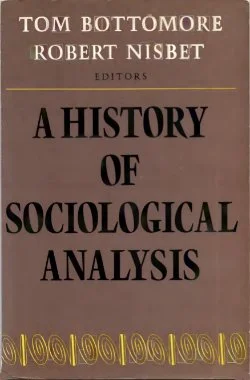
A History Of Sociological Analysis

Edited by Tom Bottomore & Robert Nisbet

From the cover: This landmark contribution to the history of social thought, edited by two of the world’s leading sociologists, contains spe­cially commissioned contributions by seventeen internationally renowned scholars. These authoritative essays provide the most comprehensive account of the development of sociological anal­ysis available. “It will undoubtedly become the standard reference on the sub­ject.” “Generally excellent... a valuable contribution [which] can be read with profit both by diverse specialists and by students with little familiarity with the history of social thought."

NY. Basic Books. 1978. 715p. THIS BOOK CONTAINS MARK-UP

read
Hermes the Thief: The Evolution of Myth

By Norman O. Brown

From the Preface: This study of the Greek god Hermes explores the hy­pothesis that the interrelation of Greek mythology and Greek history is much closer than has generally been recognized. Such a hypothesis seems almost inescap­able in the face of the radical transformation that the attributes and personality of Hermes underwent during the archaic period of Greek history. What I have sought to do here is to correlate these changes with the revo­lution in economic techniques, social organization, and modes of thought that took place in Athens between the Homeric age and the fifth century b.c. Such a cor­relation, I submit, casts new light on the mythology of Hermes, and especially on the Homeric Hymn to Hermes.

NY. Vintage. 1947. 1969. 183p.

read
Greek Mythology

By Sonia Soul. Art by Michael Lacinere. Translation by Philip Kamp.

From the introduction: “.Intellect is the gift of the human race, the greatest and most enduring of all. This is the means by which it perceives, exists, creates and evolves, No matter haw extensive knowledge is, it has its limits. Intellect thirsts for fulfillment, to ceaselessly push these limits outward. Thus, people in that far-off period wanted to learn for they felt powerless and vulnerable in a world without bounds. They were deeply concerned with the beginning and the end and all the supernatural forces that could not be mastered. Through intellect, humanity came to fashion its view of the world. Utilizing the raw information from its immediate surroundings, it cultivated knowledge and experience, while imagination filled in the rest. Mankind had need of "Myth" because that was his own personal truth. His path in this increased his certitude about the world he had created around himelf. This is how we have come to accept the myth. In its conventional sense, that is, a narration that informs us about an older order of the world and explains it. The content of Greek mythology is not a simple matter. There is a practically endless series of accounts from various periods, and derivations on which  an  enormous classificatory endeavor has been expended and that is only the beginning. ...”

Athens. Techni. 1998. 118p.

read
The Evolution of Culture in Animals

By John Tyler Bonner. Original drawings by Margaret La Farge.

From the cover: “On the one hand, there is culture and on the other, biology; moreover, We (the people) have the former, and They (the animals) have the latter. Or so it is often said. Recently, however, the distinction has been blurred, as sociobi­ologists have become strikingly successful in interpreting complex animal social behavior in evolutionary (hence, biological) terms. Spurred by this success, several people have begun taking a new and controversial look at human culture, presupposing that it may also be strongly biological in some sense. In this simply written, brief yet elegant book, biologist Bonner looks in the other direction: he argues that many nonhuman animals experience culture, in one form or another.” —David P. Barash, The American Scientist

Princeton. Princeton University Press. 1990. 203p.

read
Eros And Civilization: A Philosophical Inquiry into Freud

By Herbert Marcuse

Philosophical critiques of psychoanalysis have been rare. Almost all of those that have appeared hitherto have been either undisguised attacks or, equally evidently, defenses. This one takes psychoanalysis seriously but not as unchallengeable dogma. Eros and Civilization is a stirring book and a cheering (though in no sense naive) book. Except for Ernest Jones’ two notable books on Freud and his life, this strikes the reviewer as the most significant general treatment of psychoanalytic theory since Freud himself ceased publication.”—Clyde Kluckhohn in The New York Times

London. Beacon Press. 1966. 293p. CONTAINS MARK-UP

read
The Division of Labor In Society

By Emile Durkheim

Translated by George Simpson. From the Preface: The need for an English translation of Emile Durkheim’s De la division du travail social has long been felt. The first great work of a man who controlled French social thought for almost a quarter of a century and whose influence is now waxing rather than waning, it remains today, both from an historical and contextual standpoint, a book that must be read by all who profess some knowledge of social thought and some interest in social problems. First published in 1893 with the subtitle, Etude sur VOrganisation des Societes Superieures, and a dedica­tion “A Mon Cher Maitre, M. Emile Boutroux, Hommage respectueux et reconnaissatit,” it has gone through five editions, the last having been brought out in 1926, nine years after Durkheim’s death. The second edition appeared in 1902 with the now classic preface, Quelques Remarques sur les Groupements professionnels.The third edition appeared in 1907, the fourth in 1911.

In the second and subsequent editions Durkheim omitted many pages from the long introduction which he wrote for the first. I feel, however, that this introduction is fundamental to an understanding of Durkheim’s position and valuable in itself, besides being indispensable to an appreciation of a study which Durkheim had again turned to in his last years and which he considered his crowning work, the science of ethics. Conse­quently, I have appended it at the end of this volume. Nowhere else, except in the first French edition (now out of print), can this, Durkheim’s early development of the idea of a science of ethics, be found. Hence I consider it a great boon to sociological scholarship that I was enabled to have this first edition at my disposal, and present it to an English- speaking audience.

NY. The Free Press. 1964. 451p. THIS BOOK CONTAINS MARK-UP

read
A Dictionary Of Symbols

Byj. E. Cirlot

Translated from the Spanish by Jack Sage. Foreword by Herbert Read. Symbolism was an essential part of the ancient art of the Orient and of the medieval tradition in the West. It has been lately revived in the study of the unconscious, both directly in the field of dreams, visions and psycho-analysis, and indirectly in art and poetry. At the same time, the Gestalt theory of Kohler and Koffka, in pointing out the autonomy of ‘facts and expression’ and the parallel between the physical and the spiritual, has given renewed significance to the ancient principle of the Tabula smaragdina,‘What is above is what is below’. The basic aim of this work is to create a ‘cen­tre’ of general reference for sym- bological studies by clarifying the un­varying essential meaning of every symbol. The author uses the com­parative method, specifying the precise sources of information taken from a great number of widely vary­ing fields. This new edition of J.E. Cirlot’s book incorporates extensive revisions from the first edition of 1962.

NY. Philosophical Library, Inc. 1962. 497p.

read
Dictionary of Biology

Editorial director. Michael Upshall

From amino acids to zygotes, this book will give you a quick and easy reference to all life-science terms. Written for the general reader, this dictionary contains the essential facts about life-sciences, alphabetically arranged to put the facts at your fingertips.

Oxford. Helicon Publishing. Brockhampton Press. 1997. 228p.

read
Descent Of Man And Selection In Relation To Sex

By Charles Darwin

From the Introduction: “The nature of the following work will be best understood by a brief account of how it came to be written. During many years I collected notes on the origin or descent of man, without any intention of publishing on the subject, but rather with the determination not to publish, as I thought that I should thus only add to the prejudices against my views. It seemed to me sufficient to indicate, in the first edition of my 'Origin of Species that by this work light would be thrown on the origin of man and his history and this implies that man must be included with other organic beings in any general conclusion respecting his manner of appearanco on this earth. Now the case wears a wholly different aspect. When a naturalist like Carl Vogt ventures to say in his address as President of the National Institution of Geneva (1869),… it is manifest that at least a large number of naturalists must admit that species are the modified descendants of other species; and this especially holds good with the younger and rising naturalists. The greater number accept the agency of natural selection; though some urge, whether with justice the future must decide, that I have greatly overrated its importance. Of the older and honoured chiefs in natural science, many unfortunately are still opposed to evolution in overy form.:.”

London. John Murray 1901. 1062p.

download
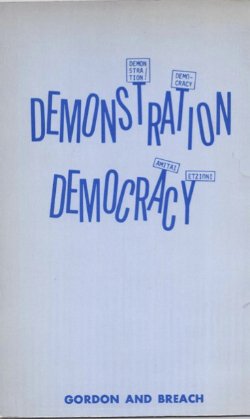
Demonstration Democracy

By Amitai Etzioni

From the Preface: “Most Americans tend to view their society as well advanced, politically stable and not very violent, although sophisticated observers point out to Americans that violence is frequently present in this country. Presidential assassinations, lynchings, abuses of police powers, threats and violence against negroes and blacks, and the violence and shootings in the newly settled western territories in the 19th century and early 20th century all indicate that violence was and still is common in the United States. We will probably never be able to answer the question whether the United States is a violent country; such a simple, naive question is obviously unanswerable. It seems safe to say that different nations are characterized by more and less violence; there are some nations that exhibit more incidence of violence and others have less; placing the United States in its proper place along this continuum would be a costly and difficult piece of social research. Whatever is the answer to this question, it is clear that many Americans, both politicians and ordinary citizens, were deeply disturbed by the demonstrations and violence of the mid-to-late 1960’s. For many reasons Lyndon Johnson appointed the President’s National Commission on the Causes and Prevention of Violence; the task of the Commis­sion was clear, to help us gain an understanding and to help us prevent the commission of violent acts.”

NY. Gordon and Breach, Science Publishers. 1970. 115p.

read
Culture And Anarchy

By Matthew Arnold. Edited by J. Dover Wilson

From the cover: Manifesting the special intelligence of a literary critic of original gifts, Culture and Anarchy is still a living classic. It is addressed to the flexible and the disinterested, to those who are not committed to the findings of their particular discipline, and it assumes in its reader a critical intelligence that will begin its work with the reader himself. Arnold employs a delicate and stringent irony in an examination of the society of his time: a rapidly expanding industrial society, just beginning to accustom itself to the changes in its institutions that the pace of its own development called for. Coming virtually at the end of the decade (1868) and immediately prior to W. E. Forster’s Education Act, Culture and Anarchy phrases with a particular cogency the problems that find their centre in the questions: what kind of life do we think individuals in mass societies should be assisted to lead? How may we best ensure that the quality of their living is not impoverished? Arnold applies himself to the detail of his time: to the case of Mr Smith ‘who feared he would come to poverty and be eternally lost’, to the Reform agitation, to the commercial values that working people were encouraged to respect, and to the limitations of even the best Rationalist intelligence. The degree of local reference is therefore high, but Professor Dover Wilson’s introduction and notes to this edition supply valuable assistance to a reader fresh to the period. And they are informed by the respect and perceptive affection that Professor Dover Wilson brings to the work of Matthew Arnold as a whole.

London. Cambridge University Press. 1963. 270p.

read