Open Access Publisher and Free Library
SOCIAL SCIENCES.jpeg

SOCIAL SCIENCES

Social sciences examine human behavior, social structures, and interactions in various settings. Fields such as sociology, psychology, anthropology, and economics study social relationships, cultural norms, and institutions. By using different research methods, social scientists seek to understand community dynamics, the effects of policies, and factors driving social change. This field is important for tackling current issues, guiding public discussions, and developing strategies for social progress and innovation.

The Organization Man

By William H. Whyte

Regarded as one of the most important sociological and business commentaries of modern times, The Organization Man developed the first thorough description of the impact of mass organization on American society. During the height of the Eisenhower administration, corporations appeared to provide a blissful answer to postwar life with the marketing of new technologies—television, affordable cars, space travel, fast food—and lifestyles, such as carefully planned suburban communities centered around the nuclear family. William H. Whyte found this phenomenon alarming.

As an editor for Fortune magazine, Whyte was well placed to observe corporate America; it became clear to him that the American belief in the perfectibility of society was shifting from one of individual initiative to one that could be achieved at the expense of the individual. With its clear analysis of contemporary working and living arrangements, The Organization Man rapidly achieved bestseller status.

Since the time of the book's original publication, the American workplace has undergone massive changes. In the 1990s, the rule of large corporations seemed less relevant as small entrepreneurs made fortunes from new technologies, in the process bucking old corporate trends. In fact this "new economy" appeared to have doomed Whyte's original analysis as an artifact from a bygone day. But the recent collapse of so many startup businesses, gigantic mergers of international conglomerates, and the reality of economic globalization make The Organization Man all the more essential as background for understanding today's global market. This edition contains a new foreword by noted journalist and author Joseph Nocera. In an afterword Jenny Bell Whyte describes how The Organization Man was written.

NY. Penguin. 1956. 387p.

read
A Journal of the Plague Year

In 1665 the plague swept through London, claiming over 97,000 lives. Daniel Defoe was just five at the time of the plague, but he later called on his own memories, as well as his writing experience, to create this vivid chronicle of the epidemic and its victims. A Journal (1722) follows Defoe's fictional narrator as he traces the devastating progress of the plague through the streets of London. Here we see a city transformed: some of its streets suspiciously empty, some—with crosses on their doors—overwhelmingly full of the sounds and smells of human suffering. And every living citizen he meets has a horrifying story that demands to be heard.

For more than seventy years, Penguin has been the leading publisher of classic literature in the English-speaking world. With more than 1,700 titles, Penguin Classics represents a global bookshelf of the best works throughout history and across genres and disciplines. Readers trust the series to provide authoritative texts enhanced by introductions and notes by distinguished scholars and contemporary authors, as well as up-to-date translations by award-winning translators.By Daniel Defoe. Introduction by Anthony Burgess.

NY. London. Penguin. 1722.

read
A Portrait of India

A monumental biography of the Indian subcontinent from the award-winning author of The World Is What It Is: The Authorized Biography of V. S. Naipaul.
 
Second only to China in the magnitude of its economic miracle and second to none in its potential to shape the new century, India is fast undergoing one of the most momentous transformations the world has ever seen. In this dazzlingly panoramic book, Patrick French chronicles that epic change, telling human stories to explain a larger national narrative. With a familiarity and insight few Westerners could approach, he provides a vital corrective to the many outdated notions about a uniquely dynamic and consequential nation.By Ted Mheta

NY. Penguin. 1957. 590p.

read
The Power Elite

First published in 1956, The Power Elite stands as a contemporary classic of social science and social criticism. C. Wright Mills examines and critiques the organization of power in the United States, calling attention to three firmly interlocked prongs of power: the military, corporate, and political elite. The Power Elite can be read as a good account of what was taking place in America at the time it was written, but its underlying question of whether America is as democratic in practice as it is in theory continues to matter very much today.

What The Power Elite informed readers of in 1956 was how much the organization of power in America had changed during their lifetimes, and Alan Wolfe's astute afterword to this new edition brings us up to date, illustrating how much more has changed since then. Wolfe sorts out what is helpful in Mills' book and which of his predictions have not come to bear, laying out the radical changes in American capitalism, from intense global competition and the collapse of communism to rapid technological transformations and ever changing consumer tastes. The Power Elite has stimulated generations of readers to think about the kind of society they have and the kind of society they might want, and deserves to be read by every new generation.By C. Wright Mills

NY. Oxford University Press. 1956. 414p.

read
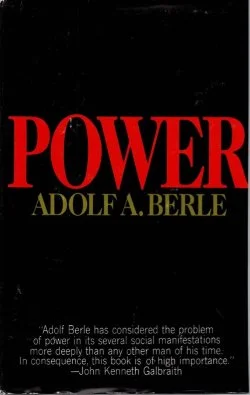
Power

By Adolfe A. Berle

People live in contexts of power. Here are Berle's Laws of Power

“The "0th" rule . . . . "Power is always preferable to chaos.

Rule One: Power invariably fills any vacuum in human organization.

Rule Two: Power is invariably personal.

Rule Three: Power is invariably based on a system of ideas or philosophy. Absent such a system or philosophy, the institutions essential to power cease to be reliable, power ceases to be effective, and the power holder is eventually displaced.

Rule Four: Power is exercised through, and depends on, institutions. By their existence, they limit, come to control, and eventually confer or withdraw power.

Rule Five: Power is invariably confronted with, and acts in the presence of, a field of responsibility. The two constantly interact, in hostility or co-operation, in conflict or through some form of dialog, organized or unorganized, made part of, or perhaps intruding into, the institutions on which power depends.

Berle' explanation of these rules, with context and stories, makes a fascinating and, I believe, quite useful read. I think anyone who cares about what "power" means can learn from and profit from this book.

New York. Harcourt, Brace & World, Inc.

read
The Presentation Of Self In Everyday Life

This book explores the realm of human behavior in social situations and the way that we appear to others. Each person in everyday social intercourse presents himself and his activity to others, attempts to guide and control the impressions they form of him, and employs certain techniques in order to sustain his performance, just as an actor presents a character to an audience.By Erving Goffman

NY. Anchor. 1959. 269p.

read
The Protestant Ethic And The Spirit Of Capitalism

An abridged edition to include: The Problem - Religious Affiliation & Social Stratification - The Spirit of Capitalism - Luther's Conception of the Calling - Task of the Investigation - The Practical Ethics of the Ascetic Branches of Protestantism - The Religious Foundations of Worldly Asceticism - Asceticism and the Spirit of Capitalism - EndnotesBy Max Weber. Translated by Talcott Parsons.

NY. .Charles Scribners. 1958. THIS BOOK CONTAINS MARK-UP

read/download
Psycho-Myth, Psycho-History: Essays in Applied Psychoanalysis. Vol.1.

By Ernest Jones

Jones was active in establishing the American Psychoanalytic Association (1911). He wrote monographs on the study of suggestion, symbolism, character formation, and obsessional neuroses; those works were collected in Papers on Psycho-Analysis (1913). After his return to London in 1913 he practiced psychoanalysis.

NY. Hillstone. 1974. 392p.

read
An Elementary Textbook of Psychoanalysis

By Charles Brenner

This standard introduction to psycho-analysis has been thoroughly revised to clarify and refine the concepts presented, and two new chapters have been added. Comprehensive and lucid, Dr. Brenner's volume is the indispensable orientation to the subject for both laymen and students.

NY. Doubleday Anchor. 1955. CONTAINS MARK-UP

read
Psycho-Myth, Psycho-History: Essays in Applied Psychoanalysis. Vol.2.

By Ernest Jones

Jones was active in establishing the American Psychoanalytic Association (1911). He wrote monographs on the study of suggestion, symbolism, character formation, and obsessional neuroses; those works were collected in Papers on Psycho-Analysis (1913). After his return to London in 1913 he practiced psychoanalysis.

NY. Hillstone. 1974. 392p.

read
The Rules Of Sociological Method

First published in 1895: Emile Durkheim’s masterful work on the nature and scope of sociology—now with a new introduction and improved translation by leading scholar Steven Lukes.

The Rules of the Sociological Method is among the most important contributions to the field of sociology, still debated among scholars today. Through letters, arguments, and commentaries on significant debates, Durkheim confronted critics, clarified his own position, and defended the objective scientific method he applied to his study of humans. This updated edition offers an introduction and extra notes as well as a new translation to improve the clarity and accessibility of this essential work.

In the introduction, Steven Lukes, author of the definitive biography Emile Durkheim: His Life and Work, spells out Durkheim’s intentions, shows the limits of Durkheim’s view of sociology, and presents its political background and significance. Making use of the various texts in this volume and Durkheim’s later work, Lukes discusses how Durkheim’s methodology was modified or disregarded in practice—and how it is still relevant today.

With substantial notes on context, this user-friendly edition will greatly ease the task of students and scholars working with Durkheim’s method—a view that has been a focal point of sociology since its original publication. The Rules of the Sociological Method will engage a new generation of readers with Durkheim’s rich contribution to the field.By Emile Durkheim

NY. The Free Press. 1938. 204p. CONTAINS MARK-UP

DOWNLOAD
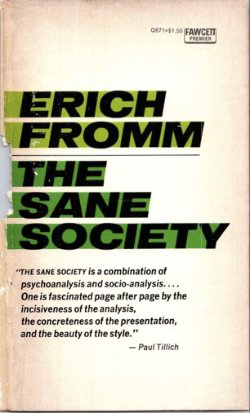
The Sane Society

The Sane Society is a continuation and extension of the brilliant psychiatric concepts Erich Fromm first formulated in Escape from Freedom; it is also, in many ways, an answer to Freud's Civilization and its Discontents.

Fromm examines man's escape into overconformity and the danger of robotism in contemporary industrial society: modern humanity has, he maintains, been alienated from the world of their own creation. Here Fromm offers a complete and systematic exploration of his "humanistic psychoanalysis." In so doing, he counters the profound pessimism for our future that Freud expressed and sets forth the goals of a society in which the emphasis is on each person and on the social measures designed to further function as a responsible individual.By Erich Fromm

Greenwich, Conn. Fawcfett. 1955. 314p.

read
The Social Process

By Charles Horton Cooley

This work has been selected by scholars as being culturally important, and is part of the knowledge base of civilization as we know it. This work was reproduced from the original artifact, and remains as true to the original work as possible. Therefore, you will see the original copyright references, library stamps (as most of these works have been housed in our most important libraries around the world), and other notations in the work.

This work is in the public domain in the United States of America, and possibly other nations. Within the United States, you may freely copy and distribute this work, as no entity (individual or corporate) has a copyright on the body of the work.

As a reproduction of a historical artifact, this work may contain missing or blurred pages, poor pictures, errant marks, etc. Scholars believe, and we concur, that this work is important enough to be preserved, reproduced, and made generally available to the public. We appreciate your support of the preservation process, and thank you for being an important part of keeping this knowledge alive and relevant.

NY. Scribners. 1922. 416p. CONTAINS MARK-UP

DOWNLOAD
Social Statics

By Herbert Spencer

This work has been selected by scholars as being culturally important, and is part of the knowledge base of civilization as we know it. This work was reproduced from the original artifact, and remains as true to the original work as possible. Therefore, you will see the original copyright references, library stamps (as most of these works have been housed in our most important libraries around the world), and other notations in the work.

NY. Appleton. 1901. 432p.

download
The Sociology of George Simmel

Translated, Edited, And With An Introduction By Kurth. Wolff

Georg Simmel rejected the organicist theories of Auguste Comte and Herbert Spencer and German historical tradition. He believed that society is an intricate web of multiple relations between individuals who are in constant interaction. He introduced the term sociation to describe and analyze particular forms of human interaction and their crystallization in-group characteristics. He emphasized the study of forms of interaction and this approach gave impetus to the rise of formal sociology. Georg Simmel's concept of social types was complementary to his concept of social forms. He used the example of 'The Stranger' to explain his social type, which is someone who has a particular place in society within the social group that the person has entered. Simmel stressed both the connection as well as the tensions between the individual and society, arguing that an individual is both a product of society and the link in all-social processes that take place in society. His dialectical approach brings out the dynamic interlink ages as well as conflicts that exist between social units in a society. Georg Simmel argued that conflict is an essential and complementary aspect of consensus or harmony in society. He made a distinction between social appearances and social realities, and argued that in pre-modern societies the relationships of subordination and superordination between master and servant, between employer and employee involved the total personalities of individuals. In capitalist modern society, the concept of freedom emerges and the domination of employer on employee, master on servant becomes partial. In modern societies, individualism emerges in societies with an elaborate division of labor and a number of intersecting social circles, but human beings are surrounded by objects that put constraint on them and dominate their individual needs and desires. Simmel warned that in modern societies, individuals will be frozen into social functions and the price of the objective perfection of the world will be the atrophy of the human soul.

New York Collier-Macmillan. 1950. 496p. CONTAINS MARK-UP

DOWNLOAD
The Strategy of Conflict

By Thomas C. Schelling

A series of closely interrelated essays on game theory, this book deals with an area in which progress has been least satisfactory—the situations where there is a common interest as well as conflict between adversaries: negotiations, war and threats of war, criminal deterrence, extortion, tacit bargaining. It proposes enlightening similarities between, for instance, maneuvering in limited war and in a traffic jam; deterring the Russians and one's own children; the modern strategy of terror and the ancient institution of hostages.

London. Oxford University Press. 1960. 301p.

read
The Structure of Scientific Revolutions. Second Edition

By Thomas S. Kuhn

Thomas Kuhn was a graduate student in theoretical physics at Harvard, close to finishing his dissertation for his PhD, when he was asked to teach an experimental college course on science for non-scientists. It was his first real taste of the history of science, and it changed his life.

To his surprise, the course altered some of his basic assumptions about science, and the result was a big shift in his career plans from physics to the history and then philosophy of science. In his mid-30s he wrote a book on Copernicus, and five years later produced The Structure of Scientific Revolutions. A monograph of only 170 pages, the book sold over a million copies, was translated into 24 languages, and became one of the most cited works of all time in both the natural and social sciences. Its success was highly unusual for an academic work, and was a shock to Kuhn himself. 

The work is shortish because it was originally composed with the aim of being a long article in the Encylopedia of Unified Science. Once published, this article was expanded into a separate book. This limitation turned out to be a blessing, as he was prevented from going into lengthy and difficult scientific detail, making the book just readable for the layman.

Why has the Structure made such a huge impact? If its message has been restricted to science itself the work would still be very important, but it is the generic idea of ‘paradigms’, in which one world view replaces another, that has been considered valuable across so many areas of knowledge. Indeed, at several points in the book Kuhn touches on the fact that paradigms exist not only in science, but are the natural human way of comprehending the world. The roots of the book lay in an experience Kuhn had reading Aristotle, when he realised that Aristotle’s laws of motion were not just ‘bad Newton’, but a completely different way of seeing the world.

Chicaco. The University Ofchicago Press. 1970. 217p. CONTAINS MARK-UP

read
The Americans: The National Experience

By Daniel J. Boorstin

This book is a historical look at the people who became "The Americans." Main subject headings: The Versatiles: New Englanders, The Transients: Joiners, The Upstarts: Boosters, The Rooted and the Uprooted: Southerners, White and Black, The Vagueness of the Land, American Ways of Talking, Search for Symbols, A Spacious Republic. This second volume in “The Americans” trilogy deals with the crucial period of American history from the Revolution to the Civil War. Here we meet the people who shaped, and were shaped by, the American experience—the versatile New Englanders, the Transients and the Boosters. 

NY. Random House. 1965. 515p.

read
The Feminine Mystique

By Betty Friedan

The Feminine Mystique begins with an introduction describing what Friedan called "the problem that has no name"—the widespread unhappiness of women in the 1950s and early 1960s. It discusses the lives of several housewives from around the United States who were unhappy despite living in material comfort and being happily married with fine children. "[The Feminine Mystique] now feels both revolutionary and utterly contemporary. Four decades later, millions of individual transformations later, there is still so much to learn from this book. Those who think of it as solely a feminist manifesto ought to revisit its pages to get a sense of the magnitude of the research and reporting Friedan undertook" (Anna Quindlen). Named by TIME Magazine as one of the 100 best and most influential non-fiction books since 1923.

NY. Dell. 1963. 375p.

read