
By Tina Won Sherman
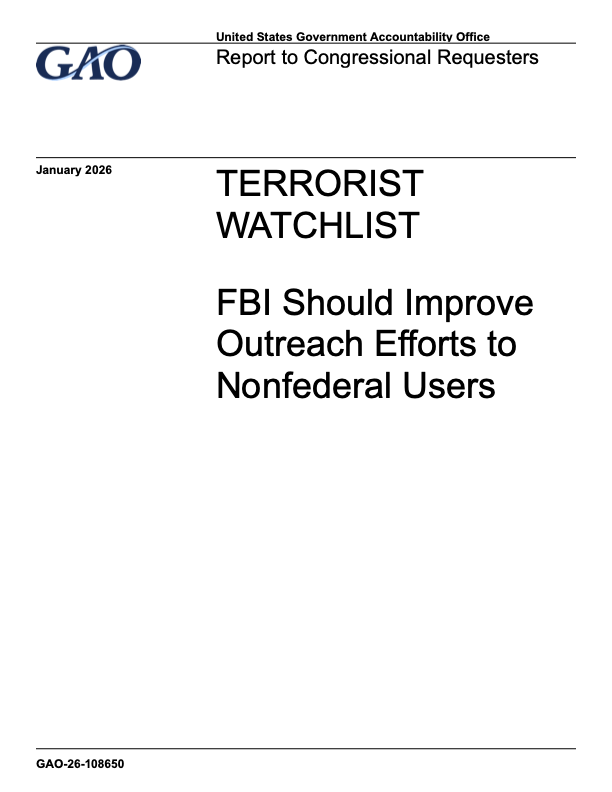
Why GAO Did This Study The Threat Screening Center, administered by FBI, is responsible for managing the terrorist watchlist. In recent years, Members of Congress have raised questions about how nonfederal entities use the terrorist watchlist. GAO was asked to examine the use of the terrorist watchlist by nonfederal law enforcement entities. This report examines (1) nonfederal entities’ reporting of terrorist watchlist encounters to FBI and opportunities for improvement and (2) steps FBI has taken to ensure nonfederal entities’ awareness of watchlist policies through outreach and state-led trainings. GAO reviewed watchlist policies and training resources for nonfederal entities and collected encounter data for fiscal years 2019 through 2024. GAO interviewed nonfederal law enforcement officials in four states selected based on the number of encounters and other factors. While not generalizable, these interviews provided insights into officials’ awareness of policies and training. This is the public version of a sensitive report GAO issued in August 2025. Information on encounter data and official FBI instructions on handling watchlist encounters that FBI deemed sensitive has been omitted.What GAO Recommends GAO recommends that FBI (1) seek information to understand the extent to which nonfederal law enforcement entities are consistently reporting terrorist watchlist encounters, (2) develop a communication plan to improve its outreach efforts, and (3) develop a process to review state efforts to instruct NCIC users about watchlist policies. FBI concurred with the recommendations.
By Dmytro Bukhanevych, Rayan Succar, Maurizio Porfiri
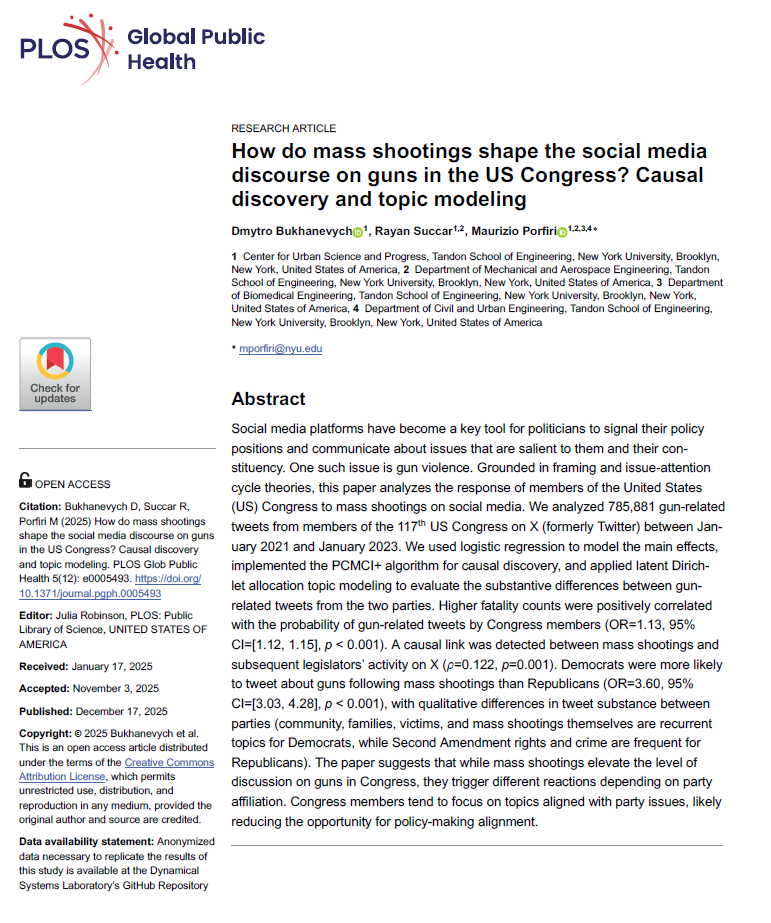
Social media platforms have become a key tool for politicians to signal their policy positions and communicate about issues that are salient to them and their constituency. One such issue is gun violence. Grounded in framing and issue-attention cycle theories, this paper analyzes the response of members of the United States (US) Congress to mass shootings on social media. We analyzed 785,881 gun-related tweets from members of the 117th US Congress on X (formerly Twitter) between January 2021 and January 2023. We used logistic regression to model the main effects, implemented the PCMCI+ algorithm for causal discovery, and applied latent Dirichlet allocation topic modeling to evaluate the substantive differences between gun-related tweets from the two parties. Higher fatality counts were positively correlated with the probability of gun-related tweets by Congress members (OR=1.13, 95% CI=[1.12, 1.15], p < 0.001). A causal link was detected between mass shootings and subsequent legislators’ activity on X (ρ=0.122, p=0.001). Democrats were more likely to tweet about guns following mass shootings than Republicans (OR=3.60, 95% CI=[3.03, 4.28], p < 0.001), with qualitative differences in tweet substance between parties (community, families, victims, and mass shootings themselves are recurrent topics for Democrats, while Second Amendment rights and crime are frequent for Republicans). The paper suggests that while mass shootings elevate the level of discussion on guns in Congress, they trigger different reactions depending on party affiliation. Congress members tend to focus on topics aligned with party issues, likely reducing the opportunity for policy-making alignmen
PLOS Global Public Health, Dec. 2025.