Open Access Free Library
TERRORISM.jpeg

TERRORISM

Terrorism-Domestic-International-Radicalization-War-Weapons-Trafficking-Crime-Mass Shootings

Posts in punishment
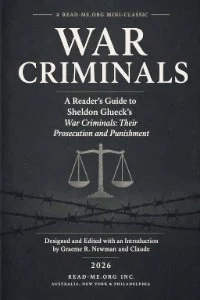
War Criminals: Their Prosecution and Punishment (Mini-Classic)

A Reader’s Guide to Sheldon Glueck’s WAR CRIMINALS: Their Prosecution and Punishment (Read-Me.Org Mini-Classics) by Graeme R. Newman

The book that predicted Nuremberg — a year before it happened.

In September 1944, with the outcome of the war no longer in doubt but the fate of its architects still unresolved, Harvard criminologist Sheldon Glueck sat down to answer a question no Allied government had yet settled: what do you actually do with the men who ordered the century's worst atrocities?

His answer — War Criminals: Their Prosecution and Punishment — argued for an international court built on customary law rather than a treaty that didn't yet exist, individual liability regardless of rank or official position, and a sharply narrowed defense of "just following orders." Fourteen months later, the Nuremberg Charter adopted nearly all of it, in places almost word for word.

This Read-Me.Org Mini-Classic is your guide to that forgotten argument. Inside:

  • Who Glueck really was — an immigrant criminologist, not an international lawyer, and how he got there

  • The failed 1919 Leipzig trials that haunted his every recommendation

  • His chapter-by-chapter case against sovereign immunity, "acts of State," and superior orders

  • The direct line from his 1944 proposals to Nuremberg, the Eichmann trial, the Pinochet case, and the modern International Criminal Court

  • Review questions for classroom or study-group use

Book One in the Read-Me.Org Mini-Classics series — short, faithful guides to significant but neglected books, for readers who want the argument without the 250 footnoted pages.

This is an independent reader's guide and critical companion. It is not a reprint of the original 1944 text; no claim is made as to that text's current copyright status.

Read-Me.Org Inc. New York-Philadelphia-Australia. 2026. p. 69p.
War Criminals: Their Prosecution and Punishment

by Sheldon Glueck

First published in 1944, War Criminals: Their Prosecution and Punishment by Harvard professor Sheldon Glueck is a landmark examination of one of the defining legal questions of the Second World War: how should those responsible for atrocities and violations of the laws of war be brought to justice?

Written while the war was still raging, Glueck examines the historical and legal foundations for prosecuting war criminals, the liability of political and military leaders, superior orders, international criminal courts, appropriate forms of trial, and the principles governing punishment and correction. The book also considers the failures of attempts to prosecute German war criminals after the First World War and argues for a more effective international system of justice.

Both a historical document and an important contribution to the development of international criminal law, this book captures the legal thinking that helped prepare the ground for the postwar prosecution of Nazi leaders and the emergence of modern international criminal justice.

New York Knopf. 1944. 261p.

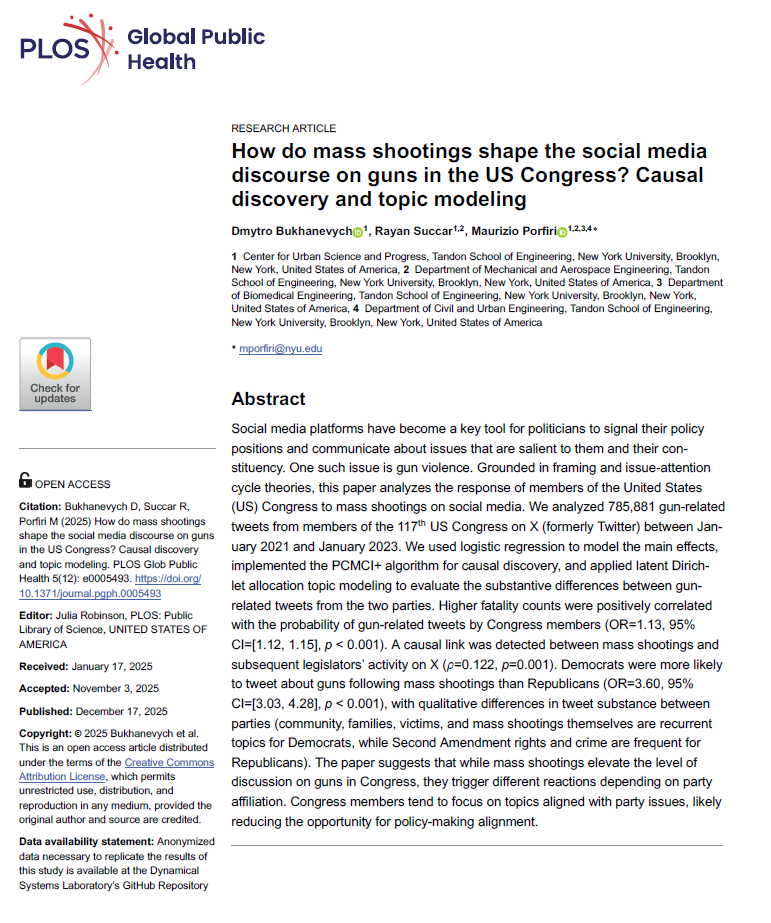
How do mass shootings shape the social media discourse on guns in the US Congress? Causal discovery and topic modeling

By Dmytro Bukhanevych, Rayan Succar, Maurizio Porfiri

Social media platforms have become a key tool for politicians to signal their policy positions and communicate about issues that are salient to them and their constituency. One such issue is gun violence. Grounded in framing and issue-attention cycle theories, this paper analyzes the response of members of the United States (US) Congress to mass shootings on social media. We analyzed 785,881 gun-related tweets from members of the 117th US Congress on X (formerly Twitter) between January 2021 and January 2023. We used logistic regression to model the main effects, implemented the PCMCI+ algorithm for causal discovery, and applied latent Dirichlet allocation topic modeling to evaluate the substantive differences between gun-related tweets from the two parties. Higher fatality counts were positively correlated with the probability of gun-related tweets by Congress members (OR=1.13, 95% CI=[1.12, 1.15], p < 0.001). A causal link was detected between mass shootings and subsequent legislators’ activity on X (ρ=0.122, p=0.001). Democrats were more likely to tweet about guns following mass shootings than Republicans (OR=3.60, 95% CI=[3.03, 4.28], p < 0.001), with qualitative differences in tweet substance between parties (community, families, victims, and mass shootings themselves are recurrent topics for Democrats, while Second Amendment rights and crime are frequent for Republicans). The paper suggests that while mass shootings elevate the level of discussion on guns in Congress, they trigger different reactions depending on party affiliation. Congress members tend to focus on topics aligned with party issues, likely reducing the opportunity for policy-making alignmen

PLOS Global Public Health, Dec. 2025.