
Open Access Publisher and Free Library
TERRORISM.jpeg

TERRORISM

Terrorism-Domestic-International-Radicalization-War-Weapons-Trafficking-Crime-Mass Shootings

Posts in Transnational
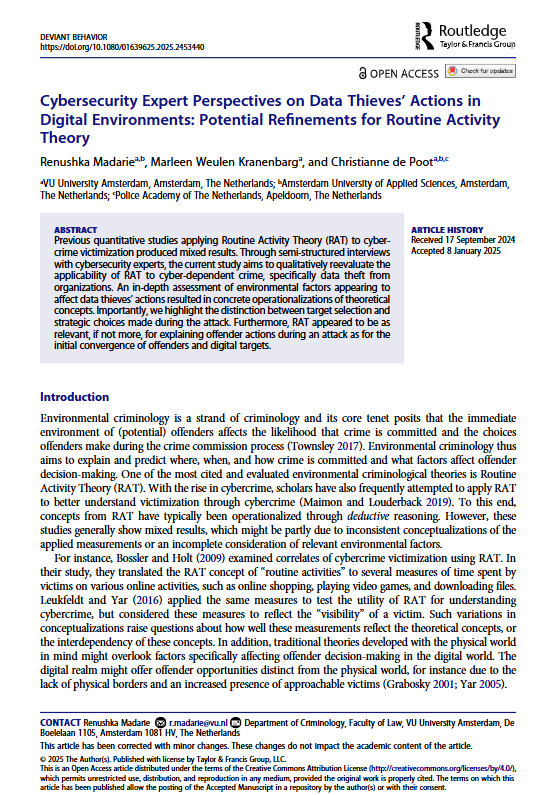
Cybersecurity Expert Perspectives on Data Thieves’ Actions in Digital Environments: Potential Refinements for Routine Activity Theory

By Renushka Madarie, Marleen Weulen Kranenbarg&Christianne de Poot


Previous quantitative studies applying Routine Activity Theory (RAT) to cybercrime victimization produced mixed results. Through semi-structured interviews with cybersecurity experts, the current study aims to qualitatively reevaluate the applicability of RAT to cyber-dependent crime, specifically data theft from organizations. An in-depth assessment of environmental factors appearing to affect data thieves’ actions resulted in concrete operationalizations of theoretical concepts. Importantly, we highlight the distinction between target selection and strategic choices made during the attack. Furthermore, RAT appeared to be as relevant, if not more, for explaining offender actions during an attack as for the initial convergence of offenders and digital targets.


DEVIANT BEHAVIOR 2025

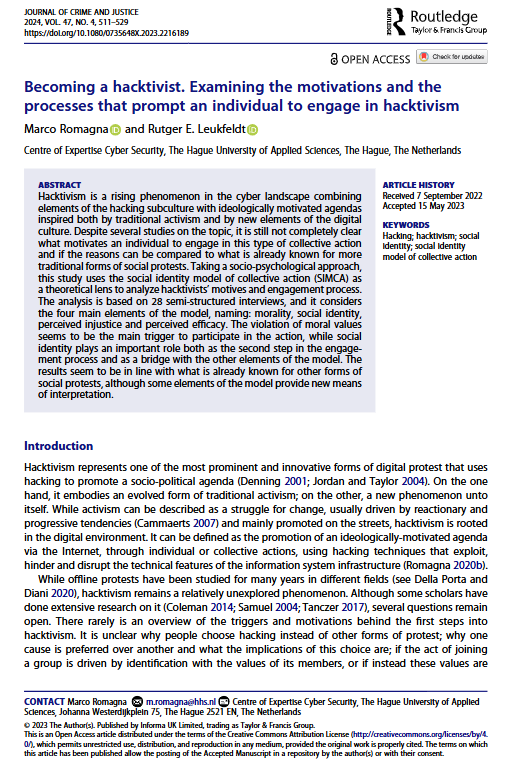
Becoming a hacktivist. Examining the motivations and the processes that prompt an individual to engage in hacktivism

By Marco Romagna &Rutger E. Leukfeldt

Hacktivism is a rising phenomenon in the cyber landscape combining elements of the hacking subculture with ideologically motivated agendas inspired both by traditional activism and by new elements of the digital culture. Despite several studies on the topic, it is still not completely clear what motivates an individual to engage in this type of collective action and if the reasons can be compared to what is already known for more traditional forms of social protests. Taking a socio-psychological approach, this study uses the social identity model of collective action (SIMCA) as a theoretical lens to analyze hacktivists’ motives and engagement process. The analysis is based on 28 semi-structured interviews, and it considers the four main elements of the model, naming: morality, social identity, perceived injustice and perceived efficacy. The violation of moral values seems to be the main trigger to participate in the action, while social identity plays an important role both as the second step in the engagement process and as a bridge with the other elements of the model. The results seem to be in line with what is already known for other forms of social protests, although some elements of the model provide new means of interpretation.

JOURNAL OF CRIME AND JUSTICE 2024, VOL. 47, NO. 4, 511–529

Transnational Dynamics In Violent Outcomes For Protest Movements: A Rapid Evidence Assessment

Aims

This review seeks to synthesise existing research on transnational mechanisms and processes to provide insights into the factors that shape protest-extremism dynamics to address the following primary research questions::

  1. What increases the vulnerability of protest mobilisations to transnational actors (states, violent movements, individuals) promoting violence across borders?

  2. What factors constrain the potential for violence, radicalisation, and terrorism in transnational social movements/ mobilisations?

  3. Under what conditions do alliances between social movements and international actors lead to an increased potential for violence? What characteristics of both types of actors contribute to this dynamic?

  4. What are the mechanisms of influence between transnational and local protest mobilisations?

Methodology 

This research uses a rapid evidence assessment (REA) approach, synthesising knowledge on specific topics in line with the research questions from published journal articles, book chapters, reports, and dissertations, including both academic and “grey” literature (e.g., government and think tank reports).

The REA adopted a streamlined methodology using keyword searches of major social science databases, after which identified documents were screened for inclusion based on pre-determined eligibility criteria.

Key findings 

The literature on both transnational protests and transnational interactions with local movements or protests does not significantly differ from the core findings of the previous two Rapid Evidence Assessments in this series which focused on social movement insights into violent protests (Salman, Marsden, Lewis, 2025) and interdisciplinary research into individual-level processes that shape radicalisation and violence related to protests (Peterscheck, Marsden & Salman, 2025). Earlier findings that remain highly relevant to transnational processes include:

  • Movement schism and fragmentation may increase potential for violence.

  • Exposure to misinformation influences protest dynamics in ways which can increase the danger of violent escalation.

  • The potential for counter-messaging to be counter-productive by producing unintended effects like reinforcing commitment to pre-existing positions, enhancing grievances like perceived discrimination, and reinforcing identities.

  • Digital platforms play a role in forging collective identities, including or especially transnational ones.

  • Fringe political movements are associated with increased acceptance of political violence.

  • Identity fusion, especially in relation to perceived threats against a group, increases the salience of group identity and individual commitment to actions in support or defence of the group, even at cost to the individual.

  • Perceptions of existential threats, discrimination, collective angst, and shared grievances can intensify group identity.

The social movement literature has developed a significant body of work on transnational movements. The key insights from the social movement and interdisciplinary literature on violence and protests also help to interpret cross-border influences. Transnational perspectives primarily add another layer of interaction, mutual influence, and opportunities for resource sharing and mobilisation. However, the mediating factors that influence contemporary social movement mobilisations, including new technology and the role of social media and their influence on violence have received less attention. This is particularly the case when violence is informed by local events and dynamics, but is influenced by transnational actors and processes. This suggests a broader gap to be filled by future research on the questions outlined in this report. 

London: CREST, The Centre for Research and Evidence on Security Threats , 2025. 48p.