Open Access Publisher and Free Library
TERRORISM.jpeg

TERRORISM

Terrorism-Domestic-International-Radicalization-War-Weapons-Trafficking-Crime-Mass Shootings

Posts in Violence and Oppression
Domestic Terrorism: An Overview

By Jerome P. Bjelopera

The emphasis of counterterrorism policy in the United States since Al Qaeda’s attacks of September 11, 2001 (9/11) has been on jihadist terrorism. However, in the last decade, domestic terrorists—people who commit crimes within the homeland and draw inspiration from U.S.-based extremist ideologies and movements—have killed American citizens and damaged property across the country. Not all of these criminals have been prosecuted under federal terrorism statutes, which does not imply that domestic terrorists are taken any less seriously than other terrorists. The Department of Justice (DOJ) and the Federal Bureau of Investigation (FBI) do not officially designate domestic terrorist organizations, but they have openly delineated domestic terrorist “threats.” These include individuals who commit crimes in the name of ideologies supporting animal rights, environmental rights, anarchism, white supremacy, anti-government ideals, black separatism, and beliefs about abortion

Washington, DC: Congressional Research Service, 2017. 62p.

download
Small Arms Survey 2010: Gangs, Groups, and Guns

By Small Arms Survey

As demonstrated in the Samll Arms Survey 2010, addressing the factors that trigger conflicts and fuel gang vioence has a much more lasting---and constructive---impact than simply incarcerating or marginalizing members of street gangs and armed groups.' Executive Director, United Nations Office on Drugs and Crime. `The Small Arms Survey 2010 provides further evidence that efforts to address gangs and gangs violence must encompass a wide range of measures---including not only targeted law enforcement tactics and illicit gun interdiction, but also prevention and youth development initiatives. In the long term, we must address the factors that lead young people to join gangs in the first place.'

Cambridge, UK: Cambridge University Press, 2010. 352p.

download
Small Arms Survey 2007: Guns and the City

By Small Arms Survey

The Small Arms Survey 2007: Guns and the City offers new and updated information on small arms production, stockpiles, transfers, and measures, including a special focus on transfer controls. This year’s thematic section explores the complex issue of urban violence with case studies on Burundi and Brazil as well as a photo essay by award-winning combat photographer Lucian Read. This edition also features chapters on lessons learned from the tracing of ammunition, the relationship between gun prices and conflict, and the role of small arms in South Sudan.

Geneva: Small Arms Survey, 2007. 360p.

download
The Small Arms Survey 2013: Everyday Dangers

By Small Arms Survey

The Small Arms Survey 2013: Everyday Dangers explores the many faces of armed violence outside the context of conflict. Chapters on the use of firearms in intimate partner violence, the evolution of gangs in Nicaragua, Italian organized crime groups, and trends in armed violence in South Africa describe the dynamics and effects of gun violence in the home and on the street. The ‘weapons and markets’ section draws attention to the use of specific weapons by particular armed actors, such as drug-trafficking organizations and insurgents. The section includes chapters on the prices of arms and ammunition at illicit markets in Lebanon, Pakistan, and Somalia; illicit weapons recovered in Mexico and the Philippines; and the impacts of improvised explosive devices on civilians. Chapters on the Second Review Conference of the UN Programme of Action and the ammunition demilitarization industry round out the 2013 volume.

Cambridge, UK: Cambridge University Press, 2013. 335p.

download
Measuring Illicit Arms Flows: Niger

By Savannah de Tessières

Measuring Illicit Arms Flows: Niger examines the measurement of illicit arms flows in Niger in the context of the UN Sustainable Development Goals (SDGs), specifically SDG 16. Based on field research conducted in Niger, the Briefing Paper maps the national and international bodies that collect data relevant to monitoring the evolution of illicit arms flows in and through Niger. It also discusses the relevance of Indicator 16.4.2 and suggests ways to improve the monitoring of progress towards the achievement of SDG Target 16.4 in Niger, and more widely in Africa

Geneva: Small Arms Survey, Graduate Institute of International and Development Studies, 2017. 12p.

download
Web Trafficking: Analysing the Online Trade of Small Arms and Light Weapons in Libya

By N.R. Jenzen-Jones and Ian McCollum

Access to arms and munitions in Libya continues to be critical to both non-state and state-supported armed groups across the ideological spectrum, as well as to individuals. Firearms play an important role in everyday life for many Libyans, often serving a dual-purpose role for those associated with militia units. Regardless of their affiliation, many Libyans keep firearms to defend their homes and businesses, and for personal protection outside the home. Distrust of the rival governments; their militias; the police and armed forces; and various tribal, ethnic, and other groups is widely expressed.1 These sentiments are echoed in mainstream media reporting and academic research from 2012 to the present.

Geneva: Small Arms Survey, Graduate Institute of International and Development Studies, 2017. 112p.

download
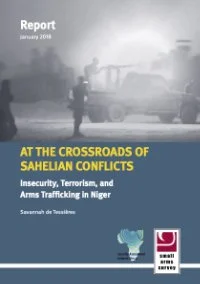
At the Crossroads of Sahelian Conflicts: Insecurity, Terrorism, and Arms Trafficking in Niger

By Savannah de Tessières

This Report from the Small Arms Survey’s Security Assessment in North Africa (SANA) project examines insecurity, terrorism, and trafficking in Niger.The Sahel hosts multiple conflicts with myriad armed actors destabilizing the entire region. Positioned at the heart of this region, Niger sits at the crossroads of terrorism, trafficking, and conflict. The Nigerien state has great difficulty in guaranteeing domestic security, which has a devastating impact on social and economic development, in addition to it reinforcing tensions and fueling local conflicts. Older tensions become locked into new insecurity dynamics, such as terrorism, further complicating any future resolutions. Armed banditry, trafficking of weapons and drugs, violent community disputes, and the rise in terrorist attacks are all symptomatic of the State’s struggles. At the Crossroads of Sahelian Conflicts: Insecurity, Terrorism, and Arms Trafficking in Niger, authored by Savannah de Tessières, a senior consultant to the Survey, draws on extensive fieldwork in the regions of Agadez, Diffa, and Niamey. This included examinations of arms and ammunition seized across the country, as well as dozens of interviews with national and international government and security officials, civil society representatives, gold diggers, former rebels, and other experts.

Geneva: Small Arms Survey, Graduate Institute of International and Development Studies, 2008. 114p.

download
From Legal to Lethal: Converted Firearms in Europe

By Nicolas Florquin and Benjamin King

Criminals purchase weapons unable to fire live ammunition legally and at low costs across Europe, converting them into lethal firearms with little to no training or expertise. The Small Arms Survey report From Legal to Lethal: Converted Firearms in Europe provides a detailed examination on the topic. Users of converted firearms include petty criminals, organized crime groups, and terrorist actors. Certain conversion techniques require some level of technical skills, but converters also make use of online, open-source tutorials to convert weapons relatively easily. While Europe has faced a range of converted weapons over the past decades, two main types of readily convertible firearms have entered into the illicit arms market in recent years: Slovak-origin acoustic expansion weapons (AEWs)—as used by Amedy Coulibaly in the Montrouge and Hypercacher Paris attacks in 2015; and Turkish-manufactured alarm pistols—currently the most prevalent converted firearm in Europe.

Geneva: Small Arms Survey, Graduate Institute of International and Development Studies, 2018. 70p.

download
Weapons Compass: Mapping Illicit Small Arms Flows in Africa

By Nicolas Florquin, Sigrid Lipott, Francis Wairagu

In the first-ever continental analysis of illicit arms flows in Africa, the African Union Commission and the Small Arms Survey identify the scale, availability, characteristics, and supply patterns of illicit small arms in Africa. The African Union (AU) Master Roadmap of Practical Steps to Silence the Guns in Africa by Year 2020 was adopted in January 2017 and sets out practical steps to address the underlying drivers of conflict as well as the tools and enablers of violence. Preventing the illicit flows of weapons within Africa, including to conflict zones, is a vital component of the AU Roadmap, and this report aims to provide AU member states with a synthesis of relevant information on the topic. Weapons Compass: Mapping Illicit Small Arms Flows in Africa finds that cross-border trafficking by land is the most prominent type of illicit arms flow affecting countries on the continent. The weapons trafficked comprise both those sourced from within the continent—such as legacy weapons recycled from earlier conflicts and weapons diverted from national stockpiles—as well as arms sourced from other parts of the world, including embargo-breaking transfers from the Middle East and Eastern Europe. The report provides practical recommendations for AU member states to tackle illicit arms flows by noting specific assessments that can be generated to fill knowledge gaps; practical guidance and tools to develop; and ways in which to support and coordinate the implementation of those recommended actions.

Geneva: Small Arms Survey, Graduate Institute of International and Development Studies, 2019. 100[p.

download
Making the Rounds: Illicit Ammunition in Ukraine

By Matt Schroeder and Olena Shumska

Making the Rounds: Illicit Ammunition in Ukraine finds that thousands of hand grenades, rockets, mortar rounds, landmines, and tins of firearms cartridges have proliferated throughout Ukraine, including to areas located far from the conflict zone in the east. Presenting findings from a comprehensive review of imagery and information on illicit ammunition trafficked to, from, and within Ukraine, the report includes an analysis of markings on more than 1,600 seized hand grenades, shoulder-fired rockets, ammunition tins, and anti-personnel landmines. The report reveals the types and sources of illicit ammunition in the country, as well as the modes of transport and smuggling techniques used by Ukrainian arms traffickers and their co-conspirators abroad. The analysis shows that the overwhelming majority of the 1,600 items analyzed were Soviet-designed models produced in Eastern European and Soviet factories prior to the dissolution of the USSR. Curbing the threat to local and regional security posed by this ammunition requires a long-term, coordinated effort by Ukrainian authorities and the international community.

Geneva: Small Arms Survey, 2021. 68p.

download
The West Africa–Sahel Connection: Mapping Cross-border Arms Trafficking

ByFiona Mangan and Matthias Nowak

This Briefing Paper from the Small Arms Survey maps cross-border arms trafficking in West Africa and the Sahel through case studies on Niger, Mali, Guinea-Bissau, and the two tri-border areas of Burkina Faso–Côte d’Ivoire–Mali, and Ghana–Côte d’Ivoire–Burkina Faso. The study reveals that highly organized trafficking networks move sizable arms quantities across large areas of land north of the Niger River. Arms trafficking south of the river is more characterized by lower-level arms flows and local intermediaries engaging in so-called ‘ant trade’. Actors range from long-established criminals, corrupt officials, and organized trafficking rings, to tribal networks and low-level transporters. Based on field research, The West Africa–Sahel Connection: Mapping Cross-border Arms Trafficking analyzes the links between illicit arms trafficking and other forms of trafficking and organized crime in the region. The study also looks into the impacts of such arms trafficking as well as the responses to it.

Geneva: Small Arms Survey, 2019. 24p.

download
Stray Bullets: The Impact of Small Arms Misuse in Central America

By William Godnick, with Robert Muggah and Camilla Waszink

This paper provides a review of the impact of small arms and light weapons in Central America in the years following the end of the armed hostilities of the 1980s and early 1990s. In this instance, ‘Central America’ refers to the Spanish-speaking countries of the isthmus—Costa Rica, Honduras, El Salvador, Guatemala, Nicaragua, and Panama. The definition of small arms and light weapons used here is the one set out by the UN (1997), and covers a wide range of weaponry, including commercial firearms and military weapons that can be used by an individual soldier or small crew.1 ‘Small arms’, ‘firearms’, and ‘weapons’ are used more or less interchangeably in the paper. Military and civilian firearms are the principal focus, but because of the type of violence affecting present-day Central America, other weapons such as hand grenades and home-made pistols are also discussed. Homicide rates, and more specifically firearm-related homicide rates, are the primary indicators used to gauge the impact of weapons on Central American societies. Other indicators given more anecdotal consideration here include armed crime and injury rates, the growth in the private security industry, the costs of firearm-related violence to the public health system, the impact of such crimes on the economy and the effects of armed violence on governance in remote rural areas.

Geneva: Small Arms Survey, Graduate Institute of International Studies, 2002. 51p.

download
Missing Pieces: Directions for reducing gun violence through the UN process on small arms control

By Kate Buchanan

This publication identifies a number of areas where additional steps are needed to tackle the availability and misuse of small arms. It points to promising policy initiatives, draws on lessons learned, and sets out recommendations for action. The main themes addressed are:- Preventing misuse- Controlling supply- Providing assistance to survivors of gun violence- Focusing on gender- Taking guns and ammunition out of circulation- Addressing the demand for small arms- Justice and security sector governance. This publication is designed specifically for government representatives, to provide a compelling people-centred agenda for the next phase of multilateral small arms activity, and will be widely distributed in the lead-up to the UN Review Conference on small arms.

Cambridge, UK: Cambridge University Press, 2005. 162p.

download
Gun-Running in Papua New Guinea: From Arrows to Assault Weapons in the Southern Highlands

By Philip Alpers

This field study focuses on PNG's Southern Highlands Province, a conspicuous hot spot for armed violence and gun-related injury. It provides a preliminary tally of illegal high-powered guns in parts of the province seen as particularly vulnerable to armed violence, and documents the profound disruption wrought by their misuse. Tribal fighters, mercenary gunmen, and criminals provide details of their illicit firearms and ammunition, trafficking routes, and prices paid. The most common illegal assault weapon is the Australian-made self-loading rifle, followed by the US-made M16, both of which are sourced primarily from PNG Defence Force stocks. Many of the remainder are AR-15s obtained from the PNG police.

Geneva: Small Arms Survey, 2005. 138p.

download
Triggering Terror: Illicit Gun Markets and Firearms Acquisition of Terrorist Networks in Europe

Edited by Nils Duquet

This edited volume offers an in-depth and detailed insight into Project SAFTE’s research findings. In-depth country studies were conducted in eight EU member states by research teams from the Flemish Peace Institute, SIPRI, SSSA, Arquebus Solutions, Small Arms Survey and Bureau Bruinsma. The in-depth qualitative research methodology involved desk research and semi-structured interviews with key international actors and stakeholders such as Europol, EMPACT Firearms, Interpol, SEESAC and the Office of the EU Counter-Terrorism Coordinator. The volume sheds light on how illegal firearms markets are structured in the EU and shows how terrorists access these.

Brussels: Flemish Peace Institute, 2018. 484p.

download
A Study of Pre-Attack Behaviors of Active Shooters in the United States Between 2000 and 2013

By James Silver; Andre Simons; and Sarah Craun

"In 2017 there were 30 separate active shootings in the United States, the largest number ever recorded by the FBI during a one-year period. With so many attacks occurring, it can become easy to believe that nothing can stop an active shooter determined to commit violence. [...] Faced with so many tragedies, society routinely wrestles with a fundamental question: can anything be done to prevent attacks on our loved ones, our children, our schools, our churches, concerts, and communities? There is cause for hope because there is something that can be done. In the weeks and months before an attack, many active shooters engage in behaviors that may signal impending violence. While some of these behaviors are intentionally concealed, others are observable and -- if recognized and reported -- may lead to a disruption prior to an attack. Unfortunately, well-meaning bystanders (often friends and family members of the active shooter) may struggle to appropriately categorize the observed behavior as malevolent. [...] Once reported to law enforcement, those in authority may also struggle to decide how best to assess and intervene, particularly if no crime has yet been committed. By articulating the concrete, observable pre-attack behaviors of many active shooters, the FBI hopes to make these warning signs more visible and easily identifiable. This information is intended to be used not only by law enforcement officials, mental health care practitioners, and threat assessment professionals, but also by parents, friends, teachers, employers and anyone who suspects that a person is moving towards violence."

Washington, DC: U.S.. Federal Bureau of Investigation, 2018. 30p.

download
Report of Governor Bill Owens' Columbine Review Commission

By Columbine Review Commission

The Commission conducted 15 meetings open to members of the public. The Commission received statements from an extensive list of State and local officials and private persons who had experience with or information concerning the event; Commission staff reviewed thousands of pages of official and unofficial documents, reports, and studies. Two recommendations related to crisis response actions. First, law enforcement policy and training should emphasize that the highest priority of law enforcement officers, after arriving at the scene of a crisis, is to stop any ongoing assault. Second, there should be an increased emphasis on training appropriate personnel in preparation for and responding to large-scale emergencies. Two recommendations pertained to improved communications for critical emergencies. First, law enforcement agencies should plan their communications systems to facilitate crisis communication with other agencies with whom they might reasonably be expected to interface in emergencies. Second, Colorado should continue to develop a single statewide digital trunked communications system. Other categories of recommendations pertained to advance planning for critical emergencies; interaction with media representatives; tasks of school resource officers; detection by school administrators of potential perpetrators of school-based violence and administrative countermeasures; medical treatment for attack victims; reuniting attack victims and their families; identification of victims' bodies and family access to bodies; and suicide prevention in the aftermath of traumatic incidents.

Denver, Colo. : Columbine Review Commission, 2001. 174p.

download
Shooting at Sandy Hook Elementary School

By The Office of the Child Advocate

In January, 2013, the Office of the Child Advocate was directed by the Connecticut Child Fatality Review Panel to prepare a report that would focus on Adam Lanza (hereinafter referred to as AL), and include a review of the circumstances that pre-dated his commission of mass murder at Sandy Hook Elementary School. The charge was to develop any recommendations for public health system improvement that emanated from the review. Authors of this report focused on AL’s developmental, educational, and mental health profile over time, the services he received from various community providers, and ultimately his condition prior to his actions on December 14, 2012. Authors looked for any warning signs, red flags, or other lessons that could be learned from a review of AL’s life. It was not the primary purpose of this investigation to explicitly examine the role of guns in the Sandy Hook shootings. However, the conclusion cannot be avoided that access to guns is relevant to an examination of ways to improve the public health. Access to assault weapons with high capacity magazines did play a major role in this and other mass shootings in recent history. Our emphasis on AL’s developmental trajectory and issues of mental illness should not be understood to mean that these issues were considered more important than access to these weapons or that we do not consider such access to be a critical public health issue.

Hartford, CT : State of Connecticut, Office of the Child Advocate, 2014. 114p.

download
Prior Knowledge of Potential School-Based Violence: Information Students Learn May Prevent a Targeted Attack

By William S. Pollack, William.; Modzeleski, and Rooney, Georgeann

In the wake of several high-profile shootings at schools in the United States, most notably the shootings that occurred at Columbine High School on April 20, 1999, the United States Secret Service (Secret Service) and the United States Department of Education (ED) embarked on a collaborative endeavor to study incidents of planned (or "targeted") violence in the nation's schools. Initiated in 1999, the study, termed the Safe School Initiative (SSI), examined several issues, most notably whether past school-based attacks were planned, and what could be done to prevent future attacks. The SSI findings highlight that in most targeted school-based attacks, individuals, referred to as "bystanders" in this report, had some type of advanced knowledge about planned school violence. Despite this advanced knowledge, the attacks still occurred. This study aimed to further the prevention of targeted school-based attacks by exploring how students with prior knowledge of attacks made decisions regarding what steps, if any, to take after learning the information. The study sought to identify what might be done to encourage more students to share information they learn about potential targeted school-based violence with one or more adults. Six key findings were identified. Given the small sample size and the exploratory nature of the study, generalization from these findings may be limited. The findings are: (1) The relationships between the bystanders and the attackers, as well as when and how the bystanders came upon information about the planned attacks, varied; (2) Bystanders shared information related to a threat along a continuum that ranged from bystanders who took no action to those who actively conveyed the information; (3) School climate affected whether bystanders came forward with information related to the threats; (4) Some bystanders disbelieved that the attacks would occur and thus did not report them; (5) Bystanders often misjudged the likelihood and immediacy of the planned attack; and (6) In some situations, parents and parental figures influenced whether the bystander reported the information related to the potential attack to school staff or other adults in positions of authority,

Washington, DC: United States Secret Service and United States Department of Education, 2008. 15p.

download
Radicalisation, De-Radicalisation, Counter-Radicalisation: A Conceptual Discussion and Literature Review

By Alex P. Schmid

Based on an in-depth literature review, Research Fellow Dr. Alex P. Schmid explores the terms “radicalisation”, “de-radicalisation” and “counter-radicalisation” and the discourses surrounding them. Much of the literature on radicalisation focuses on Islamist extremism and jihadist terrorism. This is also reflected in this Research Paper which explores the relationship between radicalisation, extremism and terrorism. Historically, “radicalism” – contrary to “extremism” – does not necessarily have negative connotations, nor is it a synonym for terrorism. Schmid argues that both extremism and radicalism can only be properly assessed in relation to what is mainstream political thought in a given period. The paper further explores what we know well and what we know less well about radicalisation. It proposes to explore radicalisation not only on the micro-level of “vulnerable individuals” but also on the meso-level of the “radical milieu” and the macro-level of “radicalising public opinion and political parties”. The author reconceptualises radicalisation as a process that can occur on both sides of conflict dyads and challenges several widespread assumptions. The final section examines various counter-radicalisation and deradicalisation programmes. It concludes with a series of policy recommendations.

The Hague: International Centre for Counter-Terrorism, 2013. 105p.

download