By David C. Pyrooz, James A. Densley, Jillian K. Peterson
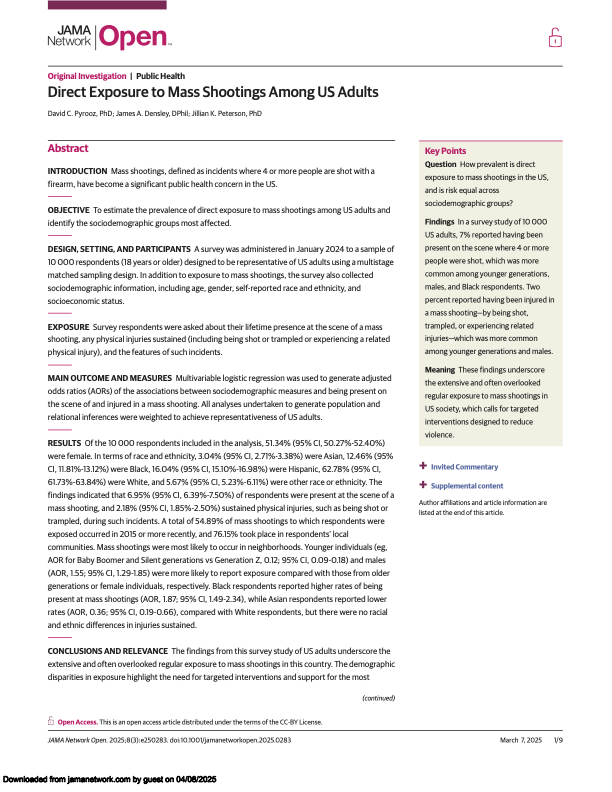
INTRODUCTION Mass shootings, defined as incidents where 4 or more people are shot with a firearm, have become a significant public health concern in the US.
OBJECTIVE To estimate the prevalence of direct exposure to mass shootings among US adults and identify the sociodemographic groups most affected.
DESIGN, SETTING, AND PARTICIPANTS A survey was administered in January 2024 to a sample of 10 000 respondents (18 years or older) designed to be representative of US adults using a multistage matched sampling design. In addition to exposure to mass shootings, the survey also collected sociodemographic information, including age, gender, self-reported race and ethnicity, and socioeconomic status.
EXPOSURE Survey respondents were asked about their lifetime presence at the scene of a mass shooting, any physical injuries sustained (including being shot or trampled or experiencing a related physical injury), and the features of such incidents.
MAIN OUTCOME AND MEASURES Multivariable logistic regression was used to generate adjusted odds ratios (AORs) of the associations between sociodemographic measures and being present on the scene of and injured in a mass shooting. All analyses undertaken to generate population and relational inferences were weighted to achieve representativeness of US adults.
RESULTS Of the 10 000 respondents included in the analysis, 51.34% (95% CI, 50.27%-52.40%) were female. In terms of race and ethnicity, 3.04% (95% CI, 2.71%-3.38%) were Asian, 12.46% (95% CI, 11.81%-13.12%) were Black, 16.04% (95% CI, 15.10%-16.98%) were Hispanic, 62.78% (95% CI, 61.73%-63.84%) were White, and 5.67% (95% CI, 5.23%-6.11%) were other race or ethnicity. The findings indicated that 6.95% (95% CI, 6.39%-7.50%) of respondents were present at the scene of a mass shooting, and 2.18% (95% CI, 1.85%-2.50%) sustained physical injuries, such as being shot or trampled, during such incidents. A total of 54.89% of mass shootings to which respondents were exposed occurred in 2015 or more recently, and 76.15% took place in respondents’ local communities. Mass shootings were most likely to occur in neighborhoods. Younger individuals (eg, AOR for Baby Boomer and Silent generations vs Generation Z, 0.12; 95% CI, 0.09-0.18) and males (AOR, 1.55; 95% CI, 1.29-1.85) were more likely to report exposure compared with those from older generations or female individuals, respectively. Black respondents reported higher rates of being present at mass shootings (AOR, 1.87; 95% CI, 1.49-2.34), while Asian respondents reported lower rates (AOR, 0.36; 95% CI, 0.19-0.66), compared with White respondents, but there were no racial and ethnic differences in injuries sustained. CONCLUSIONS AND RELEVANCE The findings from this survey study of US adults underscore the extensive and often overlooked regular exposure to mass shootings in this country. The demographic disparities in exposure highlight the need for targeted interventions and support for the most affected groups, particularly younger generations and males. Understanding these patterns is essential for addressing the broader impacts of gun violence on public health and community well-being.