Open Access Publisher and Free Library
CRIME+CRIMINOLOGY.jpeg

CRIME

Violent-Non-Violent-Cyber-Global-Organized-Environmental-Policing-Crime Prevention-Victimization

Posts in Gun Violence
Firearm Deaths among Youth in the United States, 2007–2016

By Theodore E. Trigylidas  , Patricia G. Schnitzer  , Heather K. Dykstra  , Gia M. Badolato  , Robert McCarter, Jr. , Monika K. Goyal and Richard Lichenstein 

We sought to compare risk factors contributing to unintentional, homicide, and suicide firearm deaths in children. We conducted a retrospective review of the National Fatality Review Case Reporting System. We included all firearm deaths among children aged 0–18 years occurring from 2007 to 2016. Descriptive analyses were performed on demographic, psychosocial, and firearm characteristics and their relationship to unintentional, homicide, and suicide deaths. Regression analyses were used to compare factors contributing to unintentional vs. intentional deaths. There were 6148 firearm deaths during the study period. The mean age was 14 years (SD ± 4 years), of which 81% were male and 41% were non-Hispanic White. The most common manners of death were homicide (57%), suicide (36%), and unintentional (7%). Over one-third of firearms were stored unlocked. Homicide deaths had a higher likelihood of occurring outside of the home setting (aOR 3.2, 95% CI 2.4–4.4) compared with unintentional deaths. Suicide deaths had a higher likelihood of occurring in homes with firearms that were stored locked (aOR 4.2, 95% CI 2.1–8.9) compared with unintentional deaths. Each manner of firearm death presents a unique set of psychosocial circumstances and challenges for preventive strategies. Unsafe firearm storage practices remain a central theme in contributing to the increased risk of youth firearm deaths. 

Direct Exposure to Mass Shootings Among US Adults 

By David C. Pyrooz,  James A. Densley, Jillian K. Peterson

INTRODUCTION Mass shootings, defined as incidents where 4 or more people are shot with a firearm, have become a significant public health concern in the US.

OBJECTIVE To estimate the prevalence of direct exposure to mass shootings among US adults and identify the sociodemographic groups most affected.

DESIGN, SETTING, AND PARTICIPANTS A survey was administered in January 2024 to a sample of 10 000 respondents (18 years or older) designed to be representative of US adults using a multistage matched sampling design. In addition to exposure to mass shootings, the survey also collected sociodemographic information, including age, gender, self-reported race and ethnicity, and socioeconomic status.

EXPOSURE Survey respondents were asked about their lifetime presence at the scene of a mass shooting, any physical injuries sustained (including being shot or trampled or experiencing a related physical injury), and the features of such incidents.

MAIN OUTCOME AND MEASURES Multivariable logistic regression was used to generate adjusted odds ratios (AORs) of the associations between sociodemographic measures and being present on the scene of and injured in a mass shooting. All analyses undertaken to generate population and relational inferences were weighted to achieve representativeness of US adults.

RESULTS Of the 10 000 respondents included in the analysis, 51.34% (95% CI, 50.27%-52.40%) were female. In terms of race and ethnicity, 3.04% (95% CI, 2.71%-3.38%) were Asian, 12.46% (95% CI, 11.81%-13.12%) were Black, 16.04% (95% CI, 15.10%-16.98%) were Hispanic, 62.78% (95% CI, 61.73%-63.84%) were White, and 5.67% (95% CI, 5.23%-6.11%) were other race or ethnicity. The findings indicated that 6.95% (95% CI, 6.39%-7.50%) of respondents were present at the scene of a mass shooting, and 2.18% (95% CI, 1.85%-2.50%) sustained physical injuries, such as being shot or trampled, during such incidents. A total of 54.89% of mass shootings to which respondents were exposed occurred in 2015 or more recently, and 76.15% took place in respondents’ local communities. Mass shootings were most likely to occur in neighborhoods. Younger individuals (eg, AOR for Baby Boomer and Silent generations vs Generation Z, 0.12; 95% CI, 0.09-0.18) and males (AOR, 1.55; 95% CI, 1.29-1.85) were more likely to report exposure compared with those from older generations or female individuals, respectively. Black respondents reported higher rates of being present at mass shootings (AOR, 1.87; 95% CI, 1.49-2.34), while Asian respondents reported lower rates (AOR, 0.36; 95% CI, 0.19-0.66), compared with White respondents, but there were no racial and ethnic differences in injuries sustained. CONCLUSIONS AND RELEVANCE The findings from this survey study of US adults underscore the extensive and often overlooked regular exposure to mass shootings in this country. The demographic disparities in exposure highlight the need for targeted interventions and support for the most affected groups, particularly younger generations and males. Understanding these patterns is essential for addressing the broader impacts of gun violence on public health and community well-being. 

Initiation Age, Cumulative Prevalence, and Longitudinal Patterns of Handgun Carrying Among Rural Adolescents: A Multistate Study.

By Ali Rowhani-Rahbar, Sabrina Oesterle , Martie L Skinner

Purpose: Adolescent handgun carrying is a behavioral marker for youth interpersonal conflicts and an intervention point for violence prevention. Our knowledge about the epidemiology of adolescent handgun carrying mainly pertains to urban settings. Evidence on the initiation age, cumulative prevalence, and longitudinal patterns of this behavior and on handgun-related norms and peer behavior among male and female rural adolescents is scant.

Methods: We used data from the control arm of the Community Youth Development Study, a community-randomized controlled trial of the Communities That Care prevention system. Annually, 1,039 males and 963 females were surveyed from Grade 6 (2005) to age 19 years (2012) in 12 rural towns across seven U.S. states.

Results: In Grade 6, 11.5% of males and 2.8% of females reported past-year handgun carrying. Between Grade 6 and age 19 years, 33.7% of males and 9.6% of females reported handgun carrying at least once. Among participants who ever reported handgun carrying, 34.0% of males and 29.3% of females did so for the first time in Grade 6. Among participants who ever reported handgun carrying, 54.6% of males and 71.7% of females did so only one time over the seven study assessments. Greater proportions of participants who reported handgun carrying than those who did not do so endorsed prohandgun norms and had a peer who carried among both males (Grade 10: prevalence difference = 57%; 95% CI: 46%-67%) and females (Grade 10: prevalence difference = 45%; 95% CI: 12%-78%).

Conclusions: Rural adolescent handgun carrying is not uncommon and warrants etiologic research for developing culturally appropriate and setting-specific prevention programs.

Prevalence of Adolescent Handgun Carriage: 2002-2019

By: Naoka Carey, Rebekah Levine Coley

Objectives: This study explores the changing prevalence of adolescent handgun carriage, with attention to differences across sociodemographic groups.Methods: Data were drawn from repeated cross-sectional, nationally representative surveys conducted annually from 2002 to 2019, the National Survey on Drug Use & Health. The study sample included adolescents aged 12 to 17 (N = 297 055). Logistic regression models estimated the prevalence of past year handgun carriage across cohort and sociodemographic subgroups. Interactions between 4-time cohorts and other variables explored sociodemographic variability in prevalence rates over time.

Results: Handgun carriage increased significantly, particularly among rural, White, and higher-income adolescents. Carriage increased by 41% over cohorts, with predicted prevalence rates increasing from 3.3% in 2002-2006 to 4.6% in 2015-2019. Across cohorts, rural (5.1%), American Indian/Alaskan Native (5.2%), lower-income (<$20 000; 3.9%), male (5.9%), and older (16-17 years old; 4.5%) adolescents were the most likely to report carriage. However, these patterns changed significantly over time, with White and higher-income adolescents (>$75 000) most likely to carry in the most recent cohorts. Predicted carriage rates increased from 3.1% to 5.3% among White adolescents, from 2.6% to 5.1% among higher-income adolescents, and from 4.3% to 6.9% among rural adolescents between the 2002-2006 and 2015-2019 cohorts. Carriage among Black, American Indian/Alaskan Native, and lower-income adolescents decreased.Conclusions: Adolescent handgun carriage is increasing, concentrated among particular subgroups of youth, and carriage patterns across sociodemographic groups have changed over time. Programs to address the risk of adolescent gun carriage should be tailored to the specific sociocultural and place-based concerns of diverse adolescents.

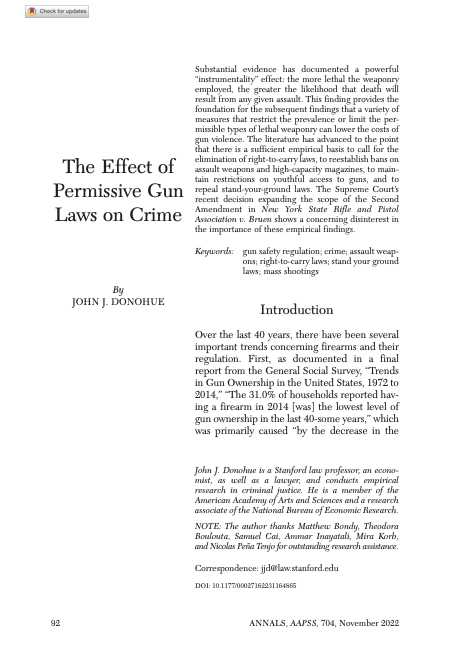
The Effect of Permissive Gun Laws on Crime

By John J. Donohue

Substantial evidence has documented a powerful “instrumentality†effect: the more lethal the weaponry employed, the greater the likelihood that death will result from any given assault. This finding provides the foundation for the subsequent findings that a variety of measures that restrict the prevalence or limit the permissible types of lethal weaponry can lower the costs of gun violence. The literature has advanced to the point that there is a sufficient empirical basis to call for the elimination of right-to-carry laws, to reestablish bans on assault weapons and high-capacity magazines, to maintain restrictions on youthful access to guns, and to repeal stand-your-ground laws. The Supreme Court’s recent decision expanding the scope of the Second Amendment in New York State Rifle and Pistol Association v. Bruen shows a concerning disinterest in the importance of these empirical findings.

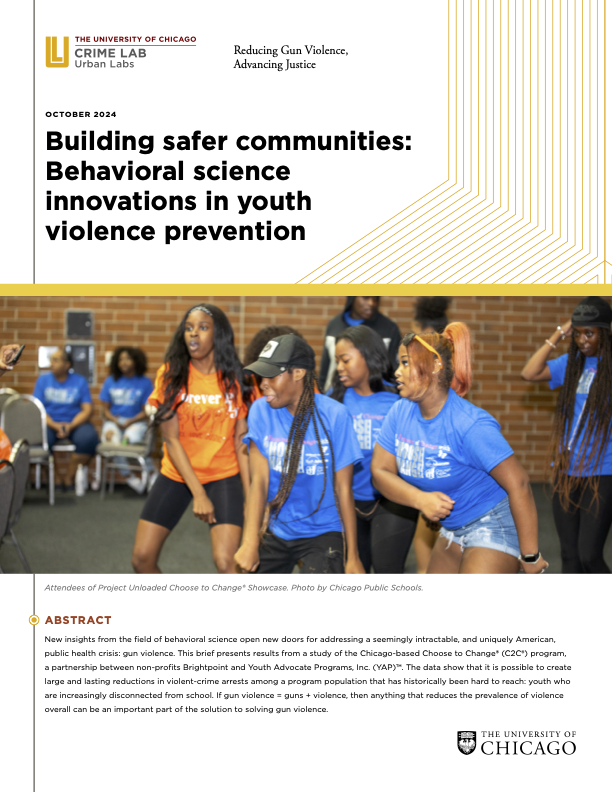
Building safer communities: Behavioral science innovations in youth violence prevention

By University of Chicago, Crime Lab

New insights from the field of behavioral science open new doors for addressing a seemingly intractable, and uniquely American, public health crisis: gun violence. This brief presents results from a study of the Chicago-based Choose to Change® (C2C®) program, a partnership between non-profits Brightpoint and Youth Advocate Programs, Inc. (YAP)™. The data show that it is possible to create large and lasting reductions in violent-crime arrests among a program population that has historically been hard to reach: youth who are increasingly disconnected from school. If gun violence = guns + violence, then anything that reduces the prevalence of violence overall can be an important part of the solution to solving gun violence.  

Guns, Lawyers, and Markets: On Economic and Political Consequences of Costly Conflict

By Stergios Skaperdas and Samarth Vaidya

We synthesize research on conflict as a fundamental economic phenomenon, arguing that the implications of the ”dark side of self-interest” have received insufficient attention in economics. We define conflict as interactions where parties choose costly inputs that are adversarially combined against one another — distinct from the collaborative input combinations typical in economic models. We make four key contributions: First, we demonstrate that conflict induces economically significant costs comparable to or exceeding traditional deadweight losses. Second, we explain how these costs vary across contexts based on property rights protection, state capacity, and cultural norms. Third, we show how incorporating conflict into economic models leads to substantially different predictions than traditional models — including inverse relationships between compensation and productivity; distortions in comparative advantage; prices determined by power rather than solely by preferences endowments, and technology. Fourth, attributes of modern states such as centralization in the presence of law, checks and balances, other forms of distributed power, and the bureaucratic form of organization can partly be thought of as restraining conflict and appropriation, with implications for governance and economic development. Overall, in the presence of conflict and appropriation, power considerations cannot be separated from economics and first-best models are not empirically plausible.

 CESifo Working Paper No. 12135, 2025

Increased Gun Violence In Sweden

By Henrik Angerbrandt, Mariana Dufort and Victor Dudas

This study examines gun violence trends in the criminal milieu since the mid-2000s, analysing how the criminal milieu has changed and what role these changes may have played in gun violence trends.