Open Access Publisher and Free Library
CRIME+CRIMINOLOGY.jpeg

CRIME

Violent-Non-Violent-Cyber-Global-Organized-Environmental-Policing-Crime Prevention-Victimization

Posts in Weapons
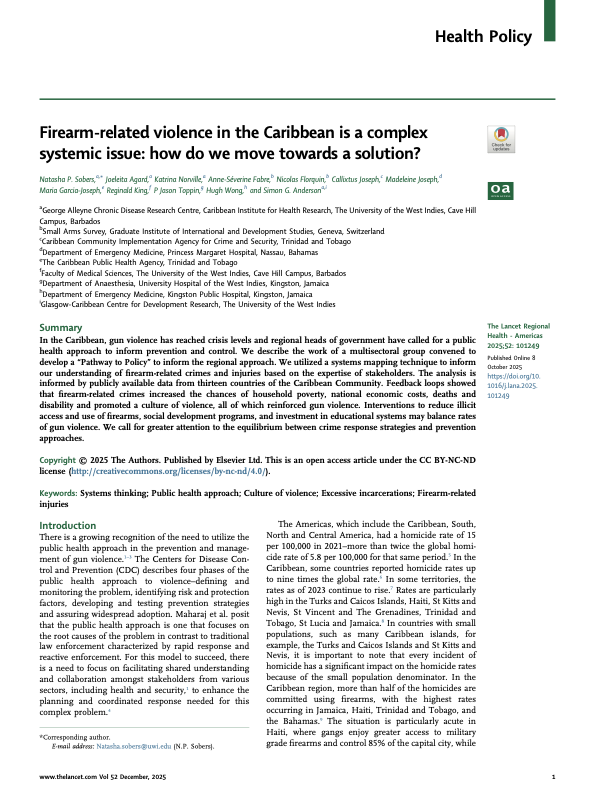
Firearm-related violence in the Caribbean is a complex systemic issue: how do we move towards a solution?

By Natasha P. Sobers, Joeleita Agard, Katrina Norville, Anne-Séverine Fabre, Nicolas Florquin, Callixtus Joseph, Madeleine Joseph, Maria Garcia-Joseph, Reginald King, Patrick Jason Toppin, Hugh Wong, Simon G. Anderson

In the Caribbean, gun violence has reached crisis levels and regional heads of government have called for a public health approach to inform prevention and control. Feedback loops resulting from work carried out under the ‘Pathway to Policy’ project showed that firearm-related crimes increased the chances of household poverty, national economic costs, deaths and disability and promoted a culture of violence, all of which reinforced gun violence. Interventions to reduce illicit access and use of firearms, social development programs, and investment in educational systems may balance rates of gun violence.

Firearm-related violence in the Caribbean is a complex systemic issue: how do we move towards a solution?—an article co-written with our project partners from the Caribbean Community Implementation Agency for Crime and Security, the Caribbean Public Health Agency, and the George Alleyne Chronic Disease Center at the University of the West Indies—discusses the work carried out by the Advisory Committee of Regional Experts, a multisectoral group convened to develop a ‘pathway to policy’ that informs a regional approach to tackling firearm violence. Using a systems mapping technique to inform our understanding of firearm-related crimes and injuries based on the expertise of stakeholders and based on analysis of publicly available data from thirteen countries within the Caribbean Community, this article calls for greater attention to the equilibrium between crime response strategies and prevention approaches.

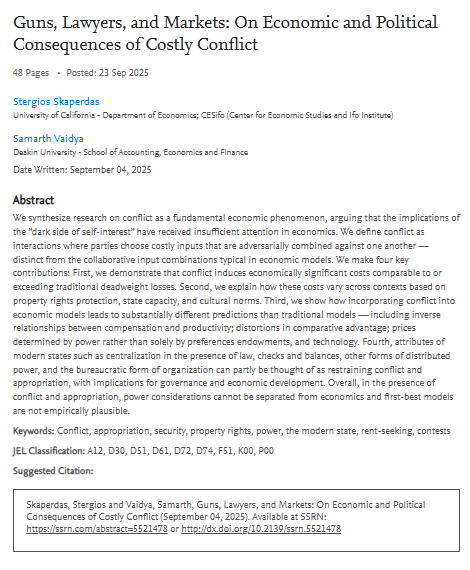
Guns, Lawyers, and Markets: On Economic and Political Consequences of Costly Conflict

By Stergios Skaperdas and Samarth Vaidya

We synthesize research on conflict as a fundamental economic phenomenon, arguing that the implications of the ”dark side of self-interest” have received insufficient attention in economics. We define conflict as interactions where parties choose costly inputs that are adversarially combined against one another — distinct from the collaborative input combinations typical in economic models. We make four key contributions: First, we demonstrate that conflict induces economically significant costs comparable to or exceeding traditional deadweight losses. Second, we explain how these costs vary across contexts based on property rights protection, state capacity, and cultural norms. Third, we show how incorporating conflict into economic models leads to substantially different predictions than traditional models — including inverse relationships between compensation and productivity; distortions in comparative advantage; prices determined by power rather than solely by preferences endowments, and technology. Fourth, attributes of modern states such as centralization in the presence of law, checks and balances, other forms of distributed power, and the bureaucratic form of organization can partly be thought of as restraining conflict and appropriation, with implications for governance and economic development. Overall, in the presence of conflict and appropriation, power considerations cannot be separated from economics and first-best models are not empirically plausible.

 CESifo Working Paper No. 12135, 2025

The State's Monopoly of Force and the Right to Bear Arms

By Robert Leiter

  In debates over the Second Amendment, the conventional view is that the government ought to possess a monopoly of legitimate force, subject to the right of individuals to act in emergency self-defense. Many treat the non-defensive circumstances in which our system decentralizes force as holdovers from the days of nonprofessional police and soldiers. When it comes to the Second Amendment, many believe that the only legitimate reason individuals may bear arms today is for individual self-defense against isolated criminal violence (e.g., to resist a home invasion). This Symposium Essay attacks the monopoly-of-force account, justifying the continued relevance of American law’s decentralization of legitimate force. This Essay argues that decentralization of force remains important for three reasons. First, despite the rise of professional police, American law enforcement still enforces core crimes below desirable levels, particularly in disadvantaged and rural communities and during times of civil unrest. Decentralization of force mitigates this underenforcement problem. And decentralization may be a better solution than providing more police because many areas where law is under-enforced also (paradoxically) suffer from the effects of overcriminalization. Second, American law has a mismatch between public duties and private rights. Providing effective law enforcement is only a public duty. Individuals have no private claim that the government adequately enforce the law or protect them against unlawful violence. Self-help and private law enforcement are the best remedies when governments undersupply needed levels of police protection. Third, even if the government has a monopoly of force, it does not follow that government officers are the only ones in whom the government’s monopoly may be vested. The “government” is an incorporeal entity whose power must be exercised by human agents. Agents do not perfectly carry out the tasks of their principals; some government officers commit malfeasance and nonfeasance. The decentralization of force provides a remedy for such abuses of office. Ultimately, this Essay concludes that the individual right to bear arms still has relevance for public defense and security. This fact should warrant consideration when determining the scope of the right, including that the  arms protected by the Second Amendment should continue to include those arms that are primarily useful for public security.   

 116 Nw. U. L. Rev. 35 (2021), 46p.

Exported Crime Guns and Domestic Gun Deaths

By David Blake Johnson and Jason Szkola

Existing research examining gun violence often faces criticism because of complications related to gun laws and gun culture. In this manuscript, we argue that these elements change the overall quality of gun owners and this quality has a significant effect on homicide. To demonstrate this, we introduce a measure of gun owner quality independent of local law enforcement and possibly indicative of illegal or dubious transfer of firearms: the time to crime of "exported" crime guns. We find that decreases in the time to crime of exported crime guns increase homicides and gun homicides while also having no effect on non-gun homicides and only a small effect on suicide. We then show how the time to crime of exported crime gun changes as a function of gun culture and gun laws.

Unpublished paper, 2024, 25p.