Open Access Publisher and Free Library
CRIME+CRIMINOLOGY.jpeg

CRIME

Violent-Non-Violent-Cyber-Global-Organized-Environmental-Policing-Crime Prevention-Victimization

Posts in Venezuela
A Rebel Playing Field: Colombian Guerrillas on the Venezuelan Border

By Bram Ebus

In the jungle along the Colombian-Venezuelan frontier, guerrillas, criminals and shadowy state elements jostle for illicit profits. Venezuela’s campaign against one armed group has raised tensions. Bogotá and Caracas should temper their war of words and work to forestall an inadvertent bilateral escalation.

A Curse of Gold: Mining and Violence in Venezuela’s South

By The International Crisis Group

What’s new? Venezuelan government forces have raided numerous illegal gold mines in the country’s south in recent years, ostensibly to protect the environment. But the truth is that they are exploiting the mines for their own enrichment or allowing armed groups to do so in exchange for a cut of the profits.

Why does it matter? Rising gold prices have fuelled unchecked illegal mining, strengthening Venezuelan criminal enterprises, Colombian guerrilla groups and corrupt elites. The racket destroys fragile ecosystems while also triggering violence against local people and migrant workers, who have been subject to sexual abuse, child labour recruitment and even summary executions.

What should be done? Hard as it is to sway President Nicolás Maduro, foreign governments should use his proclaimed environmental concern and hunger for international legitimacy after the disputed 2024 election to press for curbs on illegal mining and the attendant violence. Buyers, particularly in the Middle East and Asia, should demand conflict-free gold.

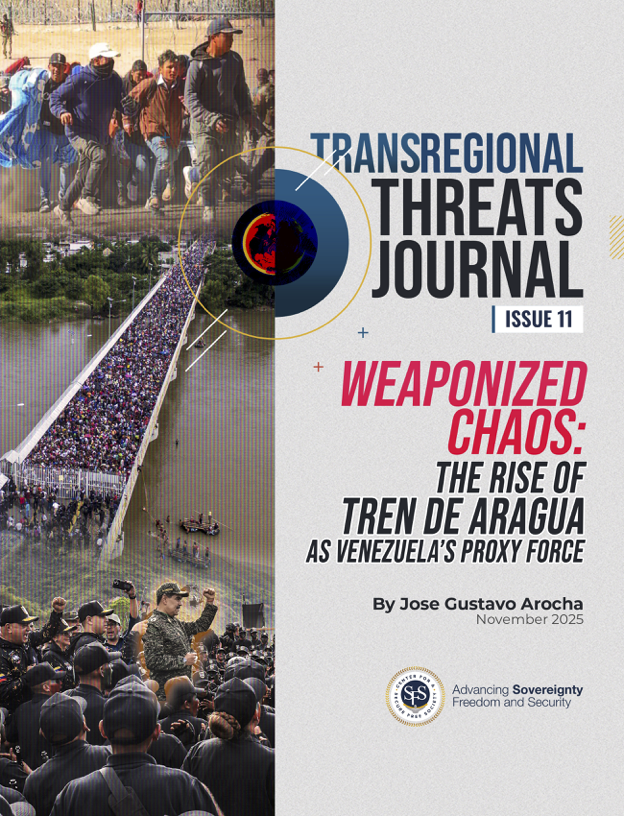
Weaponized Chaos: The Rise of Tren de Aragua as Venezuela's Proxy Force, 2014–2025

By José Gustavo Arocha

BOTTOM LINE UP FRONT: 

1 Tren de Aragua (TdA) has morphed from a prison gang into a paramilitary instrument of the Maduro regime, now active in at least eleven Latin American countries [1] and twenty-three U.S. states, [2] according to the U.S. House Oversight Committee (2025).

2 Strategic Alignment. TdA’s deliberate expansion complements Venezuela’s Guerra de Todo el Pueblo asymmetric-warfare doctrine, [3] erasing boundaries between statecraft and organized crime.

3 Elastic Network. The gang’s “insurgent archipelago” [4] of semiautonomous cells, linked through encrypted channels, makes it exceptionally resilient; when joint Peruvian-U.S. raids freed more than eighty trafficking victims in January 2025, [5] replacement cells reemerged within days. [6]

4 Weaponized Migration. By monetizing migrant flows, selling “all risk” travel packages that often devolve into debt bondage, [7] TdA offloads costs onto regional adversaries; more than 520,000 migrants transited through the Darién Gap in 2023. [8]

5 Persistent Threat. Despite terrorism designations by the United States, Argentina, Ecuador, and Trinidad and Tobago—and nearly 3,500 U.S. arrests as of August 2025, [9] TdA’s franchise model is regenerating faster than law enforcement can dismantle it.