


By Haris Mohammad
This thesis examines the origins, activities, and societal impacts of Mexican drug cartels, while assessing the effectiveness of governmental and international responses to their development and influence. This thesis examines the evolution of the cartels, starting with their collaboration with traffickers in Colombia and concluding with their supremacy in the global drug trade. The investigation elucidates the social and
political factors that have facilitated their growth. These factors include pervasive corruption, economic
disparities, and inadequate governance, all of which have fostered an environment conducive to the emergence of cartels. This thesis examines the detrimental effects of cartel involvement on Mexican
communities. These impacts include pervasive violence, societal disintegration, public health challenges stemming from substance addiction, and economic exploitation. Furthermore, it critiques the limitations of military anti-narcotics approaches, emphasizing the unintended consequences of these measures, including heightened violence and the emergence of power vacuums within the system. The research elucidates
the recruitment methods, operational tactics, and the cartels' integration into Mexican society via the use of
sociological and criminological ideas. The thesis advocates for the implementation of a comprehensive plan to counteract cartel influence. This plan must include socioeconomic transformations, government transparency, and international collaboration. This thesis aims to enhance understanding of cartel dynamics to contribute to the global battle against organized crime and to provide sustainable solutions that foster stability and justice in Mexico.
By Riya Parashar
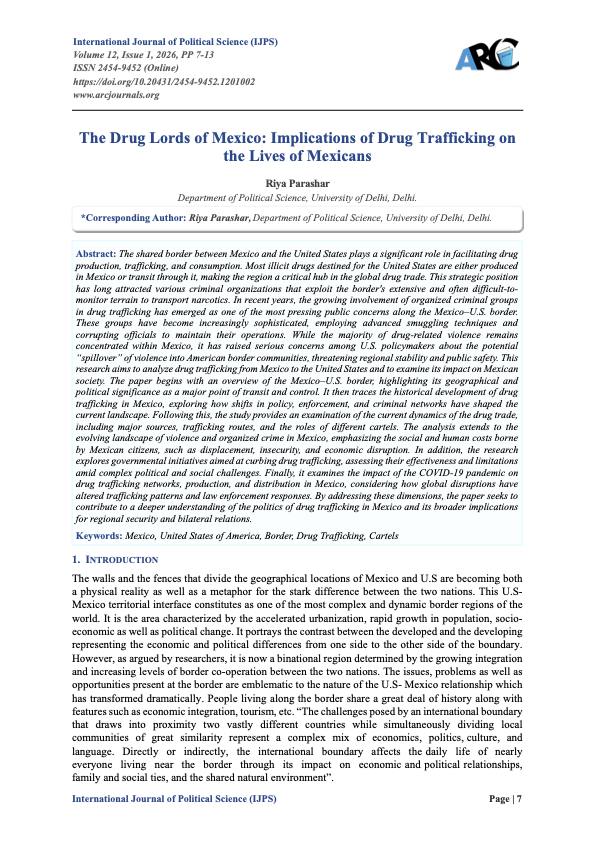
The shared border between Mexico and the United States plays a significant role in facilitating drug production, trafficking, and consumption. Most illicit drugs destined for the United States are either produced
in Mexico or transit through it, making the region a critical hub in the global drug trade. This strategic position
has long attracted various criminal organizations that exploit the border's extensive and often difficult-to monitor terrain to transport narcotics. In recent years, the growing involvement of organized
criminal groups in drug trafficking has emerged as one of the most pressing public concerns along the Mexico–U.S. border.
These groups have become increasingly sophisticated, employing advanced smuggling techniques and
corrupting officials to maintain their operations. While the majority of drug-related violence remains concentrated within Mexico, it has raised serious concerns among U.S. policymakers about the potential
“spillover” of violence into American border communities, threatening regional stability and public safety. This research aims to analyze drug trafficking from Mexico to the United States and to examine its impact on Mexican society. The paper begins with an overview of the Mexico–U.S. border, highlighting its geographical and political significance as a major point of transit and control. It then traces the historical development of drug trafficking in Mexico, exploring how shifts in policy, enforcement, and criminal networks have shaped the current landscape.
Following this, the study provides an examination of the current dynamics of the drug trade, including major sources, trafficking routes, and the roles of different cartels. The analysis extends to the evolving landscape of violence and organized crime in Mexico, emphasizing the social and human costs borne by Mexican citizens, such as displacement, insecurity, and economic disruption. In addition, the research explores governmental initiatives aimed at curbing drug trafficking, assessing their effectiveness and limitations amid complex political and social challenges. Finally, it examines the impact of the COVID-19 pandemic on drug trafficking networks, production, and distribution in Mexico, considering how global disruptions have contributed to a deeper understanding of the politics of drug trafficking in Mexico and its broader implications for regional security and bilateral relations. altered trafficking patterns and law enforcement responses. By addressing these dimensions, the paper seeks to contribute to a deeper understanding of the politics of drug trafficking in Mexico and its broader implications for regional security and bilateral relations.
By Paolo Campana
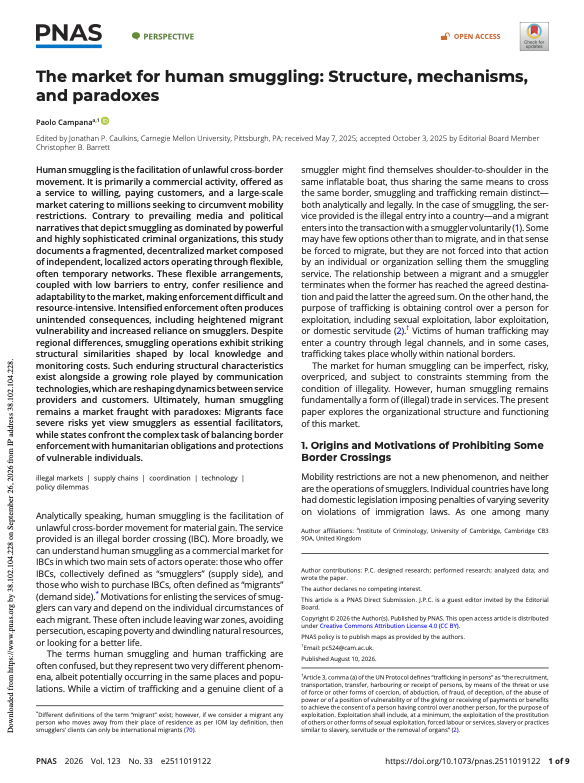
Human smuggling is the facilitation of unlawful cross- border movement. It is primarily a commercial activity, offered as a service to willing, paying customers, and a large- scale market catering to millions seeking to circumvent mobility restrictions. Contrary to prevailing media and political narratives that depict smuggling as dominated by powerful and highly sophisticated criminal organizations, this study documents a fragmented, decentralized market composed of independent, localized actors operating through flexible, often temporary networks. These flexible arrangements, coupled with low barriers to entry, confer resilience and adaptability to the market, making enforcement difficult and resource- intensive. Intensified enforcement often produces unintended consequences, including heightened migrant vulnerability and increased reliance on smugglers. Despite regional differences, smuggling operations exhibit striking structural similarities shaped by local knowledge and monitoring costs. Such enduring structural characteristics exist alongside a growing role played by communication technologies, which are reshaping dynamics between service providers and customers. Ultimately, human smuggling remains a market fraught with paradoxes: Migrants face severe risks yet view smugglers as essential facilitators severe risks yet view smugglers as essential facilitators, while states confront the complex task of balancing border enforcement with humanitarian obligations and protections of vulnerable individuals.
By Francesco Calderoni, Jürgen Lerner, David Bright
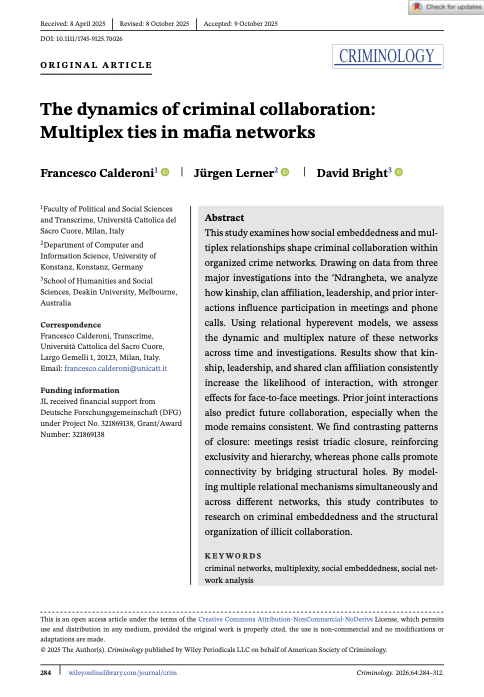
This study examines how social embeddedness and multiplex relationships shape criminal collaboration within organized crime networks. Drawing on data from three major investigations into the ‘Ndrangheta, we analyze how kinship, clan affiliation, leadership, and prior interactions influence participation in meetings and phone calls. Using relational hyperevent models, we assess the dynamic and multiplex nature of these networks across time and investigations. Results show that kinship, leadership, and shared clan affiliation consistently increase the likelihood of interaction, with stronger effects for face-to-face meetings. Prior joint interactions also predict future collaboration, especially when the mode remains consistent. We find contrasting patterns of closure: meetings resist triadic closure, reinforcing exclusivity and hierarchy, whereas phone calls promote connectivity by bridging structural holes. By modeling multiple relational mechanisms simultaneously and across different networks, this study contributes to research on criminal embeddedness and the structural organization of illicit collaboration.
By Rumbi Matamba
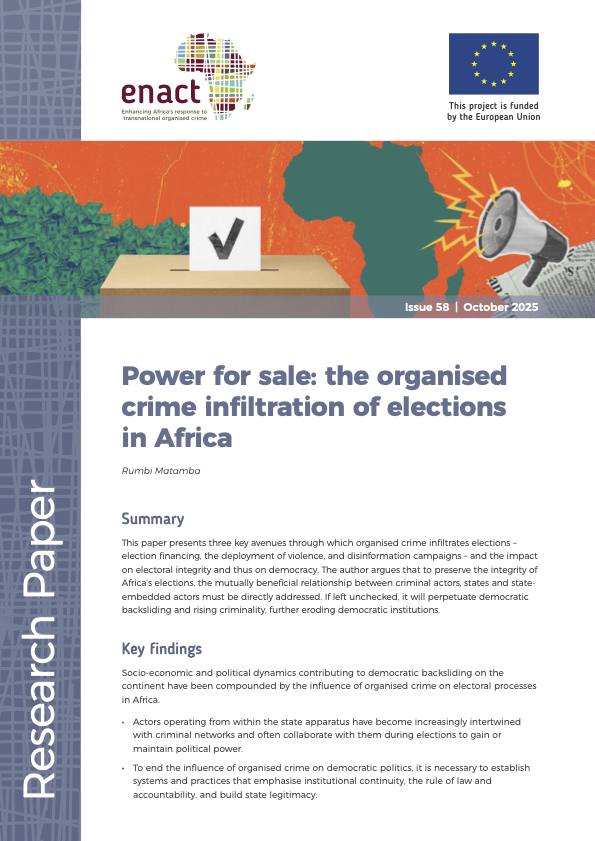
Breaking the mutually beneficial relationship between criminal actors and political elites is essential to preserving electoral integrity and democracy in Africa. This paper presents three key avenues through which organised crime infiltrates elections – election financing, the deployment of violence, and disinformation campaigns – and the impact on electoral integrity and thus on democracy. The author argues that to preserve the integrity of Africa’s elections, the mutually beneficial relationship between criminal actors, states and stateembedded actors must be directly addressed. If left unchecked, it will perpetuate democratic backsliding and rising criminality, further eroding democratic institutions
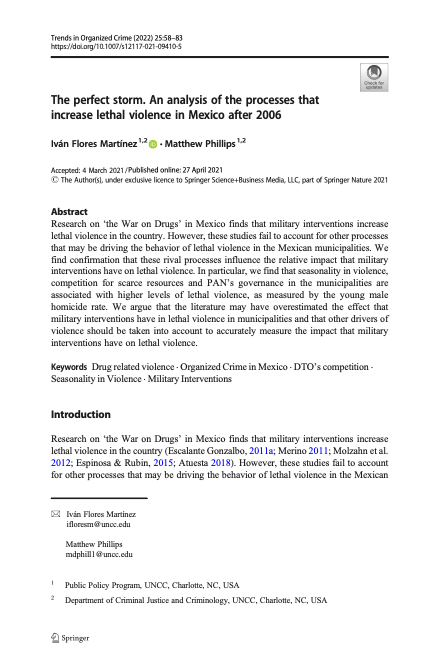
By Iván Flores Martínez & Matthew Phillips
Research on ‘the War on Drugs’ in Mexico finds that military interventions increase lethal violence in the country. However, these studies fail to account for other processes that may be driving the behavior of lethal violence in the Mexican municipalities. We find confirmation that these rival processes influence the relative impact that military interventions have on lethal violence. In particular, we find that seasonality in violence, competition for scarce resources and PAN’s governance in the municipalities are associated with higher levels of lethal violence, as measured by the young male homicide rate. We argue that the literature may have overestimated the effect that military interventions have in lethal violence in municipalities and that other drivers of violence should be taken into account to accurately measure the impact that military interventions have on lethal violence.
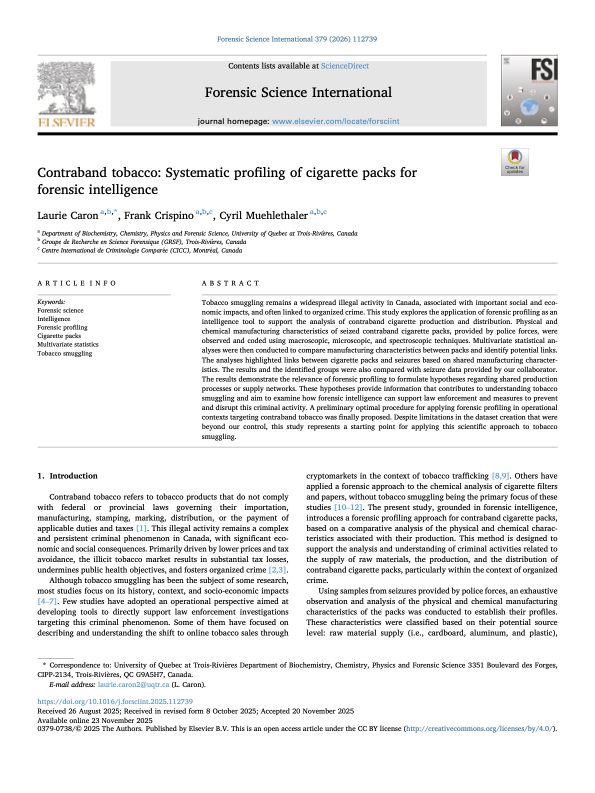
By Laurie Caron, Frank Crispino, Cyril Muehlethaler
Tobacco smuggling remains a widespread illegal activity in Canada, associated with important social and economic impacts, and often linked to organized crime. This study explores the application of forensic profiling as an intelligence tool to support the analysis of contraband cigarette production and distribution. Physical and chemical manufacturing characteristics of seized contraband cigarette packs, provided by police forces, were observed and coded using macroscopic, microscopic, and spectroscopic techniques. Multivariate statistical analyses were then conducted to compare manufacturing characteristics between packs and identify potential links. The analyses highlighted links between cigarette packs and seizures based on shared manufacturing characteristics. The results and the identified groups were also compared with seizure data provided by our collaborator. The results demonstrate the relevance of forensic profiling to formulate hypotheses regarding shared production processes or supply networks. These hypotheses provide information that contributes to understanding tobacco smuggling and aim to examine how forensic intelligence can support law enforcement and measures to prevent and disrupt this criminal activity. A preliminary optimal procedure for applying forensic profiling in operational contexts targeting contraband tobacco was finally proposed. Despite limitations in the dataset creation that were beyond our control, this study represents a starting point for applying this scientific approach to tobacco smuggling.
By Yael Anahí López Torres
Mexico is grappling with a crisis of insecurity after over 30 years since its transition to democracy. Its top-down and frequently militarised policies have been ineffective, leading to calls by scholars to alter the state’s security paradigm that has not been able to fulfil the basic right of citizens to live in a secure country. As a response to these calls, this thesis goes beyond the common state-centric perspectives on security policies and instead it focuses on the often-overlooked subnational responses to criminal violence. In particular, I perform an analysis of bottom-up responses, considering the local dynamics of institutions and civil society. My research questions are: What is the role of bottom-up approaches in responding to criminal violence? And as an extension, what are the factors that enable or constrain their responses? To achieve these objectives, I conducted micro-level analyses and comparisons of two different case studies: Ciudad Juárez, Chihuahua and Monterrey, Nuevo León. These analyses explore variations in bottom-up responses, drawing on fieldwork in the form of 57 interviews with key state and societal actors and complementary documentary resources. The analysis emphasises Mexico’s subnational democratisation processes, considering its effects on the (un)rule of law and violence. My findings reveal that uneven democratisation hinders state capacity to address the security crisis, requiring organised society to intervene. In both cases, this contributed to countering and shaping the patterns of criminal violence. Local organised society pursued broader democratic goals by promoting the means for the rule of law, while high-risk collective mobilisation was fundamental in increasing political participation. The pre-existing institutions, the local actors and the alliances thatenabled these changes varied between cases, and followed waves of political urgency and electoral periods that both provided opportunities for change, but also disrupted ongoing projects. This contributes to the scholarship of criminal politics by bridging the literature of democratisation and state capacity.
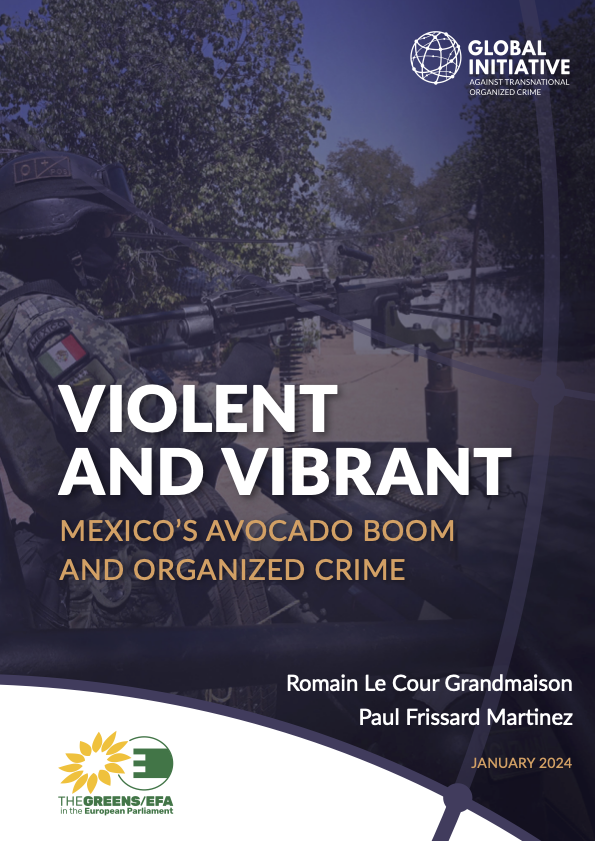
By Romain Le Cour Grandmaison and Paul Frissard Martinez
The contemporary boom of global avocado consumption has drawn attention to Mexico’s industry and the expanding criminal networks that surround it. In fact, avocado production and exports – both to the United States and the European Union − display worrying signs of criminal organizations being involved in the market, human rights violations, and environmental and health impacts.
By Araceli Vázquez-Ocaña and Alan Alberto Ramírez-Guevara
This study proposes a non-linear analytical framework, inspired by phase-transition theory, to explain abrupt regime shifts in organized violence within weak institutional systems.Using Mexico (2000-2024) as a primary case, we demonstrate that criminal violence does not escalate linearly but undergoes a "phase transition" once specific thresholds are crossed. We introduce the Criminal Nucleation Framework to model the emergence and persistence of criminal cells through three dimensions: the institutional activation barrier (ΔG), the critical organizational size (r*), and the growth constant (k). Empirical validation shows a structural rupture between 2007 and 2010, where homicide rates shifted from a stable regime (8.5–10 per 100k) to a chronic state (25–29 per 100k). By operationalizing a comparative Kinetic Risk Index (R = k/ΔG), the framework classifies cities into distinct systemic states rather than providing point predictions. The findings suggest that once a system exhibits hysteresis, reactive force is structurally insufficient; instead, policy must focus on increasing the activation barrier to prevent spontaneous criminal formation.

By Bram Ebus
In the jungle along the Colombian-Venezuelan frontier, guerrillas, criminals and shadowy state elements jostle for illicit profits. Venezuela’s campaign against one armed group has raised tensions. Bogotá and Caracas should temper their war of words and work to forestall an inadvertent bilateral escalation.
By Marisa Ross, Susan Burtner, and Andrew Papachristos
Introduction: Community violence intervention street outreach (CVI-SO) strategies are growing in popularity as non-punitive approaches to solving the public health problem of community gun violence. Evidence on the effectiveness of CVI-SO on rates of violence is mixed and faces challenges due to concerns with documentation and data privacy, intentional selection bias in program design, and variation in participant risk and needs. Effective evaluation requires methods that accurately capture the scope and delivery of services, starting with a greater understanding of the services CVI participants receive and how they vary based on individual characteristics.
Methods: This study explores the services that participants received from a coalition of Chicago CVI organizations from 2017–2023. Considering administrative and programmatic data from over 4,000 participants’ nearly 200,000 interactions with providers, the researchers examine patterns in demographics, network-based risk factors, and service provision and dosage. They then use descriptive and latent profile analyses to characterize the “typical” participant in Chicago.
Results: Results show that CVI work relies heavily on long-term mentoring relationships. Service patterns show that latent groups exist with varying dosage: higher dosage participants with higher risk for gun violence receive more frequent contacts over longer periods, demonstrating how organizations adjust their approach based on participant needs. Profiles that primarily receive behavioral or social supports-related services also emerge.
Conclusions: Findings underscore the need for evaluation frameworks that capture both the strategic variation in service delivery and the multiple pathways through which CVI programs influence participant outcomes.
By Yennesit Palacios Valencia and Ignacio García Marín
Colombia is among the countries with the highest levels of violence and crime in the world, despite the peace agreements between the State and different armed groups, including the FARC. This is partly due to the fact that the Colombian case is complex and multifaceted because of the variety of participants in the armed conflict context and due to the mutation of new actors, under the modality of organized crime. Based on the above, the objective is to study the Colombian reality, contextually and diachronically, from theoretical and epistemological elements to demonstrate how violence and criminality factors intersect in the context of the armed conflict. The study concludes, among other findings, that in Colombia the ambiguity and the multiplicity of terms used to name the emerging criminal groups presents a legal problem because of their hybrid composition and regarding their treatment within or outside of the armed conflict
By The Global Initiative against Transnational Organized Crime
Levels of organized crime have remained stable across Europe while increasing in most other regions, according to the 2025 Global Organized Crime Index. Europe remains the second-lowest continent for criminality after Oceania. However, this overall stability masks a dynamic situation across criminal markets and criminal actors.
Europe’s overall criminality score stands at 4.74, while its resilience score reaches 6.28 —the highest globally. Although Europe continues to outperform other continents across all 12 resilience indicators, criminality continues to expand and adapt, highlighting the need to update resilience strategies to keep pace with emerging threats.
Financial crime remains the most pervasive criminal market in Europe for the second consecutive edition of the Index. These crimes include increasingly complex and sophisticated fraud schemes, largely occurring online, such as investment fraud, business email compromise and romance scams, as well as embezzlement and tax evasion. Financial crimes are inherently transregional and are particularly facilitated by corruption.
Europe continues to be a global hotspot for cyber-dependent crimes, ranking second continentally. These crimes range from ransomware attacks to malware distribution and cryptocurrency fraud, often targeting government institutions, major corporations and critical infrastructure. Hybrid and traditional cybercrime actors are increasingly intertwined, with state-sponsored groups often disguising themselves as cybercriminals.
Drug markets remain salient. Cocaine and synthetic drugs have recorded the sharpest increases since 2023. Cocaine is a primary source of revenue for numerous organized crime groups in Europe, and the continent functions as a destination, transit hub and consumer market. Synthetic drug production is becoming increasingly dispersed across Europe, with Central and Eastern Europe registering the sharpest increase since 2021. Heroin, by contrast, is showing signs of decline, while cannabis remains the most widely consumed illicit drug.
Human trafficking and human smuggling remain far-reaching and widespread. Smuggling networks are entrenched along the Western Balkans route, and many European countries serve as final destinations where smuggled people may face forced labour or sexual exploitation.
The presence of criminal actors has grown steadily since 2021. Foreign actors remain the most concerning actor type, recording the largest overall increase since 2021. These groups are increasingly heterogeneous, multi-ethnic and interconnected. Private-sector actors also play a pivotal role in laundering illicit funds, while state-embedded actors, though less pervasive than elsewhere, are implicated in facilitating criminal activity in some contexts.
Europe’s resilience strengths lie in international cooperation, national policies and laws, and territorial integrity. However, government transparency and accountability consistently rank lowest among resilience indicators. Anti-money laundering and economic regulatory capacity also remain areas of concern.
While Europe demonstrates relatively strong resilience overall, certain criminal markets and actors are expanding. The findings underscore the need for more effective and tailored response mechanisms as organized crime continues to adapt across the continent.
By Nathan P. Jones and John P. Sullivan
Criminal cartels and gangs dominate the illicit economy in Mexico. These organized crime groups challenge the solvency (specifically capacity and legitimacy) of the state in Mexico. Organized crime in Mexico is involved in a range of activities including extortion, drug trafficking, human trafficking, and petroleum theft. Criminal cartels, often called drug trafficking organizations, have diversified into other illicit activities specifically petroleum theft. This paper provides an overview of the rise of a specialized organized criminal entity: huachicoleros. Huachicoleros specialize in fuel theft and like their narco counterparts use corruption and violence to protect their illicit market. The rise of Cártel de Santa Rosa Lima (CSRL) is discussed as a salient case study. The volatile mix of corruption, violence, and economic instability will be assessed, and government and national oil company (PEMEX) response is discussed
By Evan Ellis
The U.S. government threats of tariffs on the Mexican government if it did not do more to control illicit fentanyl ows into the United States have cast new attention on the growing problem of transnational organized crime that has wrought violence and corruption at all levels in Mexico. This work, based on the authors research in interviews with senior Mexican security ofcials in Mexico City in March 2025, examines the evolution of transnational organized crime in the country, and the Mexican government’s response, with the support of the United States and other partners.The principal drivers of transnational organized crime dynamics in Mexico are ows of cocaine through the country, largely destined for European and Asian markets, as well as the production of fentanyl there from Chinese and other precursors, mostly oriented toward export to the United States. In addition, other illicit activities including petroleum theft (huachicol), smuggling and exploitation of migrants transiting the country, extortion and kidnapping, illegal mining and money laundering, have also fueled Mexico’s evolving illicit economy. With respect to murders and other violence in Mexico, arms, including long arms imported from the United States, arms obtained on the black market from Central American and other global wars, drones and other military products principally from the People’s Republic of China (PRC), as well as a large, welldeveloped illicit domestic industry for military vehicles and supplies all contribute to the lethality of multiple ongoing conict within the country.The organized crime dynamics in Mexico, the domestic and international groups involved, in the pattern of violence has evolved signicantly in the almost two decades since 2006 when Mexican president Felipe Calderon declared war on the drug cartels for their escalating violence and deployed federal troops into Michoacan to respond. This work analyzes of those dynamics, their evolution, and the response of the Mexican government, in conjunction with the US and other partners.
By Patricia Faraldo Cabana
In recent years the interrelation of the trafficking of cultural property with other forms of organised crime has gained prominence in EU policies on the protection of cultural heritage. This article analyses how the EU has conceptualized and operationalized this overlap in terms of describing the phenomenon and designing countermeasures. Through a content analysis, we evaluate the articulation and use of this connection in EU policy documents published from 1993 to 2023 that include both organised crime and trafficking of cultural property or similar terms (n = 58). The analysis demonstrates conceptual and organizational deficits and a correspondingly weak foundation for EU policy. Misunderstandings related to the organised nature of trafficking of cultural property and its overlaps with other forms of organised crime, particularly the financing of terrorism, may result in misguided policies with the potential to undermine law enforcement efforts. Conversely, the addition to the list of obliged entities and persons in the anti-money laundering framework of persons trading or acting as intermediaries in the trade of works of art opens new opportunities to disrupt the illicit financial flow in the art and antiquities market.
By Omar García-Ponce
Organized criminal groups (OCGs), ranging from local gangs to powerful drug cartels that operate across national boundaries, represent the single most important security threat in Mexico and Central America. A growing body of research in political science and other disciplines has examined the political and socioeconomic roots of these organizations, as well as the mechanisms underlying the production of organized criminal violence. The unprecedented wave of organized criminal violence that has been affecting the region in recent years can be traced back to political transformations and policy changes that disrupted the social and political order at the local level, redefining the organization of illicit markets, and undermining the rule of law. On these issues there is a particularly rich literature that focuses on understanding the outbreak of violence and criminal rivalry in Mexico. Several studies have emphasized the role of state-criminal group relationships as a key factor to understand the challenges that organized crime poses in terms of peacebuilding and democratic rule. Within this framework, the existing literature has identified various forms of criminal governance prevalent in Mexico and Central America, and shed light on how communities respond to crime and violence in contexts of low state capacity. Some of these responses include social mobilization, vigilantism, and support for extralegal violence. The use of violence by OCGs in electoral contexts has also received particular attention in the literature, since they often target candidates or intimidate voters, affecting political preferences and patterns of political participation. Finally, a series of studies has rigorously investigated the impact of organized criminal violence on a number of outcomes, including political attitudes and behavior, trust in institutions, and health and education, among others.
By Omar García-Ponce
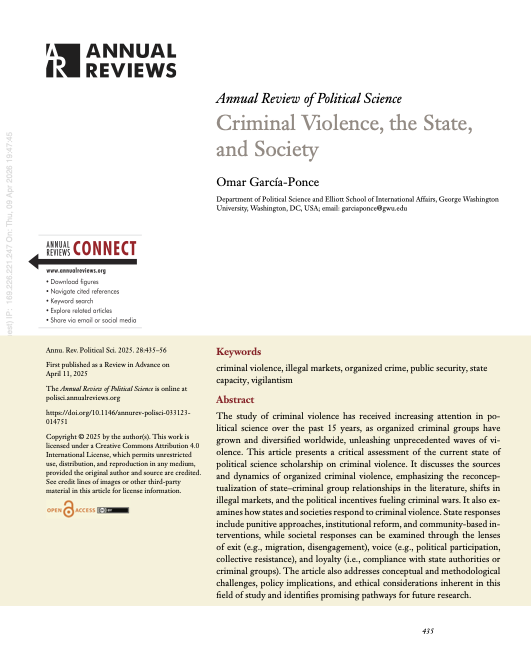
The study of criminal violence has received increasing attention in political science over the past 15 years, as organized criminal groups have grown and diversified worldwide, unleashing unprecedented waves of violence. This article presents a critical assessment of the current state of political science scholarship on criminal violence. It discusses the sources and dynamics of organized criminal violence, emphasizing the reconceptualization of state–criminal group relationships in the literature, shifts in illegal markets, and the political incentives fueling criminal wars. It also examines how states and societies respond to criminal violence. State responses include punitive approaches, institutional reform, and community-based interventions, while societal responses can be examined through the lenses of exit (e.g., migration, disengagement), voice (e.g., political participation, collective resistance), and loyalty (i.e., compliance with state authorities or criminal groups). The article also addresses conceptual and methodological challenges, policy implications, and ethical considerations inherent in this field of study and identifies promising pathways for future research.
By Jan Slobodník
This study examines the militarised approach of the Mexican government in its struggle against organised crime between 2001 and 2016, focusing on the deployment of the armed forces and the implementation of the so-called kingpin strategy. It argues that the removal of cartel leaders, rather than weakening criminal networks, produced fragmentation, diversification, and militarisation within Mexico’s underworld—a process defined here as zetafication. The thesis uses the rise and evolution of Los Zetas as a case study to analyse how a criminal organisation born from army deserters introduced military tactics, hierarchical discipline, and extreme violence into organised crime, transforming the conflict’s character and the state’s response. Drawing on government reports, interviews with Mexican military officers and civilians, and contemporary scholarship, the study situates this phenomenon within Mexico’s political, legal, and socio-economic context, including the influence of U.S. security policy. It concludes that the use of the military as a policing tool produces short-term tactical gains but undermines long-term state stability, erodes public trust, and perpetuates cycles of violence.