
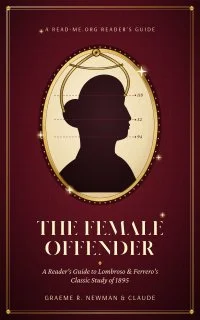
The Female Offender: A Reader's Guide
Graeme R. Newman and Claude
In 1895, English readers met The Female Offender, Cesare Lombroso and William Ferrero's notorious study of criminal women. For more than half a century it was the book people reached for when they wanted to know what science had to say about women who broke the law. Today its central claim lies in ruins. That claim held that the most dangerous female criminals were evolutionary throwbacks who could be recognized by their skulls, jaws, and faces. Yet the book remains one of the founding documents of criminology, and one of the most instructive.
This Reader's Guide is an independent companion to the 1895 edition. It is organized around the questions a thoughtful reader is likely to ask:
Who were Lombroso and Ferrero, and what was criminal anthropology?
What did the authors measure, and on whom?
Why did they find the "criminal type" so much rarer in women than in men?
How did they explain the born criminal, the occasional offender, hysteria, crimes of passion, suicide, and madness?
The guide follows the authors through skull measurements, photographs, and case histories. It shows how biased samples, missing comparison groups, circular definitions, and selective storytelling produced conclusions that confirmed what the authors already believed about women, race, and the poor. It also asks what, if anything, survives. The authors' observations on poverty, domestic service, coercive partners, and women's lower rates of crime anticipated later research, even when their explanations failed.
Later chapters trace the book's long influence on twentieth-century thinking about women and crime, from the Gluecks and Otto Pollak to the feminist critics of the 1970s. They also draw lessons for today's attempts to predict criminality from faces and algorithms.
The guide includes study questions, a glossary, notes on the people and cases the authors cite, and suggestions for further reading. It is written for students, teachers, and general readers in criminology, gender studies, history of science, and the history of crime and punishment.
The complete 1895 text is freely available from Read-Me.Org. Download it here.
Read-Me.Org Inc. New York-Philadelphia-Australia. 2026. p.77.
