Open Access Free Library
CRIME+CRIMINOLOGY.jpeg

CRIME

Violent-Non-Violent-Cyber-Global-Organized-Environmental-Policing-Crime Prevention-Victimization

Posts tagged female offenders
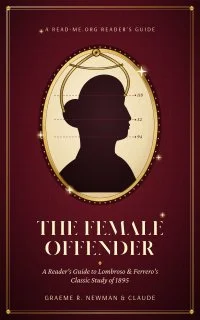
The Female Offender: A Reader's Guide

The Female Offender: A Reader's Guide
Graeme R. Newman and Claude

In 1895, English readers met The Female Offender, Cesare Lombroso and William Ferrero's notorious study of criminal women. For more than half a century it was the book people reached for when they wanted to know what science had to say about women who broke the law. Today its central claim lies in ruins. That claim held that the most dangerous female criminals were evolutionary throwbacks who could be recognized by their skulls, jaws, and faces. Yet the book remains one of the founding documents of criminology, and one of the most instructive.

This Reader's Guide is an independent companion to the 1895 edition. It is organized around the questions a thoughtful reader is likely to ask:

  • Who were Lombroso and Ferrero, and what was criminal anthropology?

  • What did the authors measure, and on whom?

  • Why did they find the "criminal type" so much rarer in women than in men?

  • How did they explain the born criminal, the occasional offender, hysteria, crimes of passion, suicide, and madness?

The guide follows the authors through skull measurements, photographs, and case histories. It shows how biased samples, missing comparison groups, circular definitions, and selective storytelling produced conclusions that confirmed what the authors already believed about women, race, and the poor. It also asks what, if anything, survives. The authors' observations on poverty, domestic service, coercive partners, and women's lower rates of crime anticipated later research, even when their explanations failed.

Later chapters trace the book's long influence on twentieth-century thinking about women and crime, from the Gluecks and Otto Pollak to the feminist critics of the 1970s. They also draw lessons for today's attempts to predict criminality from faces and algorithms.

The guide includes study questions, a glossary, notes on the people and cases the authors cite, and suggestions for further reading. It is written for students, teachers, and general readers in criminology, gender studies, history of science, and the history of crime and punishment.

The complete 1895 text is freely available from Read-Me.Org. Download it here.

Read-Me.Org Inc. New York-Philadelphia-Australia. 2026. p.77.
Female Perpetrators of Intimate Partner Homicide: Stereotyping and Factors. A Systematic Review of Twenty Years of Literature, 2003–2023

By Sally Crosland, Calli Tzani & Maria Ioannou

When considering intimate partner homicide (IPH), there is a comparative lack of recent research focusing on the specific stereotypes relating to female perpetrators, although recent findings suggest that there is a marked gender difference in instances of IPH perpetration. The current systematic review explored stereotyping of female IPH defendants between 2003 and 2023. Findings suggest stereotypes regarding female IPH perpetrators have a marked effect across several areas. Existence and extent of courtroom and media stereotyping are identified, and factors influencing jury verdicts are considered. Research limitations, implications of findings and directions for further research are specified.

Deviant Behavior, May 2025.

Trends in Female Offending in New South Wales: 2014 to 2023

By Neil Donnelly

To examine 10-year trends in offending by females in New South Wales (NSW) between 2014 and 2023. METHOD Data were extracted from the NSW Police Force’s Computerised Operational Policing System (COPS) for all people proceeded against by the NSW Police Force between 2014 and 2023. The number and proportion of offences committed by female and male offenders are presented. Offending trends are examined across 32 specific offence categories using the average annual percentage change in offences and the Kendall’s rank order correlation test to determine statistical significance. This analysis is conducted for the entire population of female and male offenders regardless of age, then repeated for the subset of young offenders. RESULTS Between 2014 and 2023 the number of females proceeded against by NSW police increased by 40%, compared to just 17% for males. The proportion of female offenders grew by around 15%, from 19% of all offenders in 2014 to 22% of all offenders in 2023. Female offenders were most commonly proceeded against for steal from retail store (12%), possess/use drugs (12%), domestic violence (DV) assault (11%), non-DV assault (7%) and breach bail conditions (7%). Much of the overall growth in female offending can be explained by increases in a small number of high-volume offence categories. These include: breach of Apprehended Violence Orders (12% increase in female offences from 2014 to 2023 versus a 7% increase in male offenders); breach bail conditions (12% vs. 8%); DV assault (8% vs. 2%); and non-DV assault (4% vs. 1%). The average annual number of female offenders (compared to males) also increased across several lower volume offences, although these contributed less to the growth in female offending overall. Most predominantly: sexual touching, sexual act and other sexual offences (13% vs. 2.5%); motor vehicle theft (12% vs. 9%); prohibited weapons offences (8% vs. 4%); break and enter non-dwelling (7% vs. stable); and trespass (6% vs. 3%). Trends and offending patterns were similar for young female offenders aged 10-17 years. One difference was the number of young female offenders grew by just 20% between 2014 and 2023 (compared to relatively stable trends for young male offenders). CONCLUSION While there has been a long-term increase in the number of female offenders proceeded against by the NSW Police Force, they continue to represent a small proportion of all offenders. Further analysis utilising representative surveys may provide insight int

Sydney: NSW BUREAU OF CRIME STATISTICS AND RESEARCH - 2024. 14p.