by Graeme Newman (Author), Sheldon Glueck (Author)
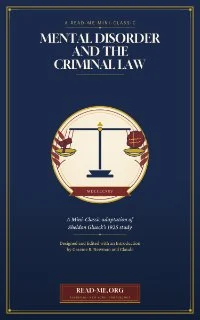
When a court asks whether a defendant was too mentally ill to be responsible, whose knowledge should decide it: the judge's, the jury's, or the doctor's? A reader's guide to the 1925 book that first mapped the whole problem.
In 1925, a young Harvard scholar named Sheldon Glueck published Mental Disorder and the Criminal Law, a study of nearly seven hundred pages on how American courts handle the mentally ill accused. It appeared while the country was arguing over Leopold and Loeb, over rising murder rates, and over Chief Justice Taft's charge that criminal justice was a disgrace to civilization. Glueck asked how courts find out that a defendant is mentally ill, how the legal tests of insanity were made, what psychiatry actually says about the main mental disorders, and what becomes of defendants who are acquitted. His answer was that the law had cut the mind into separate compartments of knowing, feeling and willing, and that reform had to begin with the unity of the mind.
The book is long, technical and dense with footnotes. This Reader's Guide makes it accessible without replacing it. It explains the argument in plain language, supplies the legal and medical background a modern reader may lack, and shows where the reasoning is strong and where it is open to question.
INSIDE THIS GUIDE
A reading plan and a chapter-by-chapter map of the original
The pretrial-examination law of Massachusetts and what its first 113 examinations found
How the tests of insanity were made, from Hale and the "wild beast" to M'Naghten and the American courts
The argument that mental processes are a unity, and why it undercuts the old tests
A table of the main mental disorders of 1925 and what each meant for criminal responsibility
What happens to defendants acquitted by reason of insanity, and the fight over release
Glueck's program: neutral experts, a new jury charge, a verdict of partial responsibility, and a commission to decide treatment after conviction
A worked example that applies his 1925 jury charge to three imaginary defendants
What has changed since 1925, from Durham to the Insanity Defense Reform Act, and the eugenics assumptions the book shared with its time
Five common misreadings, a primer of legal terms, a glossary, an annotated reading list, an FAQ, 26 discussion questions and classroom activities
WHO IT'S FOR
Students of law, criminology, psychology, psychiatry and history; teachers and reading groups; and general readers who want to know how the insanity defense came to be the way it is.
PLEASE NOTE
This is an independent guide, not an abridgment or edition of Glueck's book. It does not reproduce the original's text and is not endorsed by the author's heirs or the original publisher. It is meant to be read alongside the original. Download the original book.
Written by Graeme R. Newman with the assistance of Claude, an AI model made by Anthropic. The AI-generated content is disclosed in accordance with Read-Me.Org policy.
Read-Me.Org Inc. New York-Philadelphia-Australia. 2026. p.64.