

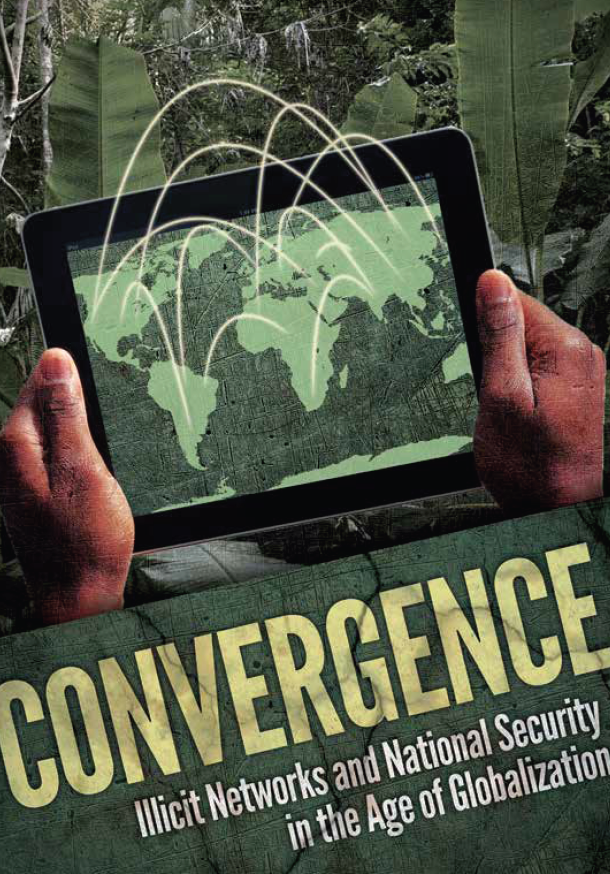
By Michael Miklaucic and Jacqueline Brewer
I llicit networks affect everyone in our modern, globalized world. From human trafficking in Eastern Europe to drug smuggling in East Asia, to the illicit arms trade in Africa, to terrorist cells in East Asia and insurgents in the Caucasus, transnational illicit networks have tentacles that reach everywhere. The trade in illegal narcotics is perhaps most worrisome, but of growing concern is the illicit trafficking of counterfeit items, weapons, natural resources, money, cultural property, and even people by shrewd, well-resourced, and nefarious adversaries. I have experience combating these threats personally at the tactical, operational, and strategic levels. As a young naval officer on a variety of ships, I spent a fair amount of time patrolling the global commons where transnational criminals in the guise of pirates and drug smugglers proliferate. I was in the Pentagon on 9/11 and personally experienced the global reach of modern terrorism. Later on, when I commanded U.S. Southern Command (USSOUTHCOM), one of my subordinate commands was Joint Interagency Task Force–South in Key West, Florida, a multinational and interagency/interministerial command that counters drug trafficking in the Western Hemisphere. I also experienced the pernicious effects that transnational crime has on our friends as it ranges throughout the entire Western Hemisphere. After leaving USSOUTHCOM to become commander at U.S. European Command (USEUCOM), I saw that Europe was also challenged by the same types of transnational crime. In response, I stood up the Joint/Interagency Counter Trafficking Center in Stuttgart, Germany, designed to counter transnational criminal networks in cooperation with our international partners. When I took command of USEUCOM, I also became the Supreme Allied Commander, Europe (SACEUR). As SACEUR, I command Operation Active Endeavor, which counters trafficking in the Mediterranean, and Operation Ocean Shield, which is part of the international counterpiracy efforts off the Somali coast. In addition, we have pioneered responses to cyber threats. At the Supreme Headquarters Allied Powers Europe, we have the North Atlantic Treaty Organization Computer Incident Response Center, and at USEUCOM, we are taking steps to create a subunified cyber command that will have links to both U.S. Cyber Command in the United States and USEUCOM in Germany. All of these organizations were designed to facilitate a whole-of-government approach, where all elements of national power work together in order to address emerging threats. Eventually, once societies understand the nature of the threats facing them, they will hope- fully mobilize nongovernmental assets, adopting a “whole of society” approach. When all of these elements work together, governmental and nongovernmental groups can join international regional and global groups to form a “whole of international society” approach, allowing us to close the seams that exist between nations and regions. Only then will we be able to close these illicit transnational networks. These networks have taken advantage of modern advances in communications and transportation to globalize. Narcotraffickers in the Andean Ridge, for instance, have expanded operations as far as their markets in the United States and Europe. Illegal arms merchants have expanded their operations around the world. Human smugglers have moved their slaves from underdeveloped countries to sex operations throughout the developed world. And, of course, we have all seen the global reach of modern transnational terrorism. No one is immune from this insidious threat.
Center for Complex Operations Institute for National Strategic Studies By National Defense University Press Washington, D.C., 2013. 304p.