

By Sophie King-Hill
This evidence review explores how masculinity influences offending, vulnerability and engagement with the criminal justice system. It examines the impact of gender norms, trauma and online influences, and considers how gender-informed, trauma-aware approaches can support prevention, rehabilitation and safer communities.

By Ruth Halkon
Digital technologies have moved rapidly from novelty to normality. Now a routine feature of everyday life, smart doorbells, journey cameras, mobile phones, wearable devices and connected home technologies are
changing how evidence is generated, captured and shared. Our new report, launched at the Emergency Services Tech Show in Birmingham, argues that this shift should be understood as more than a technological development. Rather, it represents a new form of public participation in policing. Citizens have long contributed to public safety through witness reporting, Neighbourhood Watch and Community Speedwatch. What is different today is their growing ability to provide digital evidence of events as they happen. Digital citizen evidence gives public participation a scale, permanence and immediacy that previous forms of engagement could not achieve, creating both opportunities and challenges for policing.
The scale of this shift is already significant. A nationally representative YouGov survey commissioned for this report found that half of adults (50 per cent) own and regularly use at least one technology capable of generating digital evidence, while nearly one in three (31 per cent) own and regularly use a smart doorbell camera. Public attitudes towards these technologies are also broadly positive: 69 per cent of adults believe smart doorbells improve their personal safety and security, while 58 per cent believe journey cameras improve personal safety on the roads. Crucially, the public appear willing to use these technologies in support of public safety. Three quarters (75 per cent) say they would be likely to share footage of suspicious activity outside their home, while nearly three quarters (73 per cent) would share footage of dangerous driving. Even where incidents do not affect them directly, many citizens appear willing to contribute evidence when they believe it could help make their communities safer.
Citizens are already generating and sharing digital evidence at scale. Policing now needs the capacity, governance and public trust required to receive, assess and respond to that evidence effectively. When
people submit evidence and can see that it has been reviewed, acknowledged or acted upon, participation is reinforced. When evidence appears to disappear into a black hole, confidence can be undermined
and future participation discouraged. Realizing the benefits of digital citizen evidence will depend on
appropriate safeguards and governance. Questions about how evidence is collected, retained, shared and used are central to maintaining public trust. If citizens are concerned that their information is being used
inappropriately, retained unnecessarily or handled without sufficient transparency, there is a risk of creating a chilling effect that discourages participation and weakens confidence in policing.
The report concludes that technology and evidence-submission portals, while important, are only part of the solution. Equal attention must be given to the principles, processes and governance arrangements that
determine how citizen-generated evidence is received, assessed, and acted on. To support this, we propose ten principles for the effective, proportionate and trusted use of digital citizen evidence. Digital citizen evidence is already here. The public are willing to participate. The challenge now is whether policing can create the systems, standards and safeguards needed to ensure that participation strengthens both public safety and public confidence.
By Clare O’Connor,.et al
In 2012, IPRT published The Vicious Circle of Social Exclusion and Crime: Ireland’s Disproportionate Punishment of the Poor1 setting out how poverty and social exclusion shape exposure to criminalisation, and the case for early intervention and social investment as prevention. In the years since, the effects of austerityera policies have become increasingly visible, particularly in housing, social protection and criminal justice. Ireland faces a deepening housing crisis and cost of living crisis, alongside record levels of prison overcrowding. This report provides an updated evidence base on the overlap between poverty, deprivation and criminalisation in Ireland, examines justice reinvestment approaches, outlines relevant human rights obligations, and identifies evidence-led alternatives to over-reliance on penal sanctions
By Michael Miklaucic and Jacqueline Brewer
I llicit networks affect everyone in our modern, globalized world. From human trafficking in Eastern Europe to drug smuggling in East Asia, to the illicit arms trade in Africa, to terrorist cells in East Asia and insurgents in the Caucasus, transnational illicit networks have tentacles that reach everywhere. The trade in illegal narcotics is perhaps most worrisome, but of growing concern is the illicit trafficking of counterfeit items, weapons, natural resources, money, cultural property, and even people by shrewd, well-resourced, and nefarious adversaries. I have experience combating these threats personally at the tactical, operational, and strategic levels. As a young naval officer on a variety of ships, I spent a fair amount of time patrolling the global commons where transnational criminals in the guise of pirates and drug smugglers proliferate. I was in the Pentagon on 9/11 and personally experienced the global reach of modern terrorism. Later on, when I commanded U.S. Southern Command (USSOUTHCOM), one of my subordinate commands was Joint Interagency Task Force–South in Key West, Florida, a multinational and interagency/interministerial command that counters drug trafficking in the Western Hemisphere. I also experienced the pernicious effects that transnational crime has on our friends as it ranges throughout the entire Western Hemisphere. After leaving USSOUTHCOM to become commander at U.S. European Command (USEUCOM), I saw that Europe was also challenged by the same types of transnational crime. In response, I stood up the Joint/Interagency Counter Trafficking Center in Stuttgart, Germany, designed to counter transnational criminal networks in cooperation with our international partners. When I took command of USEUCOM, I also became the Supreme Allied Commander, Europe (SACEUR). As SACEUR, I command Operation Active Endeavor, which counters trafficking in the Mediterranean, and Operation Ocean Shield, which is part of the international counterpiracy efforts off the Somali coast. In addition, we have pioneered responses to cyber threats. At the Supreme Headquarters Allied Powers Europe, we have the North Atlantic Treaty Organization Computer Incident Response Center, and at USEUCOM, we are taking steps to create a subunified cyber command that will have links to both U.S. Cyber Command in the United States and USEUCOM in Germany. All of these organizations were designed to facilitate a whole-of-government approach, where all elements of national power work together in order to address emerging threats. Eventually, once societies understand the nature of the threats facing them, they will hope- fully mobilize nongovernmental assets, adopting a “whole of society” approach. When all of these elements work together, governmental and nongovernmental groups can join international regional and global groups to form a “whole of international society” approach, allowing us to close the seams that exist between nations and regions. Only then will we be able to close these illicit transnational networks. These networks have taken advantage of modern advances in communications and transportation to globalize. Narcotraffickers in the Andean Ridge, for instance, have expanded operations as far as their markets in the United States and Europe. Illegal arms merchants have expanded their operations around the world. Human smugglers have moved their slaves from underdeveloped countries to sex operations throughout the developed world. And, of course, we have all seen the global reach of modern transnational terrorism. No one is immune from this insidious threat.
Center for Complex Operations Institute for National Strategic Studies By National Defense University Press Washington, D.C., 2013. 304p.

By Daniel Schaeffer
Often viewed through a myopic lens as an environmental issue or one relegated to fisheries authorities, illegal, unreported, and unregulated (IUU) fishing affects all coastal nations in the Western Hemisphere and has national security implications on the United States. A regional problem requires a regional solution and greater cooperation across agencies, private industry, and governments. Actions to address IUU fishing in Latin America have the potential to achieve greater aims of maritime security in the region. The report will frame the problem of IUU fishing by first highlighting its overall impacts globally and regionally. Food security, employment, national revenue, and other illicit activities are discussed. The report concludes with recommendations for interagency and regional coordination.
Miami:2021.
By Jan Slobodník
This study examines the militarised approach of the Mexican government in its struggle against organised crime between 2001 and 2016, focusing on the deployment of the armed forces and the implementation of the so-called kingpin strategy. It argues that the removal of cartel leaders, rather than weakening criminal networks, produced fragmentation, diversification, and militarisation within Mexico’s underworld—a process defined here as zetafication. The thesis uses the rise and evolution of Los Zetas as a case study to analyse how a criminal organisation born from army deserters introduced military tactics, hierarchical discipline, and extreme violence into organised crime, transforming the conflict’s character and the state’s response. Drawing on government reports, interviews with Mexican military officers and civilians, and contemporary scholarship, the study situates this phenomenon within Mexico’s political, legal, and socio-economic context, including the influence of U.S. security policy. It concludes that the use of the military as a policing tool produces short-term tactical gains but undermines long-term state stability, erodes public trust, and perpetuates cycles of violence.
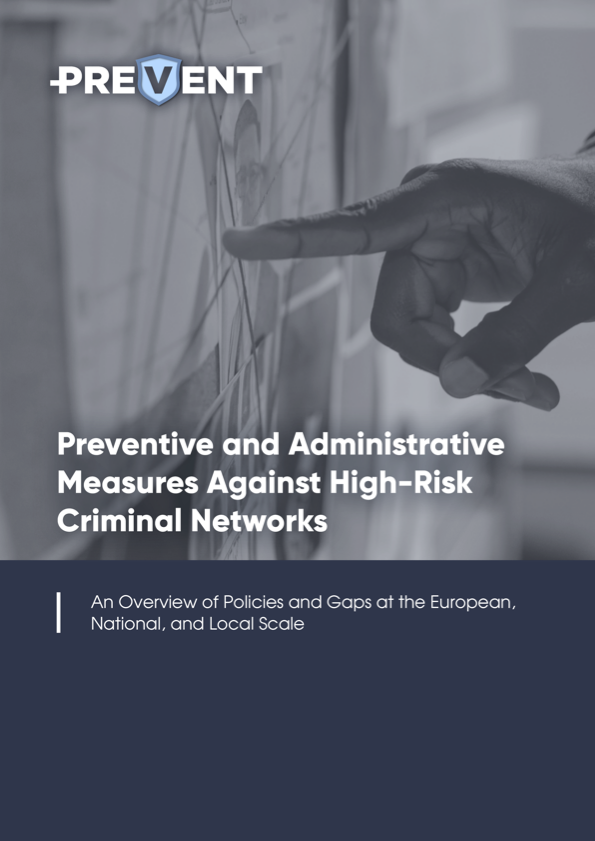
By : Lienke Hutten, Lars Merkus, Joeri Vig
To effectively counter organised crime and high-risk criminal networks, criminal law alone often
falls short. Across the European Union, the administrative approach is increasingly recognised as
a crucial strategy to disrupt the infiltration of criminal networks in the legal economy. This study
maps both the legislative framework and practical initiatives that support the administrative approach
on organised crime drawing on contributions from six member states: Sweden, Belgium,
the Netherlands, Spain, Bulgaria, and Italy. This study maps both the legislative framework and
practical initiatives that support administrative interventions. A structured template was used to
collect country-specific information on relevant laws, the policy framework, and national and local
initiatives. In addition, EU-level strategies and directives were reviewed to assess the broader
policy context and identify shared priorities.
Findings reveal considerable diversity in the design of the legislative frameworks and initiatives.
Countries such as Italy, Belgium, and the Netherlands have developed robust and proactive
frameworks, blending preventive and repressive instruments with administrative possibilities
on the local level. Others, like Sweden, demonstrate how general administrative laws can be
creatively adapted to serve crime prevention goals. Spain and Bulgaria show more centrally arranged
administrative bodies and sector-driven efforts. These differences make it apparent that
there is no one-size-fits-all model for the administrative approach. Gaining insight into the diverse
legal and institutional frameworks across countries enables mutual learning and the identification
of promising initiatives for all member states.
Legislation and initiatives at the European level such as AML directives, procurement rules and
asset recovery reforms can serve as important enablers, though their impact heavily depends
on coordinated implementation. Overall, the administrative approach is gaining attention as an
essential component of internal security, offering flexible and preventive tools with local possibilities
to reduce the infiltration and influence of high-risk criminal networks.

By Monika Sawicka
This paper aims to contribute to the debate on foreign policy strategies of state actors in the international system with a particular focus onpolicies pursued by far-right populist leaders. On the theoretical level,it builds on role theory and status-seeking strategies drawn from social identity theory (SIT) to offer an enhanced conceptual framework suit-able for scrutinising more radical forms of international activism. Thetheoretical points are then illustrated empirically by exposing the find-ings from content analysis of Brazilian policymakers’ speeches and their juxtaposition with the Bolsonaro government’s policies in the areas of environmental protection and regional cooperation. The author’s main claim is that President Jair Bolsonaro and his Foreign Affairs MinisterErnesto Araújo, through their rhetoric about cooperation in SouthAmerica and the Amazon and the actions undertaken by the adminis-tration in these fields, envisioned for Brazil the role of vandal. This had substantial consequences for the country’s international standing.
GEOPOLITICS, 2023, VOL. 28, NO. 2, 619–640

By Tamara Stotz, Angela Bearth, Signe Maria Ghelfi & Michael Siegrist
Due to the increasing number of passengers at airports, regular security checks reached their capacity limits. Thus, alternative security checks are being discussed to increase their efficiency. For example, instead of screening all passengers briefly, a randomly selected sample of passengers could be screened thoroughly. However, such randomization-based security checks could be perceived as less secure based on the assumption that fewer illegal objects would be uncovered than through regular security checks. To analyze whether this is the case, we conducted an online experiment that investigated people’s perceptions of and preference for traditional and randomization-based security checks from both the passenger and the criminal perspectives. The findings suggest that within security checks with explicitly stated equal probabilities of detecting illegal objects, passengers do not exhibit strong preferences for either the traditional or the randomization-based security checks. However, randomization-based security checks would be preferred by criminals. Thus, with regard to security, the status quo, namely traditional security checks, is still the best way to keep airports secure.
Journal of Risk Research, Volume 24, 2021 - Issue 12
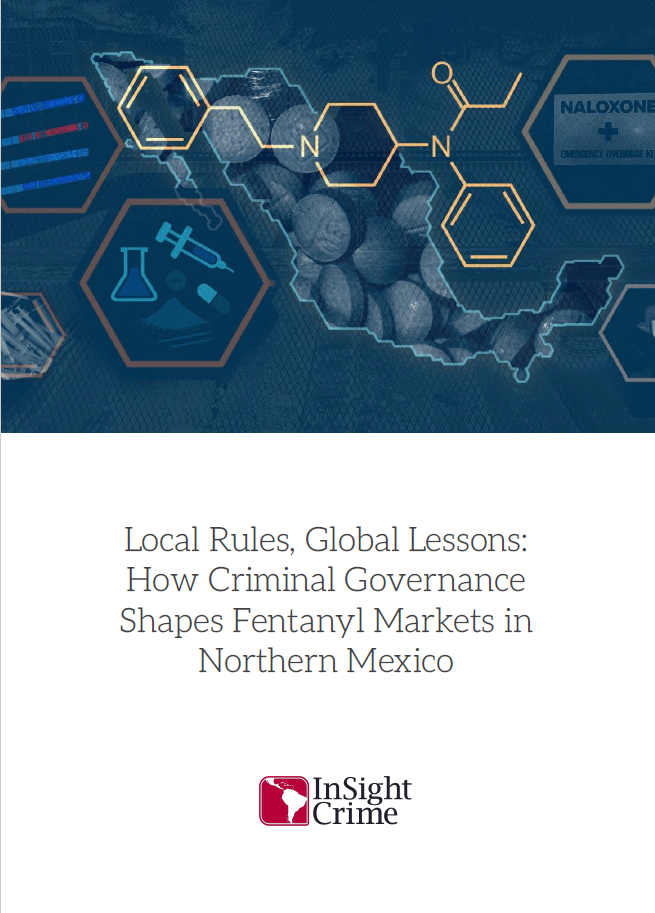
By Steven Dudley, et al.
Although traditional synthetic opioid strongholds like the United States and Canada appear to be experiencing a stabilization of their illicit fentanyl market—evidenced by a historic reduction in overdose deaths 1—synthetic opioids continue to expand across the globe, creating widespread health and security concerns. Existing explanations for the rise and stabilization of these markets focus on economic incentives, supply-chain disruption, precursor controls, consumption patterns, and public-health interventions. But the role of organized crime in structuring retail distribution has been largely overlooked. The experience of Mexico’s northern border illustrates that local criminal governance can be a decisive factor in determining where and how new drug markets take root. Fentanyl, for example, has quietly reshaped drug markets in Mexico and upended some widely held assumptions of how larger criminal groups interact with these markets. As local criminal organizations became major producers and exporters of the synthetic opioid to the United States, domestic consumption also emerged in key trafficking corridors. In Tijuana and Mexicali in Baja California, Hermosillo and Nogales in Sonora, and Ciudad Juárez in Chihuahua, the transnational fentanyl economy has taken root locally, generating unprecedented public health and security pressures. This expansion, however, has been uneven, and the criminal actors who control local drug economies are far from monolithic. Across northern Mexico, fragmented local factions—sometimes linked to larger organizations, sometimes operating with considerable autonomy—determine what reaches consumers and under what conditions. Retail fentanyl markets have therefore expanded not simply in response to demand or price signals, but according to thestrategic decisions of local criminal groups. In Baja California, these groups actively promoted fentanyl sales, enabling the market to consolidate. In Sonoran cities and Ciudad Juárez, they restricted distribution, confining consumption to specific user niches.Overall, the impact on the ground has been substantial. The introduction of fentanyl triggered waves of overdose deaths and serious health effects among users. Although there are signs that the crisis may have stabilized in some areas, the risks persist, and the problem remains underestimated in official statistics, limiting the effectiveness of institutional responses that are already ill-equipped to address it. This report aims to provide a deeper understanding of this issue. It examines fentanyl consumption dynamics in the cities mentioned, traces the evolution of the market, and outlines the distribution networks that sustain it. Additionally, it analyzes the models of criminal control over local drug markets and assesses the state’s response to date. A central question running through the analysis is why fentanyl did not spread uniformly across these cities and what role local criminal structures played in that divergence.
Washington DC: Insight Crime, 2026. 66p.

By Pilar Lizana , Maria Nizzero and Carlos Solar
This paper highlights the critical need for Chile to strengthen its asset-recovery frameworks to combat the growing threat of organised crime and money laundering. It provides an in-depth analysis of the structural challenges hindering Chile's ability to trace, seize and recover illicit assets, and situates these findings within the broader Latin American and global security context. The authors identify key obstacles, including limited risk understanding, weak state governance, gaps in cooperation and information sharing and deficiencies in asset recovery systems. The paper offers actionable recommendations to enhance Chile's institutional resilience and contribute to regional and international security efforts.
Key Recommendations
Establish a centralised asset-management office to ensure effective administration and preservation of confiscated assets.
Invest in training and capacity building to improve risk understanding and investigative capabilities across public and private sectors.
Strengthen public–private cooperation to enhance information sharing and risk mitigation strategies.
Increase human, financial and technological resources for agencies combating organised crime and recovering assets.
Update legislation to include extended confiscation and non-conviction-based confiscation mechanisms, aligning with international standards.
This paper underscores the importance of sustained reforms and international cooperation to disrupt transnational criminal networks and safeguard democratic governance in Chile and beyond.
By The Alliance for Youth Justice
The briefing, funded by the Barrow Cadbury Trust, examines what happens as exploited children turn 18, exploring how responses across safeguarding and criminal justice fail to keep pace with ongoing risk and harm. It sets out principles and practical steps to ensure protection continues into young adulthood and to prevent the unjust criminalisation of victims.
While awareness of CCE has grown, responses for children remain inconsistent and are too often led by punishment. At 18, those weaknesses are magnified. Support frequently falls away, thresholds for help rise, and young adults are more likely to be treated as perpetrators than recognised as victims. As parliament considers the Crime and Policing Bill’s new offence of child criminal exploitation (CCE), there is a critical opportunity to improve the response for victims – but a growing risk that exploited young adults will be prosecuted as perpetrators.
The briefing is informed by an evidence review and consultation with professionals, legal practitioners, academics, civil servants, and sector experts and identifies several urgent issues:
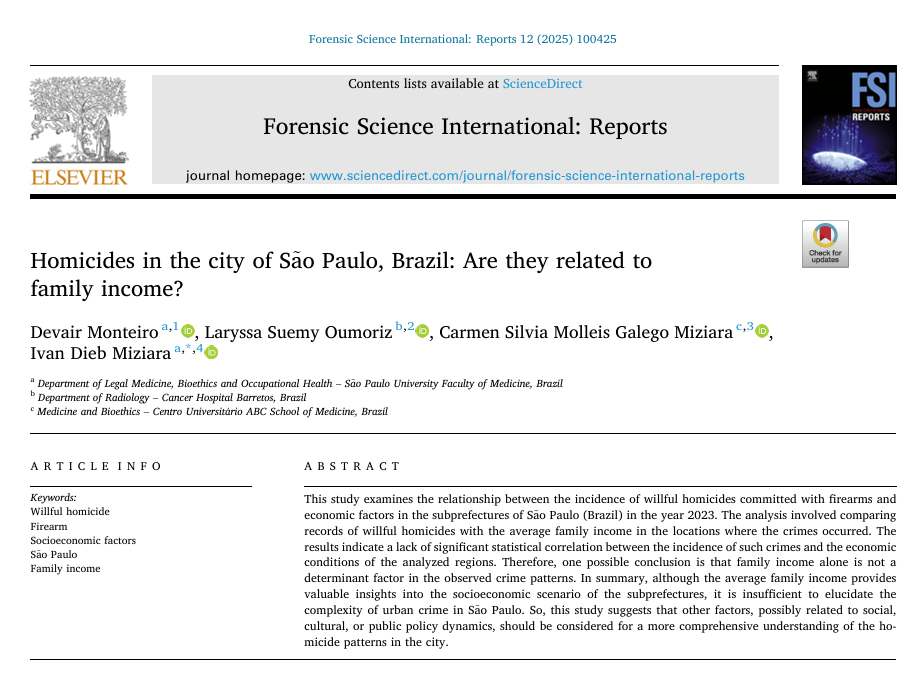
By Devair Monteiro, Laryssa Suemy Oumoriz , Carmen Silvia Molleis Galego Miziara , Ivan Dieb Miziara
This study examines the relationship between the incidence of willful homicides committed with firearms and economic factors in the subprefectures of São Paulo (Brazil) in the year 2023. The analysis involved comparing records of willful homicides with the average family income in the locations where the crimes occurred. The results indicate a lack of significant statistical correlation between the incidence of such crimes and the economic conditions of the analyzed regions. Therefore, one possible conclusion is that family income alone is not a determinant factor in the observed crime patterns. In summary, although the average family income provides valuable insights into the socioeconomic scenario of the subprefectures, it is insufficient to elucidate the complexity of urban crime in São Paulo. So, this study suggests that other factors, possibly related to social, cultural, or public policy dynamics, should be considered for a more comprehensive understanding of the homicide patterns in the city.
Forensic Science International: Reports, Dec. 2025
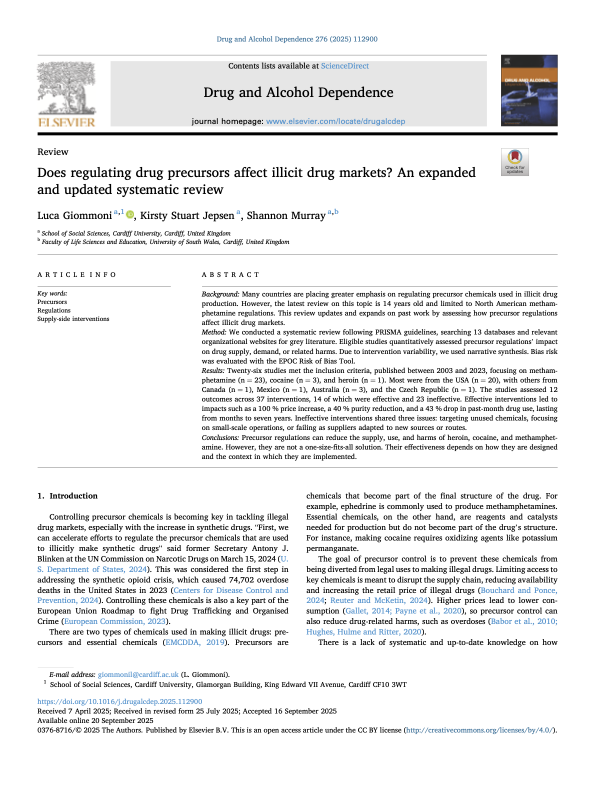
By Luca Giommoni, Kirsty Stuart Jepsen, Shannon Murray
Background
Many countries are placing greater emphasis on regulating precursor chemicals used in illicit drug production. However, the latest review on this topic is 14 years old and limited to North American methamphetamine regulations. This review updates and expands on past work by assessing how precursor regulations affect illicit drug markets.
Method
We conducted a systematic review following PRISMA guidelines, searching 13 databases and relevant organizational websites for grey literature. Eligible studies quantitatively assessed precursor regulations' impact on drug supply, demand, or related harms. Due to intervention variability, we used narrative synthesis. Bias risk was evaluated with the EPOC Risk of Bias Tool.
Results
Twenty-six studies met the inclusion criteria, published between 2003 and 2023, focusing on methamphetamine (n = 23), cocaine (n = 3), and heroin (n = 1). Most were from the USA (n = 20), with others from Canada (n = 1), Mexico (n = 1), Australia (n = 3), and the Czech Republic (n = 1). The studies assessed 12 outcomes across 37 interventions, 14 of which were effective and 23 ineffective. Effective interventions led to impacts such as a 100 % price increase, a 40 % purity reduction, and a 43 % drop in past-month drug use, lasting from months to seven years. Ineffective interventions shared three issues: targeting unused chemicals, focusing on small-scale operations, or failing as suppliers adapted to new sources or routes.
Conclusions
Precursor regulations can reduce the supply, use, and harms of heroin, cocaine, and methamphetamine. However, they are not a one-size-fits-all solution. Their effectiveness depends on how they are designed and the context in which they are implemented.
Drug and Alcohol Dependence; 2025 Volume 276, 1 November 2025, 112900
By Lisa Westfelt, Sara Jonsson and Ulrika Lindstedt
Brå has been commissioned by the Government to survey crime and fear of crime in rural areas. Brå’s commission has included describing the specific nature of criminality and how fear of crime affects people in rural areas. Brå has also analysed the incidence of crimes committed by animal rights activists. The study is mainly based on police report statistics, the Swedish Crime Survey and interviews both with municipal police officers and crime prevention coordinators in rural municipalities and with experts. Less crime and greater sense of safety As with previous studies in this area, the analysis shows that, overall, there is less crime in rural areas. This applies to both reported offences and self-reported victimisation. People living in rural municipalities report less fear of crime than those in other types of municipalities. Crime trends follow broadly the same patterns as elsewhere in Sweden. According to the Swedish Crime Survey, various types of municipalities show no differences in terms of citizens’ experiences with the police, but the survey shows a marginally lower level of confidence in the justice system in rural municipalities. However, several interviewees argue that confidence in the police, as well as in public authorities in general, is lower in certain very sparsely populated rural areas. Specific challenges for crime prevention There are certain conditions in rural areas that, directly or indirectly, impact crime and create challenges for crime prevention. Financial difficulties and skills shortages Many rural municipalities have declining and ageing populations, which leads to a shrinking tax base and financial difficulties. The low population density and declining populations of rural areas have made it more difficult for businesses providing goods and services in rural areas to operate. As public utilities and infrastructure are gradually dismantled, social trust can be negatively affected, and, with it, confidence in the justice system. Our interviews reveal that municipalities experience difficulty in securing necessary skills as well as in recruiting and retaining municipal police.
English summary of Brå report 2025:1 Stockholm: The Swedish National Council for Crime Prevention (Brå), 2025.2025. 8p.
By The Swedish National Council for Crime Prevention
This report focuses on how circumstances and situations that make fraud possible are targeted by fraud prevention measures. The report also includes recommendations for different crime prevention actors.

By Graeme R. Newman and Ronald V. Clarke
In Superhighway Robbery, Graeme Newman and Ronald Clarke provide a grounded, pragmatic analysis of how the digital revolution didn't necessarily create new types of criminals, but rather provided them with a much more efficient set of tools. They move away from the sensationalized "hacker" myths of the early 2000s to focus on the cold reality of Situational Crime Prevention. The book's central thesis is that the internet acts as a vast infrastructure—a superhighway—that significantly reduces the effort required to commit traditional crimes like theft, fraud, and piracy while increasing the potential rewards and lowering the risk of being caught.
By applying their famous CRAVED model to the digital world, the authors explain that data and software are the ultimate targets because they are easily concealable, removable, and available. They argue that the most effective way to stop cybercrime is not to wait for a change in human nature, but to change the digital environment itself. This involves "designing out" crime by making digital targets harder to reach and less profitable to exploit. Ultimately, Newman and Clarke strip away the mystery of the "Information Age" to reveal that cybercrime is essentially a matter of opportunity, and by closing those digital windows of opportunity, we can make the superhighway a significantly safer place.
In the digital realm, the CRAVED model explains why certain data or media becomes a prime target for "superhighway robbery." Concealability is at an all-time high because digital files take up no physical space and can be hidden in encrypted folders or behind innocuous filenames, making them easy to possess without detection. These files are incredibly Removable because they can be copied or moved across the globe in milliseconds, allowing a thief to "steal" an item while the original remains in place. The Availability of these targets is virtually limitless; once a movie or piece of software is uploaded to a server, it is accessible to anyone with a connection, twenty-four hours a day.
The Value of digital goods remains high because they often represent thousands of hours of professional labor or sensitive personal information that can be sold on the dark web. These items are also highly Enjoyable, as they often consist of popular entertainment, games, or high-end tools that people naturally want to use. Finally, they are perfectly Disposablebecause there is a massive, ready-made market of willing buyers or downloaders, ensuring that a criminal can quickly offload their "loot" for profit or social capital without the logistical headaches of physical fencing.
Cullompton, Devon. UK. Willan. 2003.
By Graeme R. Newman
This essay critiques a study by Copes and Vieraitis regarding the "bounded rationality" of identity thieves, arguing that a focus on offender psychology and rationalizations is insufficient for developing effective crime reduction policies[cite: ]Newman contends that current criminal justice approaches rely too heavily on punishment and victim vindication, which, while politically satisfying, fail to reduce the prevalence of identity theft.
The author advances the following arguments regarding the development of effective policy:
* Policies based on the "deep psychology" of offenders or their denial of victims are largely fruitless because these rationalizations are often unconscious defense mechanisms. Instead of asking “why” offenders commit crimes, policy should focus on “how” they are accomplished.
* Newman distinguishes between crime mitigation (reducing damage to victims) and crime prevention (reducing the number of crimes)[cite:. While legislation and credit reporting agencies have improved mitigation efforts for victims, these measures do not address the root causes of the crime.
* Effective prevention must target the technological and business arrangements that create opportunities for theft. This involves shifting focus from the offender to the "significant players" (businesses) who can implement standard security procedures, such as the use of PINs for credit cards, to harden targets.
* The essay concludes that businesses often view fraud merely as a cost of doing business rather than a crime to be prevented[cite:. Therefore, the government must establish policies that compel businesses to accept responsibility for crime reduction and eliminate the opportunities they create through their products and services[cite.
Criminology and Public Policy Vol. 8. Issue 2.

By Megan M. McNally and Graeme R. Newman
From the cover: There has been a glaring lack of scholarly attention to the crime of identity theft, according to the editors. The chapters in this volume attempt to fill some of this gap by exploring theory and research on identity theft, as well as situational measures to prevent its occurrence.
The editors' introduction outlines several key issues related to the definition, extent and commission of identity theft. The chapter by Graeme Newman applies the opportunity perspective to the study of identity theft. Megan
McNally uses the "script" approach to examine the meaning and mechanics of identity theft in all of its forms. Henry Pontell, Gregory Brown and Anastasia Tosouni present new findings on how identity theft affects victims, based on data collected by the Identity Theft Resource Center. Heith Copes and Lynne Vieraitis describe how a sample of identity theft offenders viewed their crimes. Michael Levi recounts the evolution of identity fraud and its control in the U.K. Russell Smith presents a framework for evaluating preventive measures, particularly document-based systems, biometric technologies and identity cards. Sara Berg considers how information technology can be used within a situational crime prevention framework to fight identity theft. Robert Willison examines the use of situational crime prevention to protect sensitive personal information in the context of information systems security.
Crime Prevention Studies, volume 23. Willan Publishing. Culmcott House, Uffculme, Cullompton Devon EX 15 3AT, U.K. 2008. 195p.

By Arthur MacDonald.
The narrative in Volume 1 asks many pointed questions: What does it mean to be “abnormal”? Who decides? And how have these judgments shaped modern science, education, and criminal justice?
First published in 1893, Arthur MacDonald’s Abnormal Man is one of the earliest American attempts to systematically study human difference through the emerging tools of psychology, anthropology, and criminology. Drawing on international research—from European criminal anthropology to American child-study movements—MacDonald sought to classify the physical, mental, and moral traits considered “aberrant” in his era. His work reflects the hopes and anxieties of a society confronting rapid industrialization, immigration, social change, and new scientific approaches to crime and mental health.
To the modern reader, Abnormal Man reveals both the ambition and the pitfalls of nineteenth-century science. Its pages contain pioneering observations about child development, deviance, and social responsibility, alongside early theories—now discredited—about heredity, physiognomy, and race. What emerges is a vivid and sometimes unsettling portrait of a culture striving to understand human variation without the benefit of modern psychology or ethical safeguards.
The Read-Me.org edition Volume 1 presents Abnormal Man as both a historical artifact and a gateway to critical reflection. It illustrates how scientific thought evolves, how cultural bias can shape research, and how early debates about abnormality laid the groundwork for contemporary approaches to mental health, special education, criminology, and social policy. To make such work, much of it controversial then as it is today, minimally believable, requires extensive documentation. The voluminous Bibliography of Abnormal Man reproduced here in Volume 2, contains all that Macdnald referred to within his detailed exposition. To some, his arguments may seem unsupported, or lacking in evidence. But he left no stone untuned as this amazing bibliographical documentation of all relative contemporary research
A foundational text at the crossroads of science and society, Abnormal Man invites readers to explore the origins of modern debates about deviance, diversity, and the boundaries of the “normal.”
Read-Me.Org Inc. New York-Philadelphia-Australia. 2025. 240p.