Open Access Publisher and Free Library
CRIME+CRIMINOLOGY.jpeg

CRIME

Violent-Non-Violent-Cyber-Global-Organized-Environmental-Policing-Crime Prevention-Victimization

Posts tagged illicit economy
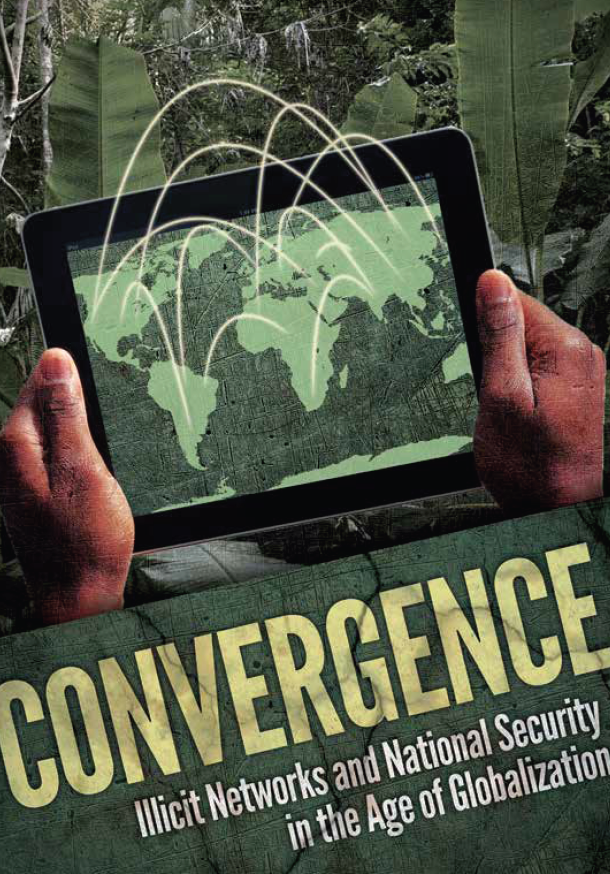
CONVERGENCE: Illicit Networks and National Security in the Age of Globalization

By Michael Miklaucic and Jacqueline Brewer

I llicit networks affect everyone in our modern, globalized world. From human trafficking in Eastern Europe to drug smuggling in East Asia, to the illicit arms trade in Africa, to terrorist cells in East Asia and insurgents in the Caucasus, transnational illicit networks have tentacles that reach everywhere. The trade in illegal narcotics is perhaps most worrisome, but of growing concern is the illicit trafficking of counterfeit items, weapons, natural resources, money, cultural property, and even people by shrewd, well-resourced, and nefarious adversaries. I have experience combating these threats personally at the tactical, operational, and strategic levels. As a young naval officer on a variety of ships, I spent a fair amount of time patrolling the global commons where transnational criminals in the guise of pirates and drug smugglers proliferate. I was in the Pentagon on 9/11 and personally experienced the global reach of modern terrorism. Later on, when I commanded U.S. Southern Command (USSOUTHCOM), one of my subordinate commands was Joint Interagency Task Force–South in Key West, Florida, a multinational and interagency/interministerial command that counters drug trafficking in the Western Hemisphere. I also experienced the pernicious effects that transnational crime has on our friends as it ranges throughout the entire Western Hemisphere. After leaving USSOUTHCOM to become commander at U.S. European Command (USEUCOM), I saw that Europe was also challenged by the same types of transnational crime. In response, I stood up the Joint/Interagency Counter Trafficking Center in Stuttgart, Germany, designed to counter transnational criminal networks in cooperation with our international partners. When I took command of USEUCOM, I also became the Supreme Allied Commander, Europe (SACEUR). As SACEUR, I command Operation Active Endeavor, which counters trafficking in the Mediterranean, and Operation Ocean Shield, which is part of the international counterpiracy efforts off the Somali coast. In addition, we have pioneered responses to cyber threats. At the Supreme Headquarters Allied Powers Europe, we have the North Atlantic Treaty Organization Computer Incident Response Center, and at USEUCOM, we are taking steps to create a subunified cyber command that will have links to both U.S. Cyber Command in the United States and USEUCOM in Germany. All of these organizations were designed to facilitate a whole-of-government approach, where all elements of national power work together in order to address emerging threats. Eventually, once societies understand the nature of the threats facing them, they will hope- fully mobilize nongovernmental assets, adopting a “whole of society” approach. When all of these elements work together, governmental and nongovernmental groups can join international regional and global groups to form a “whole of international society” approach, allowing us to close the seams that exist between nations and regions. Only then will we be able to close these illicit transnational networks. These networks have taken advantage of modern advances in communications and transportation to globalize. Narcotraffickers in the Andean Ridge, for instance, have expanded operations as far as their markets in the United States and Europe. Illegal arms merchants have expanded their operations around the world. Human smugglers have moved their slaves from underdeveloped countries to sex operations throughout the developed world. And, of course, we have all seen the global reach of modern transnational terrorism. No one is immune from this insidious threat. 


Center for Complex Operations Institute for National Strategic Studies By National Defense University Press Washington, D.C., 2013. 304p.

Youth Gangs in Liberia: Motives, Structure and Illicit Economies

By Ndubuisi Christian Ani, Feyi Ogunade and John Kamma 

Gangsterism in Liberia lies at the intersection of a society ravaged by civil war, a declining economy, social exclusion of a bulging underclass, collusion between state officials and illicit markets, and inefficient law enforcement. For youths, gang involvement offers a sense of belonging, a surrogate family structure, and a means of protection and economic benefits. Gangs are also available for hire by politicians, criminal networks and business people seeking to intimidate their opponents or protect properties. Key recommendations • A policy against gangsterism and criminal groupings is urgently needed in Liberia. A comprehensive policy would offer opportunities for a holistic response that involves the improved provision of public services, including enhanced law enforcement, in communities. • Youth-focused development is a critical priority for addressing the causes of gang violence and drug abuse in Liberia. Without discounting the importance of quick-impact youth empowerment initiatives, development programmes need to be long-term. • Schools should have drug prevention programmes. • International support could help Liberia establish treatment and rehabilitation centres to address substance abuse and criminality. • The Economic Community of West African States and African Union should establish a joint task force with Liberia, Sierra Leone and Guinea to disrupt kush production points Research Paper and supply chains  

ENACT Africa, 2025. 28p.

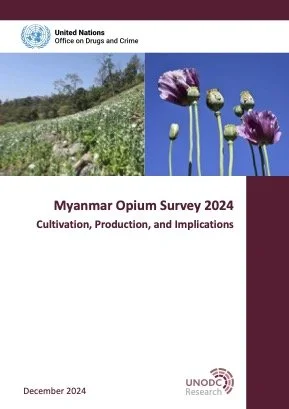
Myanmar Opium Survey 2024: Cultivation, Production, and Implications

By The United Nations Office on Drugs and Crime (UNODC).  UNODC Regional Office for Southeast Asia and the Pacific

  This report presents the results of the twenty-second Myanmar opium survey, covering the 2023/2024 opium growing and harvesting season. The last three surveys in Myanmar covering the 2020/2021, 2021/2022, and the 2022/2023 seasons showed an increase at the national level in both areas under opium poppy cultivation and opium production. The 2023 survey reported an 18% increase in the area under cultivation to an estimated 47,100 hectares. For the first time in three years the 2024 survey shows a modest decline in the area under cultivation by 4% to 45,200 hectares, indicating a possible stabilization at recent high levels. Three consecutive years of expanding cultivation followed by a year of limited decline could indicate some degree of saturation in regional heroin markets supplied by Myanmar. Declining prices of fresh opium in Myanmar and declining purity adjusted prices of heroin in regional markets could have dissuaded a further increase of production in Myanmar in 2024. However, information from the field suggests that the stagnation in productivity could also be related to the ongoing internal conflict. While instability and conflict, and their impact on the rule of law have traditionally been seen as a driver of illicit crop cultivation, the expansion of the conflict and shifts in the territorial control of armed actors, especially in the growing areas of Shan and Kachin, have limited the mobility of rural population, and likely prevented farmers from accessing cultivation areas further away from their villages. The dynamics of internal conflict might also explain the uneven development across Myanmar’s states in regions, with some areas showing declines in cultivation and others continued growth. In October 2024, the UN Office for the Coordination of Humanitarian Affairs (OCHA) estimated that there were some 3 million people internally displaced across the country, with Shan and Kachin in particular seeing escalating tensions and clashes in late 2023 and early 2024. The 2024 survey shows decreases in illicit opium cultivation in half of the geographic areas observed, including South Shan which traditionally experienced the most extensive opium cultivation. Eastern Shan, Chin, and Kayah had modest increases between survey years. Overall, cultivation in Shan State, which continues to be the centre of opium production in Myanmar at 88% of total cultivation area, decreased by 4% to 39,700 ha, with decreases in South and North Shan (-9% and -4% respectively) while East Shan increased by 10%. Cultivation in Kachin saw a moderate decrease of 10%, a change from past trends when above-average increases were observed. Estimates for Chin and Kayah, where the overall area remained small in comparison to other areas, showed an 18% and 8% increase, respectively. Overall potential opium production decreased at greater rates than cultivation due to a decline in opium yield. In 2024, average yield declined by 4% from 22.9 kg per hectare to 22kg per hectare, resulting in an estimated opium production of 995 (700-1,580) metric tons, or 8% less than in 2023. Nevertheless, both yield and production remain at high levels across the last decade. The decrease in cultivation and production coincided with a decrease in farmgate prices of both fresh and dry opium in USD terms, by 4% and 8%, respectively. In 2024, fresh opium traded at just over US$300 per kilogram, down from US$317 the year before, although it remained high compared to the last low point in 2021 when it stood at US$131 per kilogram. In combination with lower production, nationally farmers earned slightly less income than the previous year, between US$230 – US$518 million in 2024 (US$271 - US$613 million in 2023). The farmgate value only represents a small share of the overall opiate economy, with heroin manufacture and export making up a larger share. Wholesale prices of heroin in the region declined even more, contributing to a much larger decrease in the value of the total national opiate economy of about 40%, now ranging between US$589 million and US$1.57 billion, representing between 0.9 – 2.4% of Myanmar’s 2023 GDP  

Thailand: UNODC Regional Office for Southeast Asia and the Pacific 2024. 88p.