
By The Sentry
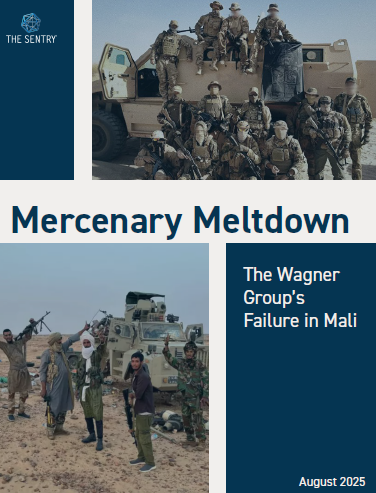
The first Wagner Group fighters arrived in Bamako in January 2022 to assist the Malian military junta in its counterterrorism campaign.1 Three and a half years later, the group has announced its withdrawal from Mali to make space for Africa Corps with the statement “Mission accomplished.”2 But as the number of Wagner fighters in Mali will stay roughly the same, since many had already signed contracts with the Russian state prior to the announcement,3, 4 the group’s claim to success—and their overall strategy in Mali—merits scrutiny. Despite the Wagner Group possessing a reputation for being battle-ready and claiming occasional public triumphs in Mali, its strategy has been plagued by a series of failures.5 Wagner forces have been unable to take control of areas in the north and center of the country where armed terrorist and separatist groups are challenging the authority of the Malian state. There has been a significant increase in attacks on civilians and in civilian casualties since Wagner’s arrival in Mali, and this, in turn, has severely undermined relations between the Malian military and the Malian public. Faced with challenges such as insufficient air support, a lack of trust, and a lack of reliable information from informants, the Wagner Group has become more reactive and violent—allowing the very terrorist groups they were hired to neutralize to gain more control and increase recruitment in Mali. Wagner’s playbook in Mali has not only affected the civilian population; it has also helped perpetuate insecurity and has paved the way for the fragmentation of the Malian state. Wagner fighters have created chaos and fear within the Malian military hierarchy, forcing the Forces Armées Maliennes (Malian Armed Forces, or FAMA) to remain silent in cases of civilian abuse. In addition, the lack of order and communication within the chain of command has led to the progressive deterioration of the FAMA’s ranks. Abuses against the Malian armed forces by Wagner troops have increased, as have complaints from Malian soldiers. Within the Malian military junta itself, the varying degrees of partnership with Russian actors are contributing to a shift in power relations in Bamako, as Malian leaders regard one another with suspicion. Despite official discourse suggesting that Wagner and Russia are reliable partners in the Malian conflict, the Wagner command in Mali has demonstrated a reluctance to intervene militarily—even in cases where the capital is directly threatened—without first having assurances of financial compensation. At the outset of its Malian venture, Wagner was seeking to secure mining concessions that would likely replicate the group’s self-funding arrangements in other countries. However, the Malian junta appears unwilling to allow Wagner to control the mining sector, and Wagner’s forays into that sector have thus far been limited. Ultimately, the Wagner Group has failed in its task of eliminating terrorist groups in Mali. The Russian presence is instead creating upheaval amid the Malian military and causing rifts within the Malian junta. And as Wagner has seemingly gone unpaid for months and failed to obtain access to lucrative natural resources, its deployment in Mali has not been a worthwhile investment for any party involved. Wagner is not an infallible actor. If anything, the Malian example illustrates that the group can fail, and this should be a warning to other African clients who are considering hiring Wagner—or its more officialoffshoot, Africa Corps. At the same time, policymakers in the Global North should see Wagner’s failures as an opportunity for alternative policy approaches in the Sahel region. Key recommendations • The Office of the Prosecutor at the International Criminal Court (ICC) should open an investigation into war crimes perpetrated by Wagner troops in Mali and prosecute those responsible for human rights abuses. Alternatively, the United Nations Security Council should refer Wagner abuses in Mali to the Office of the Prosecutor at the ICC. • The government of Mali should take steps toward criminal accountability and reparations for the victims of massacres such as Moura, as well as for the abuses against and displacement of civilian populations following attacks by the Wagner Group in the north and west of the country. • The EU, the US, the UK, Canada, and Australia should investigate and, if appropriate, designate for sanctions the network of individuals and entities in Sadio Camara’s inner circle who enable, support, or benefit from Wagner’s presence in the country, as well as those involved in corruption and human rights abuses. They should coordinate sanctions to increase their impact. • International mining companies operating in Mali and foreign refineries processing Malian gold should conduct comprehensive audits of their operations to ensure that they are not conducting business with sanctioned Wagner Group entities or individuals, such as Ivan Maslov. • The Algerian government should facilitate renewed negotiations on a peace agreement between Bamako and the northern rebel groups. As the political and security landscape has changed since the 2015 agreement, which was facilitated by Algeria, including as a result of the withdrawal of the UN peacekeeping operation MINUSMA, new terms will need to be agreed.
The Sentry, 2025. 55p.
