
Open Access Free Library
CRIME+CRIMINOLOGY.jpeg

CRIME

Violent-Non-Violent-Cyber-Global-Organized-Environmental-Policing-Crime Prevention-Victimization

Posts tagged childhood violence
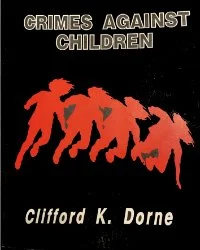
Crimes Against Children

by Clifford K. Dorne, with a Foreword by Graeme R. Newman

Why has American society so often treated child abuse as a family problem to be managed rather than a crime to be punished? In this pioneering study, first published in 1989 by Harrow and Heston, Clifford Dorne traces how the nation's response to child maltreatment was shaped by competing professions: social workers, physicians, psychiatrists, legislators, police, and the courts.

Dorne begins by untangling the overlapping definitions of abuse, neglect, molestation, incest, and institutional abuse. He then follows the history of child protection from the houses of refuge and child labor campaigns of the nineteenth century, through the founding of the Societies for the Prevention of Cruelty to Children and the invention of the juvenile court, to the "medicalization" of abuse after the discovery of the battered child syndrome. Later chapters examine reporting laws, child protective services, the criminal prosecution of abusers, and what criminology has learned about the causes and lasting effects of maltreatment.

Written as a blueprint for university courses, the book is notable for bringing the neglected criminal justice perspective into a field long dominated by social welfare and medicine. Graeme Newman's foreword praises it as thorough, clear, and concise. It remains a valuable record of how the modern child protection system came to be.

Read-Me.Org Inc. New York-Philadelphia-Australia. 2026. p. 267.
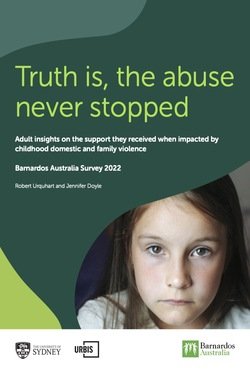
Truth Is, The Abuse Never Stopped: Adult insights on the support they received when impacted by childhood domestic and family violence

By  Robert Urquhart and Jennifer Doyle 

The devastating effect of domestic and family violence (DFV) on children and young people has been increasingly researched, and its lasting impact acknowledged. Yet, despite the evidence, children and young people continue to be regarded as onlookers who ‘witness’ DFV, rather than as victims who directly experience DFV. Indeed, recognition of children and young people experiencing DFV as victim survivors in their own right and with their own unique needs is long overdue. It is time to recognise children and young people as equal victim survivors with their own safety and support needs, and to establish appropriate DFV support policy and programs which reflect the presence of multiple victims of DFV.  

Sydney: Barnardos Australia, 2022. 116p.

Children, Families and Violence: Challenges for Children's Rights

By Katherine Covell and R. Brian Howe

This book examines the risk factors surrounding children at risk of experiencing and perpetrating violence, and looks at the positive role that children's rights can play in their protection.The authors propose that violence in childhood is not spontaneous: that children are raised to become violent in poorly functioning families and child-unfriendly environments. They may be exposed to toxic substances in utero, to maltreatment in infancy, to domestic violence or parental criminality as they grow up. Each of these risk factors is empirically linked with the development of antisocial and aggressive behaviour, and each reflects a violation of children's rights to protection from maltreatment. The authors show how respecting children's rights and safeguarding them from exposure to violence can shift the balance between risk and protective factors and, as a result, reduce the incidence and severity of childhood violence.

Jessica Kingsley Publishers, 2008. 288p.