Open Access Publisher and Free Library
CRIME+CRIMINOLOGY.jpeg

CRIME

Violent-Non-Violent-Cyber-Global-Organized-Environmental-Policing-Crime Prevention-Victimization

Posts in criminal law
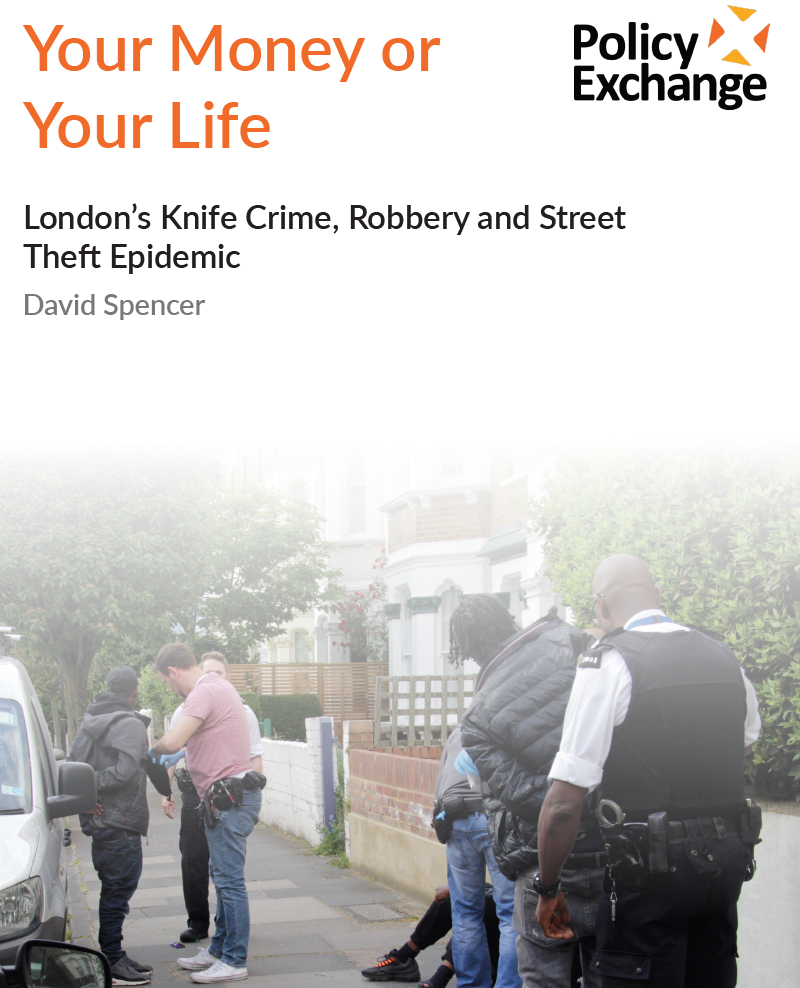
Your Money or Your Life:  London’s Knife Crime, Robbery and Street Theft Epidemic 

By David Spencer

A new report from Policy Exchange demonstrates how London is in the grip of a street crime epidemic and makes seventeen recommendations to show how the Metropolitan Police, City Hall and the Government can turn the tide.  

The report shows that:

  • Knife crime in London increased by 58.5% in only three years between 2021 and 2024;

  • Only 1 in 20 robberies and 1 in 170 “theft person” crimes in the capital were solved last year.

  • 60% of the knife crimes committed in the capital were robberies – with over 81,000 mobile phones stolen in robberies and thefts last year.

  • In 2024 one small geographic area of around 20 streets in London’s West End near Oxford Circus and Regent Street had more knife crime than nearly 15% of the rest capital combined; in 2023 these streets had more knife crime than 23% of the capital combined.

  •  

 The report identifies the top 20 neighbourhoods (technically known as Lower Layer Super Output Areas or LSOAs of about 15-20 streets each) in London which had the highest levels of knife crime in 2024. One in 15 of every knife crime offence in the capital in 2024 occurred in one of these 20 neighbourhoods (908 knife crimes). In 2024 only 4% of neighbourhoods accounted for nearly a quarter of all knife crime offences in the capital (3,615 knife crimes) and 15% of neighbourhoods accounted for half of all knife crime offences (7055 knife crimes).

The report identifies that within the Metropolitan Police there are least 850 police officers currently in non-frontline posts which could be redeployed to the policing frontline to tackle knife crime, robbery and theft in the areas where criminals are most prolific. This includes police officers currently posted to the following departments: Transformation (142 officers), Human Resources (24 officers), Culture, Diversity and Inclusion (20 officers) and Digital, Data & Technology (34 officers).  

Policy Exchange rejects the suggestion that stop and search is being deployed in a “racist” way. While only 39.5% of those stopped and searched by the police are black, 43.6% of those charged with murder are black, 45.6% of non-domestic knife-crime murder victims are black and 48.6% of robbery suspects are black. 13.5% of London’s population are black. Policy Exchange asserts that it is not “racist” when the police are merely responding to the demographic breakdown of serious and violent offending in the capital.  

Policy Exchange analysis shows that the courts are taking a dangerously lax approach to the most prolific criminals. Despite already having 46 or more previous convictions, “Hyper-Prolific Offenders” are sent to prison on less than half of all occasions (44.5%) on conviction for a further indictable or either-way offence – 4,555 such criminals walked free from court in 2024. For “Super-Prolific Offenders” (those with 26 to 45 previous offences) this falls to 42.1% with 9,483 such criminals walking free from court in 2024. Despite there being mandatory sentencing provisions for repeat knife-carriers to be sent to prison over a third are not sentenced to a term of immediate custody

THE MUSLIM BROTHERHOOD’S STRATEGIC ENTRYISM INTO THE UNITED STATES: A SYSTEMIC ANALYSIS

By The Institute for the Study of Global Antisemitism and Policy (ISGAP)

This study investigates the Muslim Brotherhood’s strategy of “civilizational struggle” (jihad) in Western society, with a specific focus on the United States. By analyzing primary documents, including the “Explanatory Memorandum” (1991) and “The Project” (1982), along with comparative historical analysis, it traces the development of the Brotherhood’s doctrine of tamkeen (institutional entrenchment) from its theoretical roots in early twentieth-century Egypt to its more advanced practical application in the United States. The study identifies and thoroughly analyzes four strategic domains of influence: policy impact through government entryism and coalition-building; manipulation of the legal framework via lawfare and the redefinition of core concepts; institutional infiltration across educational and civil society organizations; and the establishment of narrative control through media influence and discourse shaping. Multiple detailed case studies within each domain show how Brotherhoodaligned groups have executed these strategies across different countries and historical periods. The analysis in this study, supported by extensive documentary evidence and organizational network assessments, demonstrates that the Muslim Brotherhood’s long-term strategy is a deliberate, multigenerational effort that closely aligns with its founders’ vision of gradually transforming Western society from within, primarily through nonviolent means. Ideologically speaking, it is also fundamentally opposed to Western democratic values and governance systems. This study offers an important assessment of the key strategic objectives of Islamist extremism and ideological entryism within democratic systems by the Muslim Brotherhood, as well as the intersection of Islamist extremism with religious identity politics that exploit democratic principles, multicultural respect for diversity, and transnational movements in an era of globalization and information warfare. The study concludes with an assessment of the challenges faced by policymakers, security professionals, and civil society leaders who aim to protect democratic values while respecting religious freedoms. In a nutshell, it states that effective responses need to balance security concerns with civil liberties, differentiate between genuine religious practice and ideological extremism, and create more sophisticated frameworks for understanding and addressing radical Islamism.

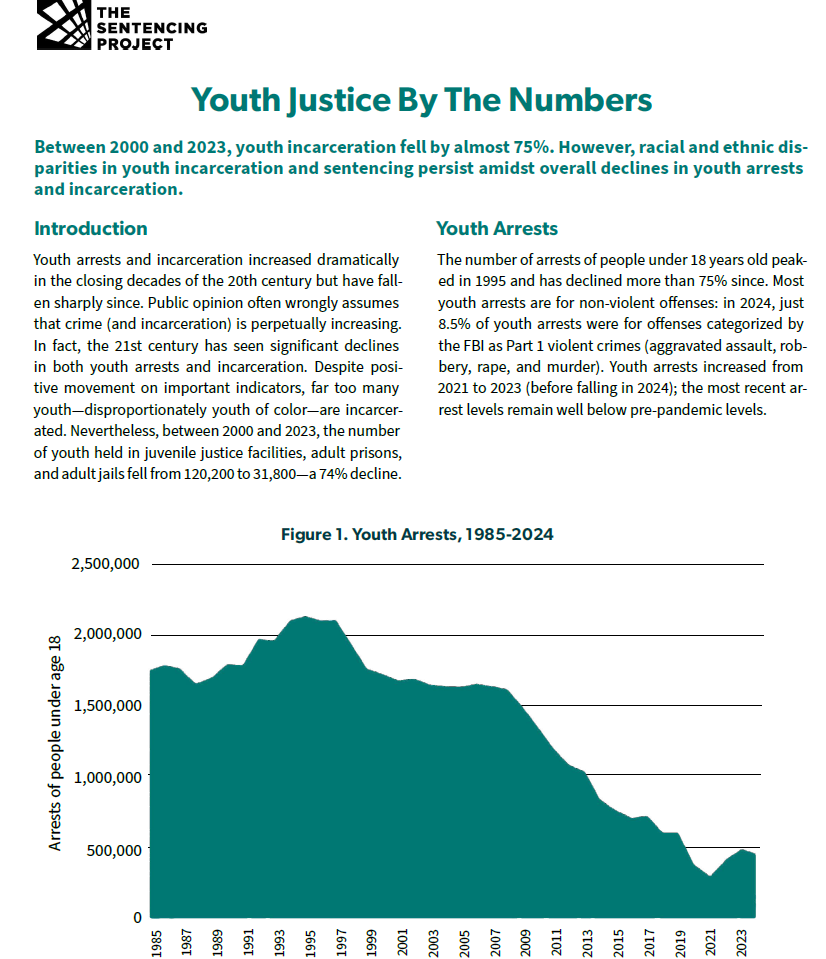
Youth Justice by the Numbers

By Joshua Rovner

Youth arrests and incarceration increased dramatically in the closing decades of the 20th century but have fallen sharply since. Public opinion often wrongly assumes that crime (and incarceration) is perpetually increasing. In fact, the 21st century has seen significant declines in both youth arrests and incarceration. Despite positive movement on important indicators, far too many youth—disproportionately youth of color—are incarcerated. Nevertheless, between 2000 and 2023, the number of youth held in juvenile justice facilities, adult prisons, and adult jails fell from 120,200 to 31,800—a 74% decline.

Understanding variation in juvenile life without parole legislation following Miller

By Leah Ouellet, Daphne M. Brydon, Laura S. Abrams, Jeffrey T. Ward, Dylan B. Jackson, Rebecca Turner, J. Z. Bennett, Reese Howard, Ashley Xu


Miller v. Alabama and Montgomery v. Louisiana restricted states’ ability to impose life without parole for youth under age 18 (henceforth JLWOP). Since Miller, 46 pieces of legislation across 34 states and the District of Columbia have altered JLWOP sentencing policies. The current study provides the first comprehensive and scientific review of this legislation. Using policy surveillance as a methodological guide, we found that a majority of statutes (N = 28) ban JLWOP sentencing, above and beyond the Supreme Court's requirement. Many statutes also extended sentencing reforms and post-conviction relief eligibility to other types of sentencing beyond JLWOP. However, all but one statute still allows either JLWOP or life with parole as a sentencing option for minors convicted of homicide crimes and requires between 15 and 40 years, at minimum, to be served before being eligible for release. Grounding our analysis in institutional theory, we argue that the relative punitivity of the JLWOP reforms enacted was associated with measures of JLWOP institutionalization across states (i.e., pre-Miller JLWOP population and pre-Miller sentencing schema), suggesting that states where JLWOP was more routinely used were more resistant to policy reform.

Policy Implications

The current study provides implications for future decarceration efforts. Findings suggest that state legislatures are willing to enact post-conviction relief measures (e.g., judicial review or “second look” measures) for individuals convicted of violent crimes to address over-incarceration, deviating from previous decarceration efforts focused on non-violent, low-level offenses. In spite of the promising window for juvenile justice reform that Miller provided, however, these reforms have taken a relatively modest, incremental approach toward altering extreme youth sentencing practices in the United States. Policy makers and advocates seeking to promote sentencing reform efforts should factor in how highly institutionalized a sentencing practice is in each state, as this might inform effective strategies for policy change.

The role of UK policing in economic growth

By Crest Advisory with RSM UK Consulting

Economic growth is the number one mission of the Government in the UK, seeking to restore stability, increase investment and reform the economy to improve productivity, prosperity, and living standards. This commitment has been made in the context of a sustained period of economic stagnation, throughout which there has been an ongoing conversation as to whether the right levers are being pulled to achieve economic growth. The Office of the Chief Scientific Adviser for the National Police Chiefs’ Council (NPCC) commissioned us to understand the role of policing as a lever - our research seeks to collate existing evidence as well as identify where there are opportunities to develop this evidence in the future. This research also falls within the wider discussion on police funding, police productivity and police reform which is particularly relevant given that the Home Office will be looking to find savings ahead of this year’s spending review as an unprotected government department, ongoing debate about the police funding formula and growing financial pressures on police forces. Science and technology has a significant role to play in police efficiency and effectiveness, but also growth. The NPCC’s Science and Technology Strategy sets a clear ambition for policing “to deliver the most science and technology led police service in the world”. Often, our understanding of policing impact is focused on implementation and public safety outcomes, but economic outcomes have the potential to shift the narrative in terms of how we define an effective and efficient police response. Our work, in partnership with RSM UK Consulting, has sought to understand the evidence between policing and economic outcomes, from which we have produced a logic model to understand these relationships (a logic model conceptualises the links between activities and key outcomes). While we have not been able to estimate the scale of impact of UK policing on economic growth, we hope this logic model can act as a framework for partners to use to further develop the evidence base around the impact of policing on economic outcomes, specifically designing evaluations with these outcomes in mind. In time, this evidence may begin to change how we understand the positive impact of policing on individuals, businesses and communities in England and Wales - with the potential for positive economic outcomes influencing future decisions on funding allocations and commitments to specific policing initiatives and operational interventions. Furthermore, growth could sit alongside efficiency and effectiveness as key metrics for success in policing.

London: Crest Advisory, 2025. 69p.