
Open Access Publisher and Free Library
CRIME+CRIMINOLOGY.jpeg

CRIME

Violent-Non-Violent-Cyber-Global-Organized-Environmental-Policing-Crime Prevention-Victimization

Posts tagged cyber enabled fraud
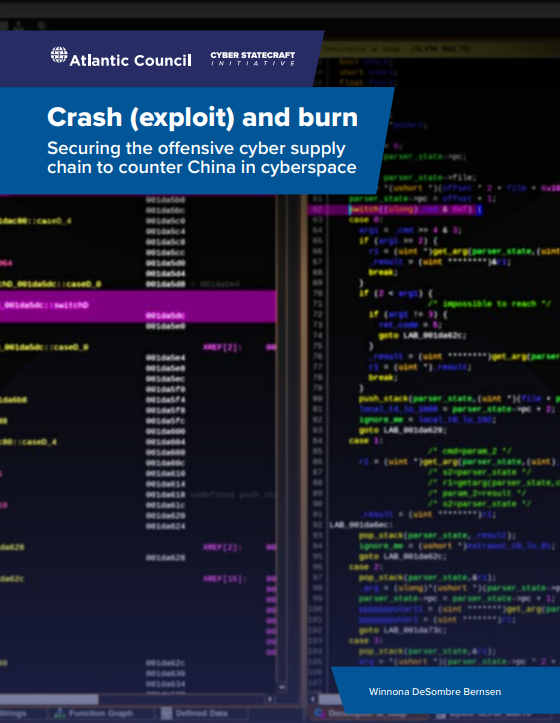
Crash (exploit) and burn: Securing the offensive cyber supply chain to counter China in cyberspace,

By Winnona DeSombre Bernsen

If the United States wants to increasingly use offensive cyber operations internationally, does it have the supply chain and acquisition capabilities to back it up—especially if its adversary is the People’s Republic of China? 

 The Cyber Statecraft Initiative’s new report from CSI nonresident fellow Winnona DeSombre Bernsen, Crash (exploit) and burn: Securing the offensive cyber supply chain to counter China in cyberspace,  is the first to conduct a comparative study within the international offensive cyber supply chain, comparing the United States’ fragmented, risk-averse acquisition model with China’s outsourced and funnel-like approach.

 Strategic competition between the United States and China has long played out in cyberspace, where offensive cyber capabilities, like zero-day vulnerabilities, are a strategic resource. Since 2016, China has been turning the zero-day marketplace in East Asia into a funnel of offensive cyber capabilities for its military and intelligence services, both to ensure it can break into the most secure Western technologies and to deny the United States from obtaining similar capabilities from the region. If the United States wishes to compete in cyberspace, it must compete against China to secure its offensive cyber supply chain.

Washington, DC: Atlantic Council, 2025. 44p

Trends in and Characteristics of Cybercrime in NSW.

By Ilya Klauzner, Amy Pisani

  AIM To examine the trends in, major characteristics of, and the police response to cybercrime in NSW. METHOD We extracted data from the ReportCyber Application Platform (RCAP), a national cybercrime reporting system operated by the Australian Cyber Security Centre. Data was analysed over a three-year period from 1 July 2019 to 30 June 2022 and was restricted to incidents where the victim resided in NSW. We separate cybercrime into five offence categories: cyber-enabled fraud, identity theft, cyber-enabled abuse, online image abuse (OIA), and device. We conducted a descriptive analysis on the victim, suspected perpetrator, and report characteristics to report on trends and characteristics of reported cybercrime. We estimated an ordinary least squares regression model to identify factors correlated with a referral to police of reported cybercrime. RESULTS Over the three years to June 2022, there were 39,494 reports of cybercrime where the victim resided in NSW, and more than $404 million reported lost. Cybercrime reports increased by 42%, with all cyber offence categories increasing except cyber abuse. Increases in cyber enabled fraud and identity crime, spurred a corresponding increase in reported cyber crime related financial losses by individuals. Most victims were individuals (89%), male (53%) and over 25 years of age (87%); however, differences in victim type were observed within offence categories. While a high proportion of victims have evidence about the incident (94%), the majority did not know their perpetrator and therefore few reports included suspect details (28%). The majority (71%) of reports were closed by police in RCAP with no further investigation undertaken. Reports were however more likely to be referred to police when the incident involved a victim aged 17 years or younger, the suspect was known to the victim, money was lost, or an OIA offence was indicated. CONCLUSION Our results show that cybercrime in NSW largely follows the same increasing trend that has been observed in national cybercrime studies. However, the statistics we report here only offer a partial view of reported cybercrime in NSW as we do not capture data reported directly to police or other national reporting systems. There are clear benefits in ongoing public reporting of cybercrime trends both at the national level and separately for individual states and territories, which could be enabled by integrating reporting systems and enhancing police data

Bureau Brief no. 165. 

Sydney:  NSW Bureau of Crime Statistics and Research. , 2023. 18p.