
Open Access Publisher and Free Library
CRIME+CRIMINOLOGY.jpeg

CRIME

Violent-Non-Violent-Cyber-Global-Organized-Environmental-Policing-Crime Prevention-Victimization

Posts tagged immigration detention
A New Balance in Prolonged Mandatory Immigration Detention

By Mary Holper

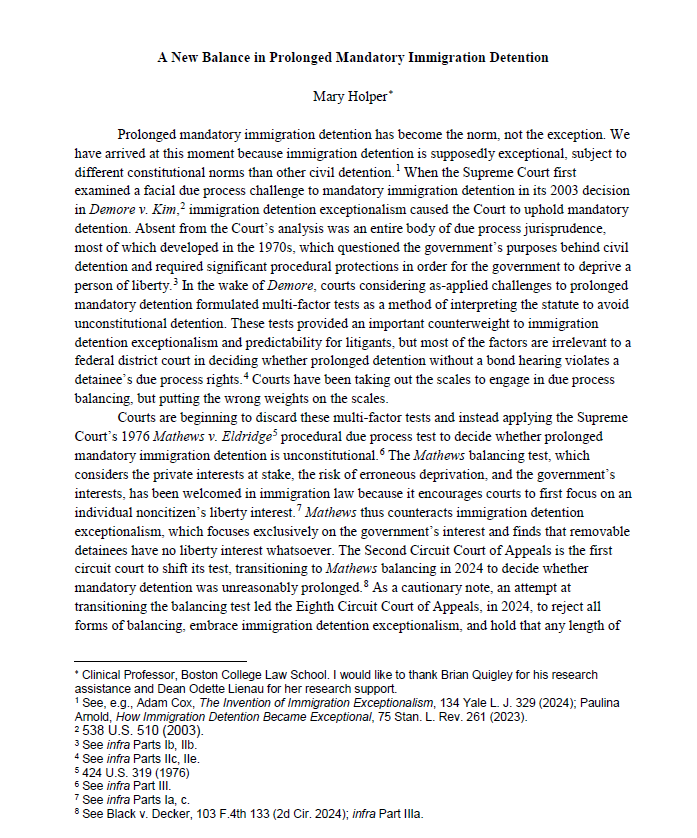
Prolonged mandatory immigration detention has become the norm, not the exception. We have arrived at this moment because immigration detention is supposedly exceptional, subject to different constitutional norms than other civil detention. When the Supreme Court first examined a facial due process challenge to mandatory immigration detention in its 2003 decision in Demore v. Kim, immigration detention exceptionalism caused the Court to uphold mandatory detention. Absent from the Court's analysis was an entire body of due process jurisprudence, most of which developed in the 1970s, which questioned the government's purposes behind civil detention and required significant procedural protections in order for the government to deprive a person of liberty. In the wake of Demore, courts considering as-applied challenges to prolonged mandatory detention formulated multi-factor tests as a method of interpreting the statute to avoid unconstitutional detention. These tests provided an important counterweight to immigration detention exceptionalism and predictability for litigants, but most of the factors are irrelevant to a federal district court in deciding whether prolonged detention without a bond hearing violates a detainee's due process rights. Courts have been taking out the scales to engage in due process balancing, but putting the wrong weights on the scales.

Courts are beginning to discard these multi-factor tests and instead applying the Supreme Court's 1976 Mathews v. Eldridge procedural due process test to decide whether prolonged mandatory immigration detention is unconstitutional. The Mathews balancing test, which considers the private interests at stake, the risk of erroneous deprivation, and the government's interests, has been welcomed in immigration law because it encourages courts to first focus on an individual noncitizen's liberty interest. Mathews thus counteracts immigration detention exceptionalism, which focuses exclusively on the government's interest and finds that removable detainees have no liberty interest whatsoever. The Second Circuit Court of Appeals is the first circuit court to shift its test, transitioning to Mathews balancing in 2024 to decide whether mandatory detention was unreasonably prolonged. As a cautionary note, an attempt at transitioning the balancing test led the Eighth Circuit Court of Appeals, in 2024, to reject all forms of balancing, embrace immigration detention exceptionalism, and hold that any length of mandatory detention is acceptable during removal proceedings. This Article argues that courts can make prolonged mandatory immigration detention exceptional by continuing the work of the Second Circuit in applying the Mathews procedural due process balancing test instead of the existing multi-factor tests.

 Boston College Law School Legal Studies Research Paper No. 662

Uncovering the Truth: Violence and Abuse Against Black Migrants in Immigration Detention

By Timantha Goff, et al.

Black migrants are subject to abuse and a disturbing pattern of racism, violence and harm at disproportionately higher incidence than non-Black migrants while in the custody of Immigration and Customs Enforcement (ICE), according to a groundbreaking report released today by Black-led and immigrants rights organizations.

Authored by the Black LGBTQIA+ Migrant Project (BLMP), Black Alliance for Just Immigration (BAJI), UndocuBlack Network, and Freedom for Immigrants (FFI), the first-of-its-kind study draws on nearly 17,000 call records from FFI’s National Immigration Detention Hotline spanning a six year period.

The data reveal a disturbing pattern of abuse perpetrated against Black migrants by ICE, private detention contractors and officials at contracting jails. Key findings include:

28 percent of all abuse-related reports made to the FFI hotline come from Black migrants, despite accounting for only only six percent of the total ICE detention population;

In some detention facilities in Alabama, Georgia and Louisiana, Black migrants are almost twice as likely to experience abuse inside detention compared to non-Black migrants;

Black non-binary migrants are 3.5 times more likely to experience abuse in immigration detention;

A new FOIA request corroborated a previous study that found that 24 percent of all people in solitary confinement are Black;

Over 53 percent of the most high-intensity and life-threatening cases that FFI intervened on in the six year period were on behalf of Black migrants.

“No one should live in fear or face punishment like this, especially not for the color of their skin or where they were born,” said Moussa Haba, an author of the report and monitoring fellow with Freedom for Immigrants who was previously detained by ICE. “The United States calls itself the land of the free, but for this to be true, Black migrants like me deserve to live in freedom, not from behind bars. What I experienced in detention was the opposite of freedom. Significant trauma was inflicted upon me during this time. I was subject to an unending racism in detention, and our new report demonstrates that I am not alone. It’s clear that detention must end to stop this cycle of abuse—and our fight to abolish detention is really a fight for freedom.”

“Being detained as an immigrant and having to fight for my freedom, I have faced discrimination based on my race,” said Marlissa, a 22-year-old Bahamian woman from South Florida currently detained at the Baker County Detention Center in Florida. “I have faced a lot of racism, a lot of disrespect, and a lot of unfairness in this system. I was threatened with solitary confinement after officers used racial slurs against me. Being detained, it’s like you have no say and you have no rights. It’s as if they look at you like you're beneath them, and the door is just being slammed in your face like you're an animal. Once released and given a second chance, the first thing I want to do is see my family because it's been almost three years. Then I want to continue my enrollment in college to follow my dream, and I want to continue to try to be successful in life and be a role model to my siblings and society.”

“It is not shocking that Black migrants in detention describe their conditions as torture, because detention is torture,” said Ronald Claude, director of policy & advocacy with Black Alliance for Just Immigration (BAJI). “Our report ‘Uncovering the Truth’ makes it clear that the U.S. immigration system is anti-Black. Detention is one of the enduring legacies of this country’s history of slavery and Jim Crow laws. Collecting race and ethnicity data is critical as it makes visible the Black people detained by the U.S. government.”

“The profit-driven mass incarceration system of the U.S. is built on the backs of formerly enslaved Black people and Black migrants,” said Haddy Gassama, policy and advocacy director of UndocuBlack Network. “White supremacist sentiments and anti-Blackness are not only endemic in the current systems of policing and immigration enforcement, they were the driving factors for the existence of these inhumane institutions. The U.S. has the world's largest carceral system, and Black folks bear the heaviest brunt of its cruelty. Immigration is a Black issue, and as long as the practice of detention exists, Black migrants will always face anti-Blackness within the system that was built to uniquely harm them. The findings of this report affirm the call for the complete abolition of all forms of detention.

Black Alliance for Just Immigration (BAJI) , 2022. 31p.