
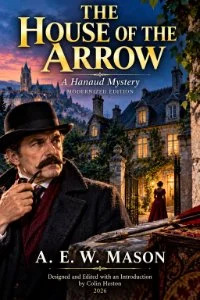
By John Oxenham. Edite, adapted and introduced by Colin Heston.
A wealthy woman dies. A young heiress stands accused of murder. A mysterious poisoned arrow holds the key to a deadly secret.
First published in 1924, The House of the Arrow is one of the outstanding detective novels of the Golden Age of crime fiction. Written by A. E. W. Mason, creator of the celebrated French detective Inspector Hanaud, this ingenious mystery combines psychological suspense, forensic investigation, and an intricate puzzle in which appearances are dangerously deceptive.
When wealthy widow Jeanne-Marie Harlowe dies at her home in Dijon, France, her considerable fortune passes to her young niece, Betty Harlowe. But Betty's inheritance brings an unexpected nightmare. Boris Waberski, an embittered relative who has been excluded from the will, accuses her of poisoning her aunt.
An English solicitor, Jim Frobisher, travels to France to defend the frightened heiress. There he encounters the formidable Inspector Hanaud of the Paris Sûreté, a brilliant, unpredictable investigator whose methods alternately astonish, amuse, and exasperate his English companion.
At the center of the investigation stands the mysterious Maison Grenelle, an old French mansion filled with valuable antiques, concealed secrets, suspicious inhabitants, and a remarkable collection of exotic weapons. Among them is a poisoned arrow that may explain a death previously attributed to natural causes.
As anonymous letters spread fear through Dijon and suspicions multiply, Hanaud must unravel a complex web of greed, deception, jealousy, and carefully concealed motives. Every apparently insignificant detail may matter, from a clock on an antique cabinet to a misplaced book and the behavior of those who insist they have nothing to hide.
More than an ingenious whodunit, The House of the Arrow explores the difficulty of proving murder when the physical evidence is uncertain or nonexistent. Mason's vivid characterization, atmospheric French setting, and sophisticated treatment of criminal investigation make this novel both a compelling entertainment and a fascinating contribution to the history of detective fiction.
ABOUT THIS MODERNIZED EDITION
This complete and unabridged edition preserves Mason's original story, characters, dialogue, and intricate mystery while updating spelling and selected older language conventions for contemporary American readers.
A substantial new introduction by Colin Heston examines the novel's publishing history, its place in Golden Age detective fiction, the character and investigative methods of Inspector Hanaud, and its treatment of poisoning, criminal evidence, and French justice.
For readers of Agatha Christie, Dorothy L. Sayers, Arthur Conan Doyle, and classic British mysteries, The House of the Arrow offers an absorbing encounter with one of the genre's most distinctive detectives.
A classic mystery of murder, suspicion, and the elusive nature of truth-restored for a new generation of readers.
Read-Me.Org Inc. New York-Philadelphia-Australia. ..2026. p 221..