
Open Access Free Library
CRIMINAL JUSTICE.jpeg

CRIMINAL JUSTICE

CRIMINAL JUSTICE-CRIMINAL LAW-PROCDEDURE-SENTENCING-COURTS

Posts in Latin America
Determinants of Support for Extralegal Violence in Latin America and the Caribbean

By José Miguel Cruz and Gema Kloppe-Santamaría 

What are the factors behind citizen support for the use of extralegal violence in Latin America? The prevailing argument is that, in countries overwhelmed by skyrocketing levels of criminal violence, people endorse the use of extralegal violence as a way to cope with insecurity. Other scholars believe that support for extralegal violence is the result of state withdrawal and failure. Few empirical studies, however, have tested any of these arguments. In this article, using regional data from the 2012 AmericasBarometer, we examine different explanations regarding citizen support for the utilization of extralegal violence in Latin America and the Caribbean. We developed a multi-item scale that gauges support for different forms of extralegal violence across the Americas, and we hypothesize that support for extralegal violence is higher not only in countries with extreme levels of violence but especially in countries in which people distrust the political system. Results indicate that support for extralegal violence is significantly higher in societies characterized by little support for the existing political system.
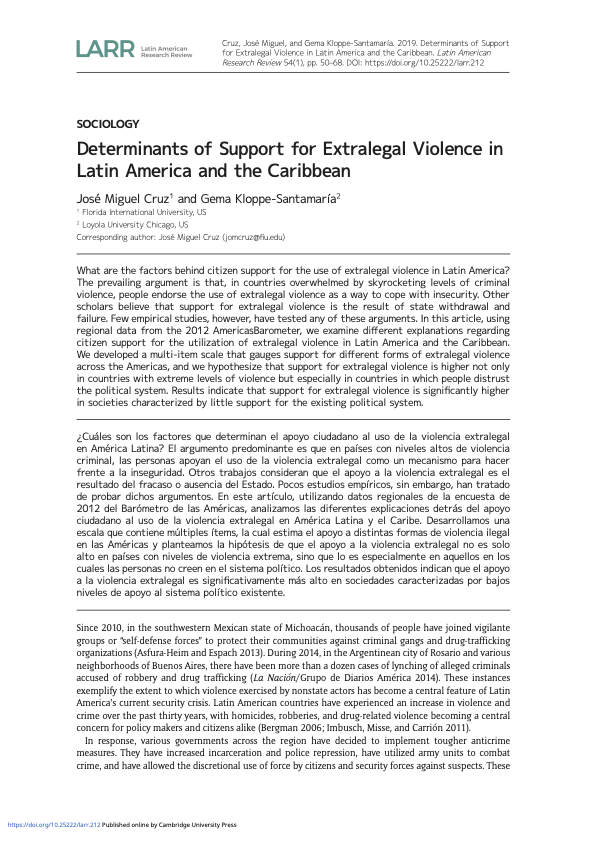
Determinants of Support for Extralegal Violence in Latin America and the Caribbean 

By José Miguel Cruz and Gema Kloppe-Santamaría

 What are the factors behind citizen support for the use of extralegal violence in Latin America? The prevailing argument is that, in countries overwhelmed by skyrocketing levels of criminal violence, people endorse the use of extralegal violence as a way to cope with insecurity. Other scholars believe that support for extralegal violence is the result of state withdrawal and failure. Few empirical studies, however, have tested any of these arguments. In this article, using regional data from the 2012 AmericasBarometer, we examine different explanations regarding citizen support for the utilization of extralegal violence in Latin America and the Caribbean. We developed a multi-item scale that gauges support for different forms of extralegal violence across the Americas, and we hypothesize that support for extralegal violence is higher not only in countries with extreme levels of violence but especially in countries in which people distrust the political system. Results indicate that support for extralegal violence is significantly higher in societies characterized by little support for the existing political system.

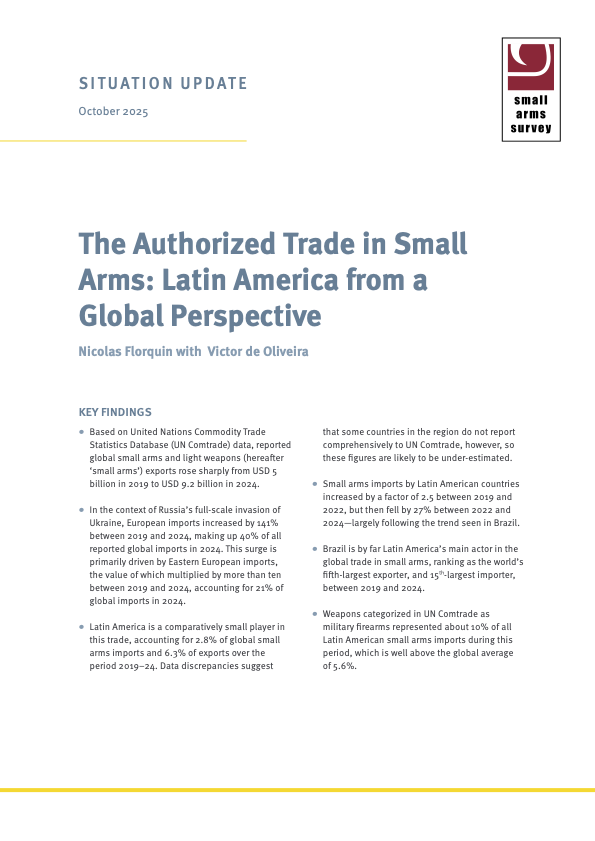
The Authorized Trade in Small Arms: Latin America from a Global Perspective

By Nicolas Florquin with Victor de Oliveira

SITUATION UPDATE: LATIN AMERICA

Based on UN Comtrade data, reported global small arms and light weapons (hereafter ‘small arms’) exports rose sharply from USD 5 billion in 2019 to USD 9.2 billion in 2024. Consistent with previous trade updates, ammunition remains the most traded weapon category, accounting for 35% of the value of reported global imports for the period 2019–24, followed by sporting and hunting shotguns and rifles (21%), and pistols and revolvers (18%).

The Authorized Trade in Small Arms: Latin America from a Global Perspective—a Situation Update from the Mapping the Transnational Circulation and Control of Small Arms in Latin America project—examines the global authorized trade in small arms between 2019 and 2024, with a particular focus on trends in Latin America. It finds the region to be a comparatively small player in the global authorized small arms trade, accounting for 2.8% of global small arms imports and 6.3% of exports. Yet military firearms represented about 10% of all Latin American small arms imports during this period—almost double the global average of 5.6%.

The Situation Update also identifies a significant increase in European—and in particular Eastern European—imports during this period, which seem to have fuelled the growing trade. Indeed, European imports accounted for 40% of all reported global imports in 2024, while the value of Eastern European imports multiplied by more than ten between 2019 and 2024.

Geneva: Small Arms Survey, 2025. 16p.