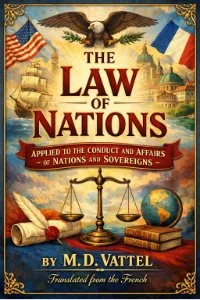
By M. D. Vattel. Introduction by Graeme R. Newman
A foundational work of international law, still resonant today.
First published in the eighteenth century and issued in authoritative English editions throughout the nineteenth, The Law of Nations by Emer de Vattel shaped how statesmen, jurists, and diplomats understood the rights and duties of sovereign powers. In this monumental treatise, Vattel applies the principles of natural law to the real conduct of nations, addressing war and peace, treaties and alliances, commerce and neutrality, diplomacy, and the limits of lawful power.
Rejecting both utopian idealism and brute realpolitik, Vattel argues that true national interest is inseparable from justice, restraint, and respect for sovereignty. Nations, like individuals, are bound by moral obligations arising from their coexistence in a shared international society. His careful analysis of war, intervention, and treaty obligations established enduring standards that influenced constitutional debates, foreign policy doctrine, and the development of modern international law.
This edition preserves a work that continues to illuminate contemporary conflicts and global challenges. Clear-eyed, systematic, and profoundly influential, The Law of Nations remains essential reading for anyone seeking to understand how lawful order, moral principle, and power intersect in the affairs of nations.
The theses advanced in The Law of Nations remain strikingly relevant to contemporary international disputes, particularly those involving intervention, recognition of governments, and claims of humanitarian necessity. Vattel’s insistence on sovereignty as the cornerstone of international order places clear limits on the legitimacy of external interference in the internal affairs of states. While he allows that extreme cases—such as manifest tyranny threatening the very existence of a people—may raise difficult moral questions, he consistently warns that powerful states are prone to disguise ambition and interest under the language of justice.
This caution is especially pertinent when considering recent controversies surrounding efforts by the United States to promote regime change in Venezuela, including diplomatic, economic, and political measures aimed at displacing the government of Nicolás Maduro. From a Vattelian perspective, such actions raise fundamental questions about lawful authority, the limits of collective judgment, and the distinction between moral condemnation and legal right. Vattel argues that no nation may unilaterally assume the role of judge over another sovereign without undermining the mutual independence on which international society depends. To do so, he suggests, risks converting international law into a mere instrument of power.
At the same time, Vattel’s framework does not deny the reality of gross misrule or humanitarian suffering. Rather, it demands rigorous scrutiny of motives and means. Economic coercion, diplomatic isolation, and recognition of alternative authorities would, in his analysis, need to be justified not by ideological preference or strategic advantage, but by clear evidence that such measures genuinely serve the common good of nations and do not erode the general security of the international system. His emphasis on proportionality, necessity, and respect for established sovereignty stands in tension with modern practices of intervention that rely on contested doctrines of legitimacy.
Viewed through this lens, contemporary debates over Venezuela illustrate the enduring force of Vattel’s central warning: that the stability of international relations depends less on the moral claims of individual powers than on shared restraint. His work reminds modern readers that the erosion of sovereignty in one case—however rhetorically justified—sets precedents that may ultimately weaken the legal protections upon which all nations, strong and weak alike, rely.
P.H. Nicklitn etc. Philadelphia. 1829. Read-Me.Org Inc. New York-Philadelphia-Australia. 2026 p.424.