
Open Access Publisher and Free Library
CRIMINAL JUSTICE.jpeg

CRIMINAL JUSTICE

CRIMINAL JUSTICE-CRIMINAL LAW-PROCDEDURE-SENTENCING-COURTS

Posts in Community
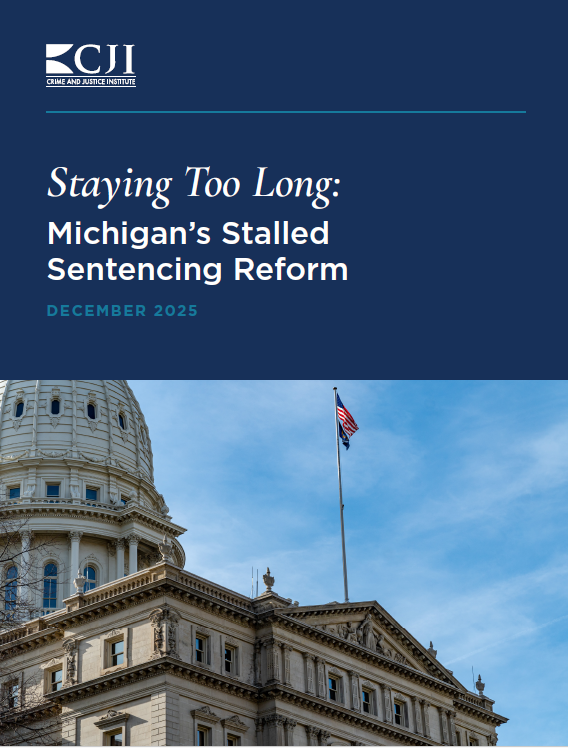
Staying Too Long: Michigan’s Stalled Sentencing Reform

By Kate Bryan, Rachel Schmidt, and Ashley Neufeld, with support from Nikki Miguel and Maura McNamara.

Michigan’s sentencing structure remains among the most restrictive in the nation. While many states have adopted policies that allow earned-time credits and provide opportunities for early release or resentencing, Michigan requires individuals to serve 100 percent of their minimum sentence before parole eligibility. While recent reforms, such as record clearing, medical parole, and limits to pretrial detention, have advanced progress to the state’s system, they do not target the key challenge of long lengths of stay. Today, more than 65 percent of the state’s prison population is serving a sentence of ten years or more, with limited opportunity for review or reduction. As the prison population rises for the first time in a decade, coupled with the state’s mounting budget pressures, a comprehensive examination of the state’s length of stay challenges is necessary. The goal of this brief is to serve as a baseline to begin that deeper examination. The Crime and Justice Institute, supported by Arnold Ventures, analyzed Michigan’s publicly available prison population data to understand the key trends regarding length of stay. Key findings include: Population growth: The prison population is growing after decades of decline, up 3% since 2021, with more individuals receiving additional sentences while already incarcerated. Sentences are getting longer: Average minimum terms rose 30% in the past decade, from 9.3 years (2014) to 12 years (2023). Drug offenses saw sharpest increases: Average minimum terms for drug offenses grew 33% over  the past decade. Sentencing practices exceeding statutory maximums: Data show minimum terms beyond statutory maximums for top offenses indicating the impacts of habitual offender enhancements, consecutive sentences, and additional sentencing stacking. With the urgency of a now rising population, the reinstated Sentencing Commission provides a renewed opportunity for the state to review sentencing practices. As Michigan prepares for leadership changes in 2026, the state has an opportunity to tackle its most pressing criminal justice challenge. To advance reform, Michigan must: Leverage the Sentencing Commission to produce data-driven recommendations and introduce corresponding legislation. Use corrections data to identify policies contributing to long stays, especially those related to enhancements, habitual offenders, and additional sentences imposed on already incarcerated individuals. Analyze the fiscal impact of long sentences considering recent budget volatility and an aging prison population. Reintroduce policies to reduce length of stay early in the 2026 session, backed by fiscal and public safety data.

Boston: Crime and Justice Institute, 2026. 17p.

CHICAGO POLICE TRAINING TEACHES OFFICERS THAT THEIR LIVES MATTER MORE THAN COMMUNITY LIVES

Public Report on Chicago Police Training on the Use of Force

From the introduction; This Report from community representatives of Chicago’s Use of Force Community Working Group offers our feedback on the Chicago Police Department’s (CPD) training on de-escalation and the use of force. The Working Group was first convened in the summer of 2020 in response to the requirements of the federal civil rights Consent Decree designed to bring an end to the CPD’s pattern of police brutality and racial discrimination. Over the course of two years, the Working Group persuaded the CPD to make transformative changes to its policies governing police use of force. 1 Last fall, we issued a Public Report on CPD’s new policies, including areas still in need of change. 2 The new policies, if implemented and enforced on the ground, have the potential to dramatically reduce unnecessary CPD violence and improve public safety.

Second Report of the Community Representatives of Chicago’s Use of Force Working Group. 2023March 2023. 24p.

Building Alliances: Community spaces centring justice in times of injustice 

By  Becky Clarke and Zara Manoehoetoe

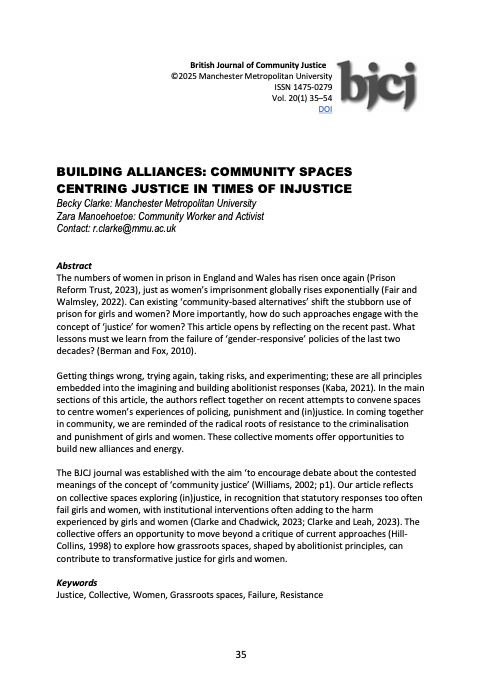
The numbers of women in prison in England and Wales has risen once again (Prison Reform Trust, 2023), just as women’s imprisonment globally rises exponentially (Fair and Walmsley, 2022). Can existing ‘community-based alternatives’ shift the stubborn use of prison for girls and women? More importantly, how do such approaches engage with the concept of ‘justice’ for women? This article opens by reflecting on the recent past. What lessons must we learn from the failure of ‘gender-responsive’ policies of the last two decades? (Berman and Fox, 2010). Getting things wrong, trying again, taking risks, and experimenting; these are all principles embedded into the imagining and building abolitionist responses (Kaba, 2021). In the main sections of this article, the authors reflect together on recent attempts to convene spaces to centre women’s experiences of policing, punishment and (in)justice. In coming together in community, we are reminded of the radical roots of resistance to the criminalisation and punishment of girls and women. These collective moments offer opportunities to build new alliances and energy. The BJCJ journal was established with the aim ‘to encourage debate about the contested meanings of the concept of ‘community justice’ (Williams, 2002; p1). Our article reflects on collective spaces exploring (in)justice, in recognition that statutory responses too often fail girls and women, with institutional interventions often adding to the harm experienced by girls and women (Clarke and Chadwick, 2023; Clarke and Leah, 2023). The collective offers an opportunity to move beyond a critique of current approaches (HillCollins, 1998) to explore how grassroots spaces, shaped by abolitionist principles, can contribute to transformative justice for girls and women.