Open Access Publisher and Free Library
CRIMINAL JUSTICE.jpeg

CRIMINAL JUSTICE

CRIMINAL JUSTICE-CRIMINAL LAW-PROCDEDURE-SENTENCING-COURTS

Posts in Social Issues
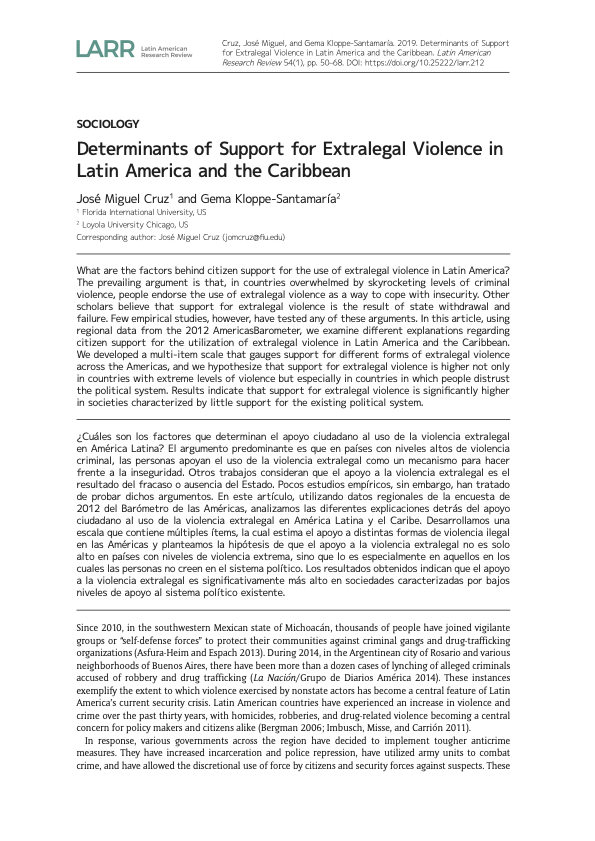
Determinants of Support for Extralegal Violence in Latin America and the Caribbean

By José Miguel Cruz and Gema Kloppe-Santamaría 

What are the factors behind citizen support for the use of extralegal violence in Latin America? The prevailing argument is that, in countries overwhelmed by skyrocketing levels of criminal violence, people endorse the use of extralegal violence as a way to cope with insecurity. Other scholars believe that support for extralegal violence is the result of state withdrawal and failure. Few empirical studies, however, have tested any of these arguments. In this article, using regional data from the 2012 AmericasBarometer, we examine different explanations regarding citizen support for the utilization of extralegal violence in Latin America and the Caribbean. We developed a multi-item scale that gauges support for different forms of extralegal violence across the Americas, and we hypothesize that support for extralegal violence is higher not only in countries with extreme levels of violence but especially in countries in which people distrust the political system. Results indicate that support for extralegal violence is significantly higher in societies characterized by little support for the existing political system.

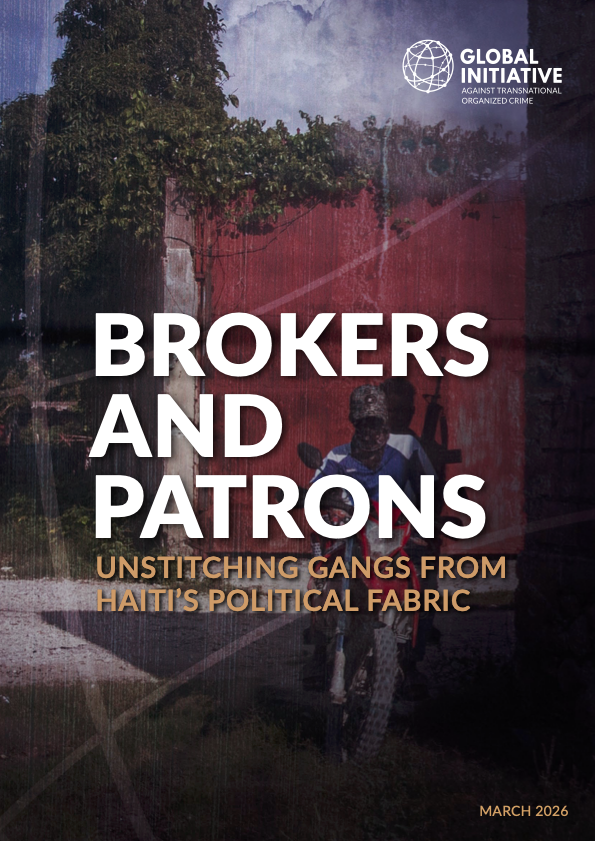
BROKERS AND PATRONS: UNSTITCHING GANGS FROM HAITI’S POLITICAL FABRIC  

By The Global Initiative Against Transnational Organized Crime.

In Haiti, 5 915 people were killed in 2025 (compared to 5 601 in 2024). The national homicide rate got to 49.8 per 100 000 people, and Port-au-Prince, which is home to about a quarter of the population, reached nearly 140 per 100 000 people, ranking it among the most violent cities in the world.

Gangs continued to expand their influence in Haiti, both through territorial control and by consolidating their role as political brokers. This latter dimension remains largely absent from national and international crisis response strategies.By failing to account for the political economy of violence, particularly the importance of addressing politico-criminal relationships, current policies risk perpetuating rather than loosening the links between armed groups and the political system, especially if the 2026 elections proceed without a more comprehensive response adapted to the complexity of the crisis.Haiti’s gangs are neither insurgents nor revolutionaries; they are embedded within circuits of political and economic power. The crisis is sustained by illicit financial flows, arms and drug trafficking, and patronage networks that protect and instrumentalize armed groups.Arrests and targeted operations may weaken certain groups, but as long as the structures that sustain criminal governance remain intact, the system will reconstitute itself. Without measures to dismantle the networks intertwining political competition and criminal governance, electoral processes risk reinforcing rather than transforming the system they are intended to renew.Haiti requires a strategy to combat organized crime that integrates public security, justice and community reconstruction. Any approach focused exclusively on force will fail if it does not address the political and economic foundations that allow violence to persist.To be effective, the Gang Suppression Force (GSF) must be paired with judicial tools capable of targeting gang support networks, particularly financial ones, and not only armed actors. This includes pursuing criminal leaders as well as their political and financial sponsors. Only by addressing the broader ecosystem of collusion can Haiti move away from a political order that is shaped by entrenched politico-criminal relationships.A long-term crisis resolution strategy must integrate justice, economic policy, security and political reform. The central question is not whether to negotiate with criminal groups, but how to articulate justice, demobilization and reintegration in a way that prevents the reproduction of violence.

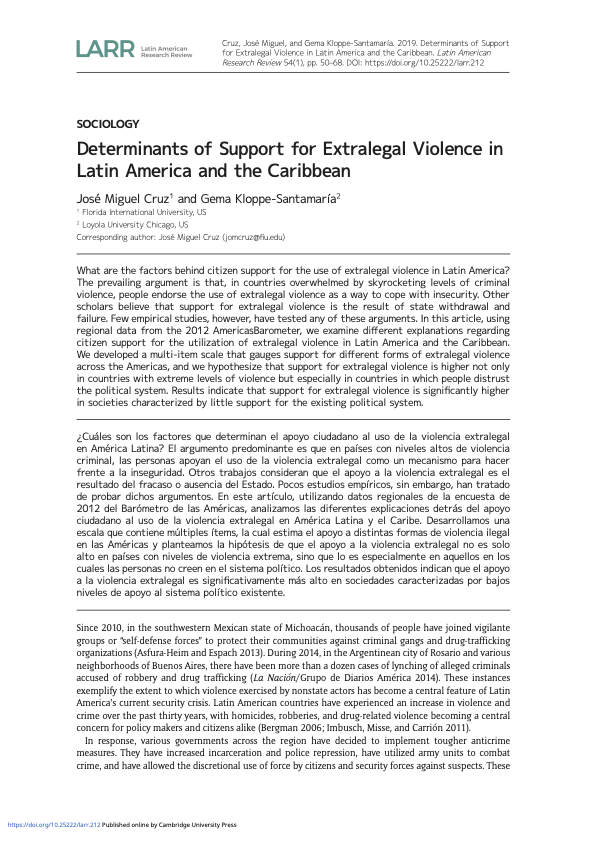
Determinants of Support for Extralegal Violence in Latin America and the Caribbean 

By José Miguel Cruz and Gema Kloppe-Santamaría

 What are the factors behind citizen support for the use of extralegal violence in Latin America? The prevailing argument is that, in countries overwhelmed by skyrocketing levels of criminal violence, people endorse the use of extralegal violence as a way to cope with insecurity. Other scholars believe that support for extralegal violence is the result of state withdrawal and failure. Few empirical studies, however, have tested any of these arguments. In this article, using regional data from the 2012 AmericasBarometer, we examine different explanations regarding citizen support for the utilization of extralegal violence in Latin America and the Caribbean. We developed a multi-item scale that gauges support for different forms of extralegal violence across the Americas, and we hypothesize that support for extralegal violence is higher not only in countries with extreme levels of violence but especially in countries in which people distrust the political system. Results indicate that support for extralegal violence is significantly higher in societies characterized by little support for the existing political system.

Identifying Community Violence Intervention (CVI) Approaches: A Grey Literature Scoping Review

By Devon Ziminski , Julia P Schleimer and  Meron Girma 

Community violence interventions (CVI) encompass a range of strategies aimed at reducing community firearm violence among those most affected. While CVI is an umbrella term, specific CVI approaches across the United States differ markedly in their underlying theoretical frameworks, specific program activities, and populations served. These different CVI approaches have not been well defined or uniformly understood. Given unprecedented financial support for CVI from local, state, and federal sources in recent years, increased research attention to understanding the implementation and impacts of these programs, and growing efforts by policymakers, practitioners, and community leaders to enact CVI programs, it is important to understand how CVI is defined and characterized in applied discourse (eg, among CVI practitioners, funders, and scholars). This grey literature review aimed to synthesize how CVI practitioners, funders, and scholars commonly characterize CVI approaches and how those approaches relate to previously identified CVI theoretical frameworks. Following processes similar to a scoping review, we conducted a grey literature search to locate and synthesize information from webpages (eg, from community groups and academic organizations) and (non-peer reviewed) reports from web sources discussing CVI approaches. We identified nine main CVI approaches commonly mentioned in applied CVI discourse: 1. Violence interruption/street outreach; 2. Group violence interventions (GVI)/focused deterrence/group violence reduction strategy (GVRS); 3. Hospital-based violence intervention programs (HVIP); 4. Built environment/place-based/Crime Prevention Through Environmental Design (CPTED); 5. Behavioral science interventions/cognitive behavioral interventions; 6. Victim/trauma/survivor programs/resources; 7. Mentoring/fellowship programs; 8. School-based/related youth interventions; and 9. Diversion/deflection programs. These approaches operated at multiple intervention levels and drew on various theoretical frameworks. Findings from this scoping review provide a timely summary of how CVI is characterized in applied discourse, which can support the field in operating from a shared understanding of what constitutes CVI and, in turn, inform CVI research, practice, and policy-making.

Community gun violence in US cities is both rare and highly concentrated. Decades of research and practice show that shootings cluster within a very small number of people, places, and social networks. Effective violence reduction therefore requires identifying and engaging the individuals at very high risk of being involved in gun violence in the immediate future (i.e., very high-risk individuals, or VHRI).

This new brief is designed to support jurisdictions working to implement community violence intervention approaches by improving their ability to identify VHRI. The brief provides 1) a concise synthesis of the research evidence on risk for involvement in community gun violence, and 2) guidance on how to implement structured processes to identify the people driving violence within their communities.