
Open Access Publisher and Free Library
CRIMINAL JUSTICE.jpeg

CRIMINAL JUSTICE

CRIMINAL JUSTICE-CRIMINAL LAW-PROCDEDURE-SENTENCING-COURTS

Posts tagged money laundering
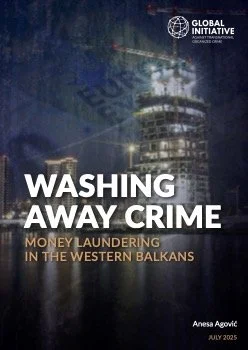
Washing Away Crime: Money Laundering in the Western Balkans

By Anesa Agovic

Money laundering remains a key enabler of organized crime in the Western Balkans, allowing criminal networks to legitimize illicit profits and integrate them into the formal economy. This report examines current trends, typologies and vulnerabilities shaping the region’s illicit financial flows.

The study outlines how systemic corruption, weak regulatory oversight, and a sizeable informal economy create fertile ground for laundering proceeds from drug trafficking, firearms smuggling, human trafficking, migrant smuggling, tax evasion and cyber-enabled crime. Key sectors, including construction, real estate and cash-intensive businesses, are often exploited, with typologies such as bulk cash smuggling, corporate layering, trade-based money laundering, underpriced real estate transactions and loan-back schemes featuring prominently.

Professional enablers, such as notaries, accountants, attorneys, and even entertainment celebrities, facilitate the integration of dirty money. The infiltration of law enforcement, misuse of remittance channels and the rise of digital currencies further complicate detection and prosecution.

The report also explores gender dynamics, highlighting the increasing role of women in money laundering activities. While some women play direct roles in financial transactions, others support criminal networks through their positions in professional sectors.

Hotspots for money laundering are often found in capitals, major cities and tourist destinations, where high-value real estate transactions and significant cash flows occur. The impact of global affairs, such as geopolitical shifts and technological advances, has amplified existing vulnerabilities.

The study calls for intensifying the prosecution of money laundering as a standalone crime, strengthening asset recovery, and reinforcing transparency across financial systems. Enhanced cooperation at the regional and international levels is vital to tackle transnational laundering schemes effectively.

This publication is part one of a two-part study of illicit finance and anti-money laundering in the Western Balkans, produced by the GI-TOC’s Observatory of Illicit Economies in South Eastern Europe with the support of the UK government’s Integrated Security Fund.

Understanding the methods and networks behind money laundering empowers governments, law enforcement, prosecutors, policymakers and civil society to disrupt the cycle of organized crime. The report underscores that combating money laundering requires addressing its root causes, from organized corruption to the misuse of legal entities and professional enablers, and demands more resilient institutions, independent regulatory bodies and robust civil society oversight.

Geneva, SWIT: Global Initiative Against Transnational Organized Crime. 2025. 72p.

download
First Taskforce Report: PPPs and Fighting Financial Crime in Ukraine

By Ian Mynot and Oksana Ihnatenko\

On 15 November 2024, RUSI’s Centre for Finance and Security and the Center for Financial Integrity (CFI)1 launched a Taskforce on Public–Private Partnership in Fighting Financial Crime in Ukraine. An in-person meeting in Warsaw, held on a non-attributable basis, convened 40 representatives, including those from the public and private sectors in Ukraine, and international experts. The discussion included two sessions focused on the current state of public–private partnerships (PPPs) in Ukraine and on international experience and recommendations. This report summarises the main findings of each of these sessions. None of the discussions at the meeting are attributable.

London: The Royal United Services Institute for Defence and Security Studies RUSI, 2025. 15p.

Download
The Impact of Covid-19 on the Future of Law

Edited by Murdoch Watney

The chapters in this volume focus on the future of law and related disciplines: human rights and access to medical care, corruption and money laundering in state procurement, counterfeit medical products, IPR waiver on COVID-19 vaccines, emergency powers, freedom of expression, prison healthcare, the impact on labour law, access to courts and digital court processes, access to education and the impact on insurance law are but a few possible topics which are addressed.

Johannesburg, UJ Press, 2022. 288p.

download
Prosecuting with the Prevention of Organised Crime Act; A review of South Africa’s anti-gang provisions

By Kim Thomas

Summary The Prevention of Organised Crime Act’s anti-gang provisions are not meeting their objectives. They were originally meant to fill the gaps in common law and help prosecutors gain convictions for gang-related crimes. But the act is severely underutilised for these specific crimes. For this paper’s recommendations to have a substantial effect on addressing organised crime, the various departments involved in South Africa’s criminal justice process need to be cleaned up and resources improved. Key points • Post-apartheid South Africa experienced an increase in organised crime and gangrelated activity. The South African legislature responded with enacting the Prevention of Organised Crime Act in 1999 and specifically addressed criminal gang activity, money laundering and racketeering. • Over 20 years later, very few gang-related cases have been prosecuted under this legislation. Most gang activity is still prosecuted under common law and other legislation. • Interviews with key stakeholders reveal that the main cause for failed/limited implementation lies in the scarcity of human resources, skills and training across the South African Police Service, National Prosecuting Authority and Crime Intelligence, and the lack of meaningful cooperation among them. • Further shortfalls of the act include a lack of provision for targeting gang leaders and Research Paper weak sentencing

ENACT-Africa, 2023. 32p.

download