
Open Access Publisher and Free Library
CRIMINAL JUSTICE.jpeg

CRIMINAL JUSTICE

CRIMINAL JUSTICE-CRIMINAL LAW-PROCDEDURE-SENTENCING-COURTS

Posts tagged law enforcement access
Who handles complaints against the police?

By William Downs

Who handles complaints against the police?

A member of the public can make a complaint if they are dissatisfied with the police. 

There are three crucial actors in the police complaints system:

  • Professional standards departments (PSDs) are specialist teams based within every police force in England and Wales. They are responsible for handling most complaints for their force.

  • The Independent Office for Police Conduct (IOPC) is an independent body that oversees the police complaints system. It also conducts independent investigations into some of the most serious police complaints and conduct matters.

  • Local policing bodies (either the police and crime commissioner or the deputy mayor for policing and crime, depending on the area) are responsible for monitoring their force’s complaint handling and conducting some complaint reviews.
How are police complaints handled?

Police complaints can be handled in different ways, depending on the seriousness of the complaint and the specific arrangements of the local area.

However, most complaints will follow this process:

  • When a complaint is made, it will be logged by the PSD of the local force.

  • The PSD will decide whether the complaint can be resolved informally or whether it must be formally recorded, and whether it requires an investigation.

  • The PSD will handle most complaints from start to finish, including conducting any investigation and compiling a report of its findings.

  • The PSD will only refer the most serious complaints to the IOPC, according to the mandatory referral criteria. On receiving a referral, the IOPC will assess (based on a mandatory referral criteria) if and how the complaint should be investigated.

  • Whoever is investigating the complaint (the PSD or the IOPC) will determine whether there is any indication of police misconduct, whether there is any learning which can be identified, or if no further action is required.

  • If a complainant is unhappy with the outcome of their complaint, they can usually request a review of how their complaint was handled. Depending on the complaint, the review body is either the IOPC or the local policing body. Complaints handled by the IOPC can’t be reviewed.

In some areas, local policing bodies will be involved in the logging and initial handling of complaints.

This system applies only to the 43 territorial police forces in England and Wales. In Scotland, Police Scotland, the Scottish Police Authority and the Police Investigations and Review Commissioner are involved in the delivery of the police complaints system. In Northern Ireland, police complaints are handled by the Police Ombudsman for Northern Ireland.


What are the laws on police complaints?


The statutory rules governing the police complaints system in England and Wales are explained in Statutory guidance published by the IOPC. The rules themselves are legislated for in the Police Reform Act 2002 and Police (Complaints and Misconduct) Regulations 2020.

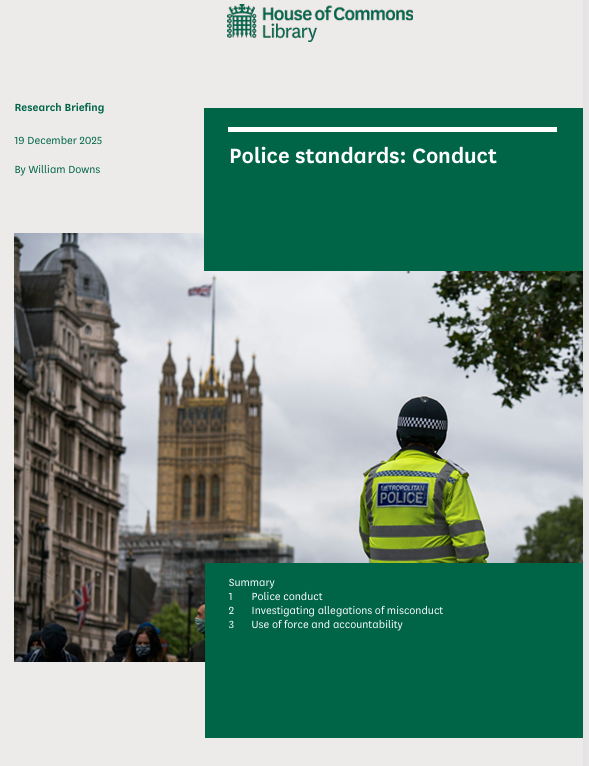
The police complaints system can be complex. This briefing provides an introductory overview of the system, and aims to support MPs and members of the public to better understand and navigate it.Who handles complaints against the police?

A member of the public can make a complaint if they are dissatisfied with the police.

There are three crucial actors in the police complaints system:

Professional standards departments (PSDs) are specialist teams based within every police force in England and Wales. They are responsible for handling most complaints for their force.

The Independent Office for Police Conduct (IOPC) is an independent body that oversees the police complaints system. It also conducts independent investigations into some of the most serious police complaints and conduct matters.

Local policing bodies (either the police and crime commissioner or the deputy mayor for policing and crime, depending on the area) are responsible for monitoring their force’s complaint handling and conducting some complaint reviews.

How are police complaints handled?

Police complaints can be handled in different ways, depending on the seriousness of the complaint and the specific arrangements of the local area.

However, most complaints will follow this process:

When a complaint is made, it will be logged by the PSD of the local force.

The PSD will decide whether the complaint can be resolved informally or whether it must be formally recorded, and whether it requires an investigation.

The PSD will handle most complaints from start to finish, including conducting any investigation and compiling a report of its findings.

The PSD will only refer the most serious complaints to the IOPC, according to the mandatory referral criteria. On receiving a referral, the IOPC will assess (based on a mandatory referral criteria) if and how the complaint should be investigated.

Whoever is investigating the complaint (the PSD or the IOPC) will determine whether there is any indication of police misconduct, whether there is any learning which can be identified, or if no further action is required.

If a complainant is unhappy with the outcome of their complaint, they can usually request a review of how their complaint was handled. Depending on the complaint, the review body is either the IOPC or the local policing body. Complaints handled by the IOPC can’t be reviewed.

In some areas, local policing bodies will be involved in the logging and initial handling of complaints.

This system applies only to the 43 territorial police forces in England and Wales. In Scotland, Police Scotland, the Scottish Police Authority and the Police Investigations and Review Commissioner are involved in the delivery of the police complaints system. In Northern Ireland, police complaints are handled by the Police Ombudsman for Northern Ireland.

What are the laws on police complaints?

The statutory rules governing the police complaints system in England and Wales are explained in Statutory guidance published by the IOPC. The rules themselves are legislated for in the Police Reform Act 2002 and Police (Complaints and Misconduct) Regulations 2020.

The police complaints system can be complex. This briefing provides an introductory overview of the system, and aims to support MPs and members of the public to better understand and navigate it.


Wiretaps on Wheels

By Evan Enzer, Anna Sipek, Mahima Arya, Nina Loshkajian, David Siffert, Eleni Manis, PHD, MPA

New cars are surveillance on wheels, sending sensitive passenger data to carmakers and police. Cars also store enormous amounts of passenger data onboard, where police can extract it using specialized tools. We estimate that law enforcement agencies could have accessed car data hundreds of thousands of times in 2020.

  • Constitutional loopholes allow access to most data on cars without a warrant. Police can access information from car-connected phones and online accounts without the warrant typically required.

  • U.S. immigration agencies weaponize car data. Other law enforcement agencies are poised to follow suit if they are not already doing so.

  • New legislation, enforcement of existing data protection laws, and responsible car design and data storage policies can shift car data surveillance into reverse.