Open Access Publisher and Free Library
CRIMINAL JUSTICE.jpeg

CRIMINAL JUSTICE

CRIMINAL JUSTICE-CRIMINAL LAW-PROCDEDURE-SENTENCING-COURTS

Posts in Crime Trends
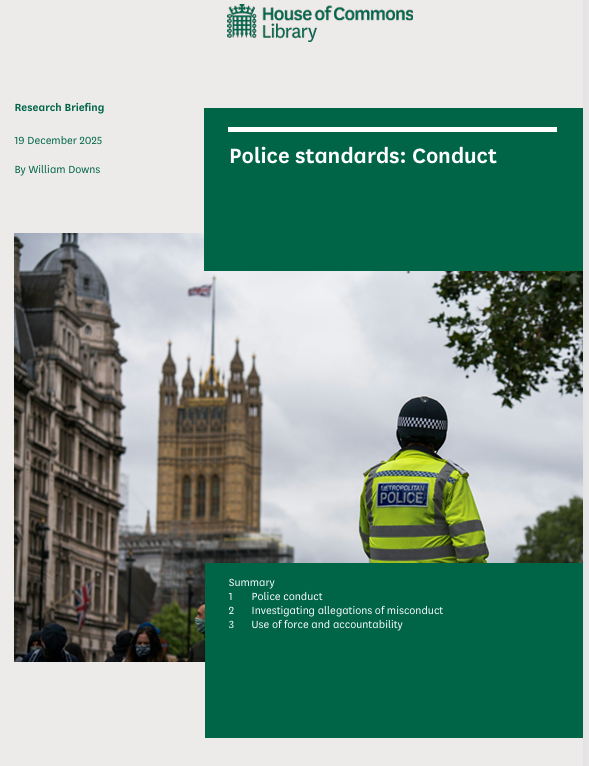
Who handles complaints against the police?

By William Downs

Who handles complaints against the police?

A member of the public can make a complaint if they are dissatisfied with the police. 

There are three crucial actors in the police complaints system:

  • Professional standards departments (PSDs) are specialist teams based within every police force in England and Wales. They are responsible for handling most complaints for their force.

  • The Independent Office for Police Conduct (IOPC) is an independent body that oversees the police complaints system. It also conducts independent investigations into some of the most serious police complaints and conduct matters.

  • Local policing bodies (either the police and crime commissioner or the deputy mayor for policing and crime, depending on the area) are responsible for monitoring their force’s complaint handling and conducting some complaint reviews.


Nonpolice Alternative Response Programs Across the United States: A National Portrait

By Anna Cook, Jon Lloyd, Fablina Sharara, Jennifer Key,

When someone is in a crisis, a police response can lead to help — or harm. Across the country, communities are trying something new: sending mental health specialists, peer specialists or other trained professionals to crisis calls instead of police through alternative response programs (ARPs). Research on ARPs has focused on case studies and standout programs like CAHOOTS in Oregon and Denver STAR, but we know relatively little about the broader trends in this growing field. Comprehensive information about where and how jurisdictions are implementing ARPs is crucial so that policymakers, funders and advocates can make better informed strategic decisions regarding public safety innovation. To address this gap, we created a novel database of 216 ARPs established since the early 1970s and operational as of 2024 to produce one of the first overviews of these programs throughout the United States. By summarizing the design, scale and geographic distribution of ARPs, we provide a broad look at the field to help inform and empower community leaders to build stronger public safety systems while reducing dependence on traditional policing. Our findings underscore critical choices in how ARPs are implemented and raise important questions about their scope, accessibility and long-term potential. As policymakers, practitioners and advocates continue to explore alternatives to police response, this report provides a foundation for understanding the current landscape and identifying paths for growth. Given current gaps in ARP implementation, future research and innovation are needed to explore how these programs can evolve to handle a higher volume and wider range of calls, understand the benefits and limitations of different call lines, and expand to meet the needs of smaller or underserved communities.

 Key findings: • Recent proliferation: Public officials and other decisionmakers established nearly 120 ARPs from 2020 through 2024, reflecting a surge in interest and political willpower following national Black Lives Matter protests. • Limited scale: Most programs serving large populations respond to fewer than five calls per 1,000 residents per year. • Narrow scope: Mental and behavioral health are a stated focus for 94% of programs; far fewer are designed to address issues like traffic safety, interpersonal conflict or homelessness. • 911 reliance: Despite their focus on mental crisis calls, only 18% of ARPs use the 988 national mental health crisis line, while 50% use 911 for dispatch. • Urban concentration: Programs are concentrated in large, racially diverse, urban areas.

West Hollywood, CA,

WeWest Hollywood, CA,West Hollywood, VThe Center for Policing Equity’s (CPE) , 2025. 23p.

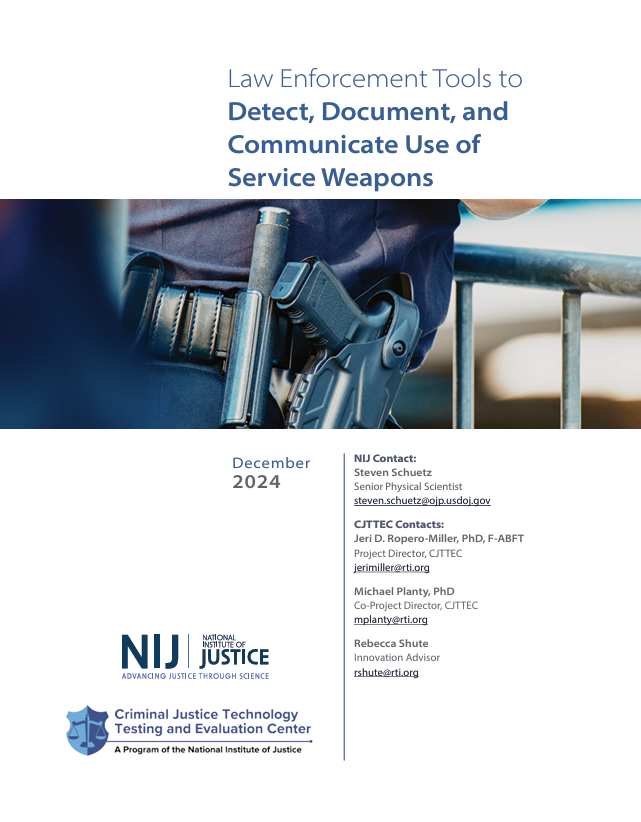
Law Enforcement Tools to Detect, Document, and Communicate Use of Service Weapons

By Steven Schuetz, et al.

  Context Service weapon activity, including instances where an officer’s firearm is drawn, pointed, or discharged, plays an important role in understanding events transpiring during a police–public encounter. Detection, documentation, and communication of these events in a way that is accurate, timely, and dependable is vital for enhancing transparency and accountability of law enforcement service weapon use. About this Report The National Institute of Justice (NIJ) requested the Criminal Justice Technology Testing and Evaluation Center (CJTTEC) to investigate the landscape of commercially available and emerging technologies that could meet this need. CJTTEC conducted a review of technologies capable of detecting when a service weapon has been unholstered, pointed, or discharged; documenting when a law enforcement officer discharges their service weapon (or initiating documentation such as body-worn camera (BWC) recordings in such incidents); and communicating the information to dispatchers. CJTTEC’s methodology to understand this technology landscape included secondary research (e.g., reviewing patents, trade literature, press releases, news articles, and publications) and primary research with technology experts, product representatives, and researchers. This brief provides a high-level summary of technology systems capable of documenting, detecting, and communicating service weapon activity, focusing specifically on technology integrated into or onto the weapon, in a holster, in a BWC, in a wearable device, or in environmental sensing tools. Conclusion Although no single commercially available tool is capable of detecting, documenting, and communicating service weapon activity, law enforcement agencies may be able to rely on a suite of products to help them address these needs.  Key Takeaways ¡ Agencies are facing increased pressure to document service weapon activity. From 2015 through 2020, on average, an estimated 1,769 people were injured annually—979 fatally and 790 nonfatally— from shootings by police in the United States.1 Because of the impact that officer-involved shootings (OISs) have on the community, law enforcement agencies are facing increased public pressure and policy mandates to document service weapon activity. ¡ There is a need for tools or technologies that can objectively detect, document, and communicate service weapon activity. OISs are stressful incidents that can occur quickly and under poor visual circumstances, which can impact accurate documentation of events. Further, obtaining reliable service weapon activity data can be challenging because of noncompliance with body-worn camera (BWC) policies, lack of BWCs, or inaccurate witness and officer accounts. ¡ There is no single commercially available product that meets service weapon activity needs. No single product can currently (1) detect service weapon activity, such as recording actual shots fired in an incident involving law enforcement weapons; (2) document the activity, such as initiating BWC recordings; and (3) communicate information about service weapon activity to police dispatchers. ¡ Agencies can rely on a suite of products to address these needs or choose specific products, each with strengths and limitations. Available technologies may be integrated into or onto the weapon, in a holster, in a BWC, in a wearable device, or in environmental sensing tools. Weapon-integrated tools offer the most functionality to detect and document multiple types of service weapon activity during a use-of-force incident, but many of these products, such as those developed by Armaments Research Company and Yardarm, are not commercially available. These products often lack the capability to communicate updates in real-time with dispatch. Holster-integrated tools can sense officer unholstering activity, activate BWC, and communicate with dispatch, but they cannot detect activity related to pointing or firing a weapon. BWCs, activated by multiple types of triggers, can document audio and video of the incident and communicate with dispatch, but they cannot specifically detect officer firearm activities (e.g., weapon unholstering, pointing, gunshot detection). Wearable devices can detect officer firearm activities, document metadata, and communicate with dispatch, but most products are still in a development phase for law enforcement applications. Environmental sensing tools may detect and document activities transpiring within a certain area, including shots fired in an incident, and communicate information to dispatch, but they cannot detect or attribute gunshot activities specifically to an officer's service weapon. ¡ Technology advancements and independent testing, evaluation, and implementation research are needed to accelerate adoption. Technology developers are currently working through several technical hurdles and are leveraging insights from BWC to improve technology uptake. Some commercially available products have been evaluated for performance, but more studies are needed as technologies are further developed and released into the market.  

Criminal Justice Testing (and Evaluation Consortium, 2024. 15p.

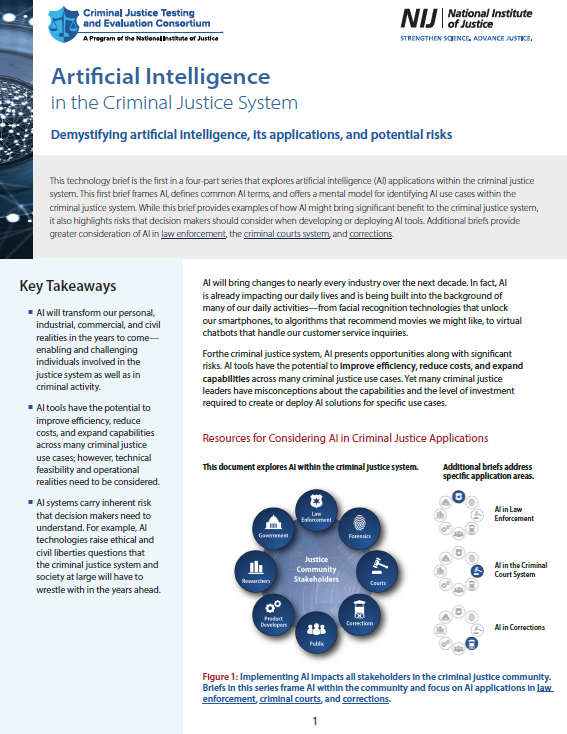
Artificial Intelligence in the Criminal Justice System.  Demystifying artificial intelligence, its applications, and potential risks 

By James Redden; Molly O'Donovan Dix

This technology brief is the first in a four-part series that explores artificial intelligence (AI) applications within the criminal justice system. This first brief frames AI, defines common AI terms, and offers a mental model for identifying AI use cases within the criminal justice system. While this brief provides examples of how AI might bring significant benefit to the criminal justice system, it also highlights risks that decision makers should consider when developing or deploying AI tools. Additional briefs provide greater consideration of AI in law enforcement, the criminal courts system, and corrections.   

  Key Takeaways ¡ AI will transform our personal, industrial, commercial, and civil realities in the years to come— enabling and challenging individuals involved in the justice system as well as in criminal activity. ¡ AI tools have the potential to improve efficiency, reduce costs, and expand capabilities across many criminal justice use cases; however, technical feasibility and operational realities need to be considered. ¡ AI systems carry inherent risk that decision makers need to understand. For example, AI technologies raise ethical and civil liberties questions that the criminal justice system and society at large will have to wrestle with in the years ahead. AI will bring changes to nearly every industry over the next decade. In fact, AI is already impacting our daily lives and is being built into the background of many of our daily activities—from facial recognition technologies that unlock our smartphones, to algorithms that recommend movies we might like, to virtual chatbots that handle our customer service inquiries. Forthe criminal justice system, AI presents opportunities along with significant risks. AI tools have the potential to improve efficiency, reduce costs, and expand capabilities across many criminal justice use cases. Yet many criminal justice leaders have misconceptions about the capabilities and the level of investment required to create or deploy AI solutions for specific use cases

Research Triangle Park, NC:RTI International.,   . 

2020. 10p.

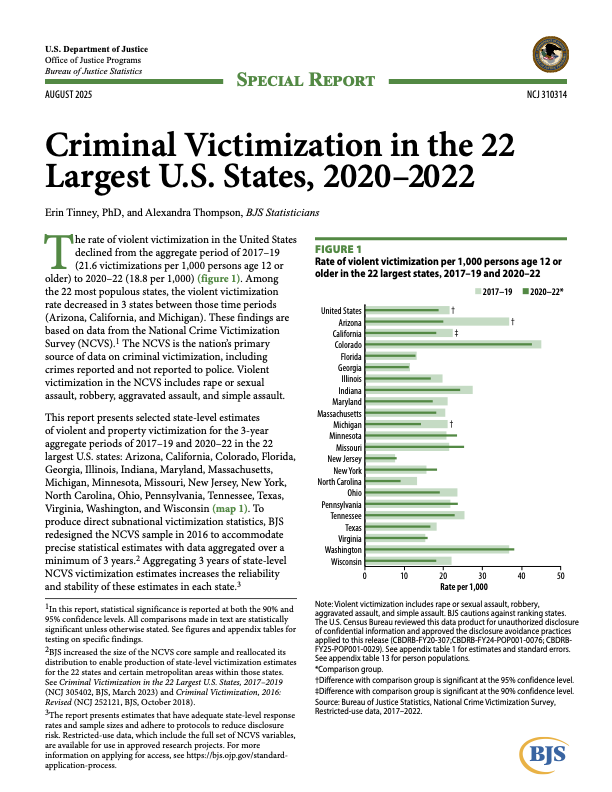
Criminal Victimization in the 22 Largest U.S. States, 2020–2022

By Erin Tinney and Alexandra Thompson,

This report presents statistics from the National Crime Victimization Survey (NCVS) and examines victimization rates across the 22 most populous U.S. states and how reported and unreported crime levels vary across these states and over time. It analyzes selected state-level estimates of violent and property victimization for the 3-year aggregate periods of 2017–19 and 2020–22 in the 22 largest U.S. states. Findings are based on data from the NCVS, the nation’s primary source of data on criminal victimization. State-level data, available following an increase in the NCVS sample that began in 2016, can provide more detailed information than the national NCVS estimates and other NCVS estimates historically produced for BJS reports, such as regional estimates.

Washington, DC: U.S. Department of Justice Office of Justice Programs Bureau of Justice Statistics. 2025. 27p.

Experience to Action: Reshaping Criminal Justice After COVID-19

By National Commission on COVID-19 and Criminal Justice.

This report provides criminal justice policymakers and practitioners with a priority agenda to prepare the nation’s criminal justice system for future public health crises. Through its recommendations, the Commission seeks to better balance the roles and responsibilities of the public health and public safety fields. Through its recommendations, the Commission seeks to better balance the roles and responsibilities of the public health and public safety fields. Launched at the end of July, the Commission received multiple reports and extensive testimony from leading national and local experts. Key findings include: + Crime: Property crime and drug offense rates fell from 2019 to 2020, but violent crime increased significantly. In particular, homicide rates increased by 42% during the summer months (June to August) in a sample of more than 20 medium to large cities, and by 34% in the fall (September to October).1 + Prisons: Prison populations have been reduced by about 5% nationally. On average, the COVID-19 mortality rate within prisons (61.8 deaths per 100,000 people in prison) was double the mortality rate for the general population, after adjusting for the gender, age, and race/ethnicity of those incarcerated. There are also substantial differences among states in the rate of prison infections and deaths.2 + Jails: Jail populations fell by 31% in the early weeks of the pandemic but have been slowly climbing toward prior levels since May.3 During the pandemic, the rates at which people have been rebooked on new charges 30, 60, and 180 days after release remain below pre-pandemic rates. Unfortunately, data regarding COVID-related infections and deaths in jails is scarce. + Racial and Ethnic Disparities: The COVID-19 pandemic may have exacerbated some racial and ethnic disparities in the criminal justice system. As jail populations began to fall in March at the onset of the pandemic, there were increases in the proportion of people who were Black, who were booked on felony charges, who were male, and who were 25 or younger. These changes in the population composition persisted even as jail populations began to rise again in early May.4 + Substance Use and Mental Health Disorders: More than 40 states have reported increases in opioid-related fatalities since the onset of the pandemic. Mandatory lockdowns, restrictions on movement, social distancing guidelines, orders limiting access to facilities for nonessential workers, and the absence of in-person treatment have created gaps in the system's ability to identify and monitor the needs and legal 3 requirements of people with substance abuse and mental health disorders, and to intervene when they are in distress.5 + Budgets: State and local governments face daunting budget deficits that will worsen as the pandemic wears on, and unemployment levels remain high. Because criminal justice operations (law enforcement, courts, and corrections) are funded more heavily by state and local governments than most other government functions, revenue shortfalls will disproportionately damage the criminal justice system without effective policy interventions.

Washington, DC: Council on Criminal Justice. 2020, 43pg