Open Access Publisher and Free Library
CRIMINAL JUSTICE.jpeg

CRIMINAL JUSTICE

CRIMINAL JUSTICE-CRIMINAL LAW-PROCDEDURE-SENTENCING-COURTS

Posts in Law
The Federal Judiciary’s Role in Drug Law Reform in an Era of Congressional Dysfunction

By Erica Zunkel and Alison Siegler

While state drug law reform is moving apace, federal drug law reform has moved much more slowly. Many, including the Judicial Conference of the United States and the United States Sentencing Commission, have urged Congress to enact substantive federal drug law reform for years. But Congress has not acted. As a result, the federal system continues to single out drug offenses for harsh treatment at the bail stage and the sentencing stage—the front end and back end of the federal mass incarceration crisis. In this paper, we argue that federal judges have a critical role to play in future federal drug law reform in light of Congress’ long-standing failures to meaningfully change the laws. At the front end, judges should encourage the release of more people on bail by closely scrutinizing prosecutors’ motions for temporary detention and giving little weight to the Bail Reform Act’s presumption of detention. Data shows that the statutory drug presumption is overbroad and does a poor job of determining who is a risk of flight or a danger to the community. At the back end, judges should issue categorical policy disagreements with the drug sentencing guidelines and the career offender sentencing guideline using the Supreme Court’s blueprint in Kimbrough v. United States. Judges should issue sentences below these guidelines because they are not based on empirical evidence, over-punish drug offenses, and result in racial disparities. At both ends, judges should rest their decisions on the evidence that the drug presumption, the drug sentencing guidelines, and the career offender sentencing guideline are flawed. While judicial action is not a cure for Congressional inaction, it would send a clear message from one co-equal branch of government to another that substantive reform is urgently needed 

Report of the Independent Legal Examination into Banning Children’s Access to Social Media

By Robert French

This Report to the Government of South Australia follows a legal examination to determine whether the State of South Australia could legislate a ban on access to social media services by children who have not attained the age of 14 and to restrict access to social media services by children between the ages of 14 and 16 by requiring parental consent to their access. The Report also considers a legislative model for achieving that end.

The examiner considered:

  • How South Australia can achieve the objective of social media prohibition for children within Australia’s constitutional framework.

  • The existing legislative and regulatory landscape in South Australia including effectiveness of current legislative and regulatory levers for limiting access to social media for children.

  • Opportunities for legislative or regulatory reform in South Australia to prevent access to social media accounts for children under 14 and require parental consent for children aged 14 and 15.

  • How actions taken in South Australia to limit social media access for children could be effectively enforced.

  • How existing technology to limit access to social media such as ‘age assurance’ mechanisms could be utilised to complement legislative and/or regulatory change.

The report concludes whatever regime is established by the South Australian Government, it will not be perfect. Effecting compliance across the industry will be challenging. The legislation would apply to existing as well as prospective users of social media services. There will undoubtedly be workarounds by knowledgeable child users. However, the perfect should not be the enemy of the good. One non-legal beneficial effect of the law may be to arm parents with the proposition that it is the law not them that restricts access to social media for children in South Australia.

Adelaide: Government of South Australia, 2024  277p.

Tell Me What You Want: An Affirmative-Choice Answer to the Constitutional Concern About Concealed-Carry on Private Property

By Ian Ayres and  Fredrick E. Vars

In a substantial majority of states, invitees may bring concealed weapons onto private property unless the owner expressly tells them that firearms are not allowed. Five states after the Supreme Court’s Bruen decision flipped the presumption, enacting statutes that prohibit bringing firearms onto other people’s property without the owner’s express consent. These statutes have been attacked as violating the Second Amendment. While the Ninth Circuit upheld the constitutionality of the “no guns” default, the Second Circuit and other lower courts have enjoined application of the law with regard to private property open to the public. This Article, after analyzing the reasoning of the courts, proposes a legislative fix. States can enact “affirmative choice” rules which require commercial establishments, as a condition of doing business, to state whether or not they want their customers to be allowed to bring concealed firearms into their stores. An affirmative-choice requirement avoids constitutional concerns that some courts have had with a “no guns” presumption because the ability to bear arms on private property would only be restricted when the landowner so chooses. Without state action restricting gun rights, the statutes would not meet the Bruen threshold requirement. The Article explains why affirmative-choice laws are likely to better effectuate the preferences of landowners and why such laws would not pose compelled speech concerns.

Yale Law School, Public Law Research Paper,

California Gun Violence Restraining Order Blueprint

By William R. Slomanson

As a result of the 2012 Sandy Hook massacre of 20 first graders and 6 staff members, a number of states responded with a various programs seeking to avoid reoccurrences. They have not yet succeeded in completely restraining the ensuing gun violence. But states like California have robustly responded with generically designated “Extreme Risk Protection Orders” (ERPO). One version of the ERPO is the comparatively new GVRO (California 2014).

The validity of any gun law begins with the threshold issue applicable to all jurisdictions: the individual’s Second Amendment right to bear arms. The U.S. Supreme Court’s blockbuster 2022 decision in New York State Rifle & Pistol Association v. Bruen, 597 U.S. 1 (2022) conjured a new test for gun litigation. Bruen thus held that “the government must demonstrate that the [challenged] regulation is consistent with this Nation’s historical tradition of firearm regulation.”

The Court’s ensuing 2024 building block connected both domestic and gun violence retraining orders. United States v. Rahimi, 602 U.S. ____, 144 S.Ct. 1889 (2024). There was no gun violence restraining order (GVRO) against Mr. Rahimi. But he did violate an analogous domestic violence restraining order (DVRO). Rahimi thus furnished the yardstick for measuring constitutional attacks on GVROs.

One may obtain various restraining orders in California, as listed in this essay. It focuses on Cal. Pen. Code § 18125 sets forth and analyses the statute’s three-option core. This essay also presents the associated GVRO Judicial Council forms. The next subsection provides selected case law regarding the GVRO regime’s key applications. Subjects covered include the Confrontation Clause; judicial assessments of the substantial evidence needed for a GVRO; hearsay evidence options; expert witnesses; oral v. written GVRO applications; notification requirements; and sanctions for misuse.Thomas Jefferson School of Law Research Paper 4930668, 38 California Litigation Reporter (forthcoming Nov. 2024)

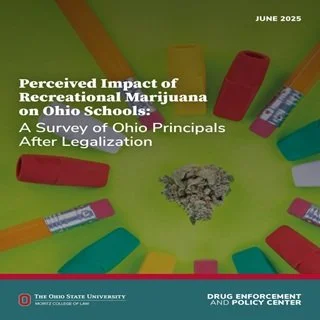
Perceived Impact of Recreational Marijuana on Ohio Schools: A Survey of Ohio Principals After Legalization

By Maria M. Orsini, Peter Leasure, & Jana Hrdinova

After Ohio voted to legalize recreational marijuana in November 2023, and before recreational marijuana became available for sale in Ohio in August 2024, the Drug Enforcement and Policy Center surveyed Ohio’s K-12 school principals to inquire about how they anticipated marijuana legalization would impact their schools and their students. In spring 2025, the center again surveyed Ohio’s principals to explore their perceptions of how marijuana legalization has impacted their schools and students now that recreational marijuana sales have commenced. This second survey, which used a nearly identical online survey instrument, was distributed to principals to allow for a comparison of anticipated impacts prior to the beginning of marijuana sales and actual experiences after marijuana sales started. Overall, results from the 2025 survey aligned fairly closely with principals’ anticipated concerns in 2024, with a few areas seeing a lower level of experienced impact such as on dropout rates, students’ behavior at school, and overall school safety. While these results suggest that principals overall anticipated a worse impact of marijuana legalization prior to the beginning of recreational sales than what they experienced after sales commenced, this conclusion has two important caveats. First, while the perceived impacts on students are lower in a few areas than the anticipated impacts from 2024, this result does not mitigate the fact that at the high school and middle school levels, principals in 2025 reported concerning observations with respect to the increased use of marijuana among their students, students’ academic performance, health, and impact on school safety, among other things. Second, our survey recorded responses from a relatively small number of Ohio’s principals and only asked about their perceptions, which does not allow us to draw any definitive conclusions about the actual effects of marijuana legalization. If state legislators and voters want to explore the concrete impact of marijuana legalization on students, it is crucial to collect and study actual student data on metrics related to academic performance, behavioral issues, mental and physical health, marijuana and other drug use, and school completion. 

Ohio State Legal Studies Research Paper No. 928,

The Legacy of Travon Martin - Neighborhood Watches, Vigilantes, Race, and Our Law of Self-Defense

By Mark S. Brodin

Reflecting back a decade later, what is the legacy of Trayvon Martin’s case, a teenage life violently cut short, and a legal system that accepted his death without consequence? Among other things, there is “The Trayvon Generation,” poet Elizabeth Alexander’s ruminations on the young African Americans who have grown up in the haunting shadow of this killing, and the anguished mothers who cannot protect their children from such a fate. “[T]o African Americans and other racialized minorities, Martin’s death became emblematic of the extreme outcomes of racial profiling enmeshed in a history of criminal laws arbitrarily targeting Black men.”

I begin with a close look at the Zimmerman trial, expanding on my earlier Howard Law Journal article with new access to an official audio-visual transcript. Then I put the case in its historical context by surveying the American tradition of vigilantism and its incarnation in the “neighborhood crime watches” (like Zimmerman’s) that have become so pervasive. Next, I contrast the response of the legal system to black as compared to white self-defense in notable cases. I conclude with an appraisal of our self-defense law -- doctrine and practice -- and the compelling need to reform it in light of what we have learned about implicit bias, unconscious stereotyping, and their role split-second panicked decision-making.

106 Marquette Law Review 593 (2022)

Derailing Deportation Through State Legislation

By Stacy Caplow

Everyone agrees: Immigration law is in crisis.  One aspect of immigration law is particularly intransigent: the impact of a criminal conviction on lawful permanent residents [LPRs]. In combination, immigration statutes and case law construct an almost inescapable box for LPRs whose movements, security, and liberty are threatened the moment they step into a criminal court. A conviction can prevent international travel, thwart naturalization, mandate detention and, worst of all, result in deportation. A conviction might cause problems at a port of entry, at a USCIS service center, at a prison or, most alarmingly, after an ICE knock on the front door years after the conviction and even the completion of the sentence. While the immigration consequences of a conviction are hydra-headed, the focus of this paper will be on LPRs facing removal who stand to lose “all that makes life worth living.”[1]

Sometimes the removal process moves on an express track—a predestined outcome with no possible relief. The more fortunate LPR may be able to delay, and a few may even avoid deportation, but all pay a steep fare of time, anxiety, uncertainty and often a loss of freedom. However long the trip or wherever its final destination, in many cases it is difficult or even impossible to justify the painful journey which may cause long term disruption, or ultimate exile from family, employment and community.

Scholars, legislators, and advocates have focused on the unfairness of many harsh immigration laws, but the search for solutions is frustrating given the unlikelihood of statutory changes at the federal level, particularly for noncitizens impacted by the criminal legal system. There have been many proposals and recommendations as well as a few notable initiatives, but these steps offer either imperfect or deficient protections for LPRs.

If federal law is intractable, what can give?  This paper argues that state legislative initiatives provide opportunities to loosen the stranglehold of federal immigration law.  Some states already have passed laws designed specifically to help immigrants avoid immigration consequences. These efforts to safeguard Lawful Permanent Residents from deportation could be adopted more widely or expanded to provide even more protections for any noncitizens caught in the criminal legal system.


 Brooklyn Law School, Legal Studies Paper No. 793, 

The Autocratic Legal Playbook

By Scott L. Cummings

This Article examines the development and rapid innovation of the autocratic legal playbook in America: the strategic blueprint used to destroy democracy through law. It argues that this playbook, with roots in autocratizing countries abroad, is now being implemented with brutal efficiency in the United States through the unprecedented abuse of executive power. The Article analyzes how autocracy has taken hold of the world’s oldest democracy with such velocity and examines what it means for the future of democracy around the world. It begins by defining the autocratic legal playbook as the roadmap for using law to undermine democratic guardrails that keep the executive within constitutional limits. The Article traces the evolution of the American playbook from Hungary’s autocratic transformation after 2010, to President Trump’s failed effort to overturn the 2020 election, to Project 2025, to the Trump 2.0 strategy of “flooding the zone” with executive orders. The Article’s central contribution is to reveal the operating principles and tactical innovations of the American playbook—premised on the subversion of truth and the conflation of legitimate policy change with illegitimate democratic attacks—while demonstrating how these principles are being systematically mobilized to target and disable key independent institutions that check executive power: government legal offices, law firms and the bar, courts, administrative agencies, universities, civil society, and the media. Because the core of autocratic legalism is creating the appearance of legality to justify attacks on the rule of law, the Article pays special attention to the legal profession, showing how actions against lawyers and courts are designed to achieve the ultimate autocratic objective: controlling the authority to define law. The Article concludes by considering how to “reverse engineer” the playbook, drawing on critical lessons from how democracies have died, and been resuscitated, in other countries to outline steps for saving American democracy in this watershed moment—before it is too late.

UCLA Law Review, Forthcoming, UCLA School of Law, Public Law Research Paper No. 25-31, 

The Dangers of Shooting First: "Stand Your Ground" Laws Are a License to Kill

By Everytown Research & Policy

In October 2022, William Hale and Frank Allison drove alongside each other on US Highway 1 in Hialeah, Florida. A traffic dispute grew more dangerous as both men began driving erratically. When Hale threw a water bottle at the other car, Allison retaliated with a gun, firing a shot that hit Hale’s 5-year-old daughter. In response, Hale fired all of the bullets in his handgun, striking Allison’s 14-year-old daughter. Though both men were initially charged with attempted murder, prosecutors dropped the charges against the man who fired first. Under Florida’s so-called “Stand Your Ground” legal defense law, the thrown water bottle justified responding with deadly force, leading to a child being shot.1 In the end, with two girls wounded in a road rage tragedy, the man who started the shootout was protected by a distortion of self-defense that allows people to shoot first and ask questions later.

New York: Everytown Research and Policy, 2025. 9p.

Maine's Risk-Based Firearm Restriction Statute: Opportunities for Improvement in the Wake of a Mass Shooting

By David Benjamin Joyce 

On October 25, 2023, Robert Card executed 18 civilians in mass shootings at Just-In-Time Recreation and Schemengees Bar and Grille Restaurant in Lewiston, Maine. Three months before the rampage, Card spent 14 days in a New York psychiatric hospital. His violent tendencies were known to family members, the Army Reserves, and law enforcement officials in Maine. Despite the warning signs, Card never faced a firearm prohibition. He maintained control of a high-powered Ruger SFAR rifle, which he turned on victims ranging in age from 14 to 76. The Lewiston tragedy brought renewed focus on Maine’s risk-based firearm removal statute. Phase One of this dissertation examines barriers and facilitators to use of Maine’s statute from the perspective of law enforcement officers, prosecutors, medical providers, and researchers in Maine. Phase Two of this dissertation reviews risk-based restriction statutes in three comparison states – Connecticut, Maryland, and Vermont – and examines implementation outcomes. Semi-structured interviews with stakeholders form the basis for the qualitative data in this study. The responses led to identification of key barriers and facilitators to effective implementation of risk-based firearm statutes. From these emerging themes, this dissertation offers eight recommendations to improve Maine’s risk-based firearm removal program. A plan for change is presented using an adaption of the Overseas Development Institute’s RAPID approach. The plan for change includes recommendations for legislative modification by the Maine legislature and implementation strategies to be employed by local stakeholder groups. Although no policy can eliminate the risk of gun violence, adoption of the recommendations in this dissertation will reduce the risk that the tragic events of October 25, 2023, repeat in the State of Maine.

Chapel Hill, NC: University of North Carolina, 2024. 140p.

The Financial Consequences of Legalized Sports Gambling

By Brett Hollenbeck, Poet Larsen, and Davide Proserpio

Following a 2018 ruling of the U.S. Supreme Court, 38 states have legalized sports gambling. We study how this policy has impacted consumer financial health using a large and comprehensive dataset on consumer financial outcomes. We use data from the University of California Consumer Credit Panel, containing credit rating agency data for a representative sample of roughly 7 million U.S. consumers. We exploit the staggered rollout of legal sports betting across U.S. states and evaluate two treatment effects: the presence of any legal sports betting in a state and the specific presence of online or mobile access to betting. Our main finding is that overall consumers' financial health is modestly deteriorating as the average credit score in states that legalize sports gambling decreases by roughly 0.3%. The decline in credit score is associated with changes in indicators of excessive debt. We find a substantial increase in average bankruptcy rates, debt sent to collections, use of debt consolidation loans, and auto loan delinquencies. We also find that financial institutions respond to the reduced creditworthiness of consumers by restricting access to credit. These results are substantially stronger for states that allow online sports gambling compared to states that restrict access to in-person betting. Together, these results indicate that the ease of access to sports gambling is harming consumer financial health by increasing their level of debt. 

Unpublished Paper, 2024.

The Impacts of and Response to Drug Use on Transit

By Emily Grisé; Alexander Cooke; David Cooper; Zane Oueja; Willem Klumpenhouwer; Amy HobbsOn transit systems across the United States, rising rates of drug use along with deteriorating safety conditions for customers and staff have become increasingly pressing and complex issues for transit agencies to solve. Many challenges surround agencies’ responses to drug use on transit, such as inconsistent data collection and the low uptake of support services.

TCRP Synthesis 179: The Impacts of and Response to Drug Use on Transit, from TRB's Transit Cooperative Research Program, documents and synthesizes the current practices of transit agencies in addressing the consumption and distribution of illegal drugs on their systems, as well as the resulting effects on customer and staff safety and security.

National Academies of Sciences, Engineering, and Medicine; Transportation Research Board; Transit Cooperative Research Program. 2025. p91.

Ending the Presumption of Reasonableness and Using Data to Reduce Sentencing Disparities

By Brandon MordueFollow

The idea that one’s punishment should depend on the crime committed rather than which judge happens to do the sentencing strikes most as uncontroversial, if not a requirement for a fair sentencing regime. Forty years ago, the passage of the Sentencing Reform Act promised just that result. Increased data availability allows us to evaluate the project’s success. The results are not encouraging.

Federal defendants are sentenced using guidelines issued by the United States Sentencing Commission that sometimes bear little relation to the underlying wrongdoing. This has created a split among judges, with some following the guidelines and others rejecting them. The consequences are arbitrariness in sentencing and unwarranted disparities across offenders.

In 2007, the Supreme Court permitted appellate courts to presume the reasonableness of guideline sentences, largely insulating those sentences from judicial review. Much has changed since then, and it is time for the presumption to go. The findings of the original data analysis presented in this Article, as well as developments since the Court’s decision, show that the claims made in support of the presumption are unfounded. In fact, some of the related case law rests upon provably false empirical premises.

Today, most sentences are not within the range set by the guidelines. Favoring the minority of sentences that are within the range results in a sentencing regime incompatible with the overriding statutory aim of avoiding unwarranted sentencing disparities. Rather than presuming the reasonableness of within-guideline sentences, the courts can chart a course correction by prioritizing the data on actual sentences from the Sentencing Commission. Such a shift would achieve more consistent sentences across offenders convicted of similar crimes.

115 J. Crim. L. & Criminology 133 (2025), 73p.

Participatory Defense and Three Pillars of Criminal Injustice

By Isis Misdary

Three separate but closely related factors have together produced this nation’s epidemic of mass incarceration. First, the enforcement of criminal law has become wholly dominated by a caste of repeat players. The chasm between this grouping and outsiders has become far more important than the prosecution-defense duality ostensibly dominating the system. Second, the system’s design and policies have become dominated by central authorities sealed in a “tough-on-crime” echo chamber. This leaves local communities largely powerless to check the devastation being visited upon them. And third, the system has ruthlessly suppressed the individuality of those facing charges. They are rarely seen, almost never heard, ignored if they try to contextualize events giving rise to the charges, and punished severely if they attempt to assert their rights, much less their innocence. Robbed of all that makes them human, their fates arouse little sympathy. Devastated communities have mounted various responses to mass incarceration. None is more exciting than the participatory defense movement. This movement seeks to involve the person facing charges as well as that person’s family and community. Together, they meet with defense counsel, gather evidence for the case, and in mitigation, prepare videos or other testimonials to influence charging and plea-bargaining decisions and undertake other efforts to support the person facing charges. Through the movement’s work on individual cases, families and communities have spotted issues within the criminal systems and the criminal laws close to home that must change, that must end. Case by case, they have started to challenge, change, and end them. Yet, for all its promise, participatory defense may face considerable challenges going forward in these areas. As a relatively new movement, it must continue to resolve significant design challenges and overcome formidable institutional and attitudinal buttresses the current system has erected.

25 Nev. L.J. 325 (2025), 92p.

THE PRETRIAL FAIRNESS ACT: EQUITY, BUT AT WHAT COST?

By John Burns

This Note traces the evolution of bail from its origins to modern commercial bail, highlighting how the system has disproportionately affected low-income defendants. In 2023, Illinois became the first state to eliminate cash bail with the enactment of the Pretrial Fairness Act, which attempted to remedy longstanding inequities. The Note situates Illinois’s approach between New Jersey’s successful risk-based reform and California’s oversimplified and harmful “zero bail” experiment. While Illinois’s reform represents a meaningful step toward fairness, this Note argues that its reliance on a categorical approach and its limited use of pretrial assessments may unintentionally undermisne its effectiveness. The Note concludes that Illinois must go further by expanding judicial discretion and mandating the use of risk assessment tools.

Washington University Journal of Law & Policy [Vol. 78, 2025. 29p.

Judge-Scholar Collaboration and the Second Amendment

By Andrew Willinger and Eric Ruben

Legal scholarship is overly abstract and theoretical, making it unhelpful to judges and lawyers. That, at least, is the common critique from the bench. When it comes to the Second Amendment, however, a different pattern has emerged: judges consistently cite law review articles and look to the academy for guidance. Most recently, in United States v. Rahimi, some Justices went further, implicitly inviting more scholarly work to help the Court answer open questions raised by its novel methodological approach to the Second Amendment. This Article explores this aberrant trend.

We raise several explanations for the distinctive scholarly role in Second Amendment jurisprudence, including the Amendment's unique aspects as well as the role of legal movements in facilitating the Amendment's development. Faced with a lack of judicial precedent on both the right to keep and bear arms and originalism-in-practice, law review articles often can be more helpful than past opinions. Beyond scholarship's utility in a new area of law, we suggest that a related phenomenon-the gun rights and conservative legal movements' trifold success at facilitating the rise of the individual Second Amendment right, popularizing originalism as a methodology, and elevating originalist judges to the bench-is an important part of the story. For a half century, organizations focused on achieving both a robust right to bear arms and a conservative vision of the Constitution have become more prominent and have closely associated with both scholars and judges. If, in the usual telling, judges look askance at scholarship, this specific area of law might present an exception since it has been a joint project from the beginning.

The Article concludes that the judge-scholar collaboration that has characterized Second Amendment case law is likely to continue. Moreover, it could have ramifications far beyond the right to keep and bear arms, including for other rights that may be on the cusp of transformation and for other legal movements seeking to emulate the strategies that ushered in modern Second Amendment law.

78 SMU Law Review __ (forthcoming), Duke Law School Public Law & Legal Theory Series No. 2025-26, SMU Dedman School of Law Legal Studies Research Paper No. 696,

Antisemitism, Anti-Zionism, and Title VI: A Guide for the Perplexed

By Benjamin Eidelson, Deborah Hellman,

Universities are facing an unprecedented wave of claims that they have violated their obligations to Jewish students under Title VI of the 1964 Civil Rights Act. These charges center on an equally unprecedented wave of anti-Israel activity on college campuses, much of which is alleged to cross the line into antisemitism. This essay, forthcoming in the Harvard Law Review Forum, provides one of the first systematic analyses of these exceptionally high-stakes claims about Title VI.

Our analysis reveals that the Title VI claims face formidable hurdles, including some that have received surprisingly little attention thus far. Most fundamentally, Title VI’s omission of “religion” as a protected characteristic means that Jewishness is protected under the statute only insofar as it constitutes a “race” or (less likely) a “national origin.” Under existing law, however, discrimination based on the cultural practices or viewpoints that may be associated with such an immutable characteristic—as Zionism might be associated with Jewishness—is ordinarily not cognizable as discrimination based on the protected characteristic itself. Moreover, if “hostile environment” liability can be founded on offensive conduct that does not constitute covered disparate treatment in its own right, this is likely possible only pursuant to a disparate impact theory that the Trump Administration has denounced and that the Supreme Court has rejected for private suits. Any notion of harassment based on conduct’s “objective offensiveness” would also need to account for distinctive features of the university setting that likely preclude liability for much of the protest activity that has loomed large in recent public discussions of Jewish students’ experiences on campus.

Although specific facts matter and not all of the issues are clear-cut, we thus conclude that appeals to Title VI in this area are much weaker than has been widely appreciated. Of course, this does not mean that campus antisemitism is acceptable. But it does mean that, for the most part, universities have both the right and the responsibility to balance their competing commitments in this area—including commitments to both inclusion and freedom of expression—using their own considered judgment.

Harvard Public Law Working Paper 25-13

Forthcoming, Harvard Law Review Forum (June 2025)

Assembly-Line Public Defense

By David Abrams and Priyanka Goonetilleke

Each year, millions of Americans rely on public defenders to fulfill their Sixth Amendment right to counsel. Despite being the linchpin of the criminal justice system, public defense remains both underfunded and understudied. This article provides empirical analysis to contribute to a critical question: How should public defender systems be structured?

Criminal justice advocates, scholars, and the American Bar Association strongly favor vertical representation in public defense. Under this model, a single public defender represents a defendant throughout their case, from initial appearance through sentencing. The alternative approach—horizontal representation—operates like an assembly line: Different attorneys handle each stage of a case, from preliminary hearings to pretrial conferences to trials. The preference for vertical representation stems from the intuitive belief that continuity of representation improves outcomes for defendants. However, no prior empirical work has tested this assumption.

Using a natural experiment created by the Defender Association of Philadelphia’s transition from a fully horizontal representation system to a partially vertical one, we find no evidence that increasing attorney continuity improves defendant outcomes.

These findings have significant implications for how public defender offices should allocate their scarce resources. While vertical representation is considered by many as the ideal, our results cast doubt on whether the additional resources and logistical challenges relative to horizontal representation are justified given the current reality of underfunded public defense. As jurisdictions nationwide grapple with a chronic lack of resources for public defense, this article provides crucial empirical evidence to inform decisions about how best to uphold defendants’ Sixth Amendment right to counsel.

.100 New York University Law Review No. 5 (forthcoming), Northwestern Law & Econ Research Paper No. 25-05, Northwestern Public Law Research Paper No. 25-22, U of Penn, Inst for Law & Econ Research Paper No. 25-10,

Civilly Criminalizing Homelessness

By Sara K. Rankin

The criminalization of homelessness refers to the enactment and enforcement of laws and policies that punish unsheltered people for surviving in public space, even when those individuals have no reasonable alternative. The constitutional and civil rights issues stemming from criminally charging unsheltered people for public survival are clear, albeit not uncontested. But cities often skirt legal challenges to criminalization by pursuing means other than criminal charges to punish homelessness. Many cities “civilly criminalize” homelessness through civil enforcement, which extends from infractions or fines to “invisible persecution,” such as the persistent policing and surveilling of unsheltered people. While courts, legislatures, and advocates largely focus on criminal charges, those punishments are just the tip of the criminalization iceberg: civil enforcement is arguably more extensive and damaging. However, courts and legislatures largely do not protect people experiencing homelessness from civil criminalization. This Article argues for greater attention to the devastating impact of civil punishments, drawing from other critiques that expose how civil tools punish poor and vulnerable people. It also examines how punishment operates outside of both criminal charges and civil sanctions, severely penalizing unsheltered people and requiring reform.

Harvard Civil Rights-Civil Liberties Law Review [Vol. 56 , 2021. 46p.

Lethal Immigration Enforcement

By Abel Rodriguez

Increasingly, U.S. immigration law and policy perpetuate death. As more people become displaced globally, death provides a measurable indicator of the level of racialized violence inflicted on migrants of color. Because of Clinton-era policies continued today, deaths at the border have reached unprecedented rates, with more than two migrant deaths per day. A record 853 border crossers died last year, and the deadliest known transporting incident took place in June 2022, with fifty-one lives lost. In addition, widespread neglect continues to cause loss of life in immigration detention, immigration enforcement agents kill migrants with virtual impunity, and immigration law ensures courts routinely order people deported to their deaths. As these preventable deaths persist, particularly among migrants of color, the Supreme Court has all but foreclosed causes of action against individual federal agents for wrongful death. It has done so most notably in its recent 2022 decision Egbert v. Boule, further limiting judicial remedies for constitutional violations and sanctioning use of force as a routine function of immigration enforcement.

This Article provides a novel perspective on law enforcement and race. It is the first to provide a comprehensive examination of lethal immigration enforcement, arguing that racialized policy rationales, impunity instituted by courts, and prevailing political paradigms have coalesced to render migrants of color expendable. Therefore, the enforcement system must be reimagined. While scholars have begun to analyze the immigration system in terms of “slow death,” or harms that occur over time, a holistic view of “spectacular deaths,” those readily perceived, is lacking. After mapping how the immigration enforcement system takes migrant lives, this Article interrogates the policy rationales for lethal enforcement in light of largely unexamined data, finding that anti-Blackness drives punitive immigration detention and the perceived dangerousness of Latinx migrants fuels lethal border policies. It then turns to an analysis of wrongful death actions and recent Supreme Court doctrine, poised to impede remedies for excessive force in courts further and escalate racialized violence against noncitizens. Ultimately, given the urgency of addressing rising migrant mortality, it calls for a paradigm shift beyond liberal reforms to end lethal enforcement and its racial subordination.

CORNELL LAW REVIEW [Vol. 109:465, 2024, 71p