
Open Access Publisher and Free Library
HUMAN RIGHTS.jpeg

HUMAN RIGHTS

Human Rights-Migration-Trafficking-Slavery-History-Memoirs-Philosophy

Posts in Drugs
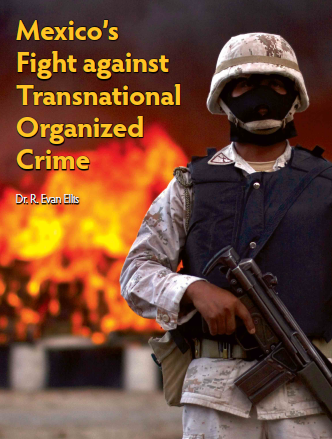
Mexico’s Fight against Transnational Organized Crime 

By R. Evan Ellis

The security environment in Mexico is characterized by a dangerous fragmentation of and competition among criminal groups that pushed the nation’s homicide rate to a record high of 22.5 per 100,000 in 2017, a 27.5 percent increase over the prior year.1 The nation, whose security and prosperity strongly impacts the United States through geographic proximity and associated flows of people, money, and goods (both licit and illicit), is at a critical juncture in its fight against transnational organized crime. Since Mexican President Felipe Calderón launched the “war against the cartels” in December 2006 with the deployment of the Mexican army into the state of Michoacán, the nation’s security forces have taken down the leaders of multiple powerful criminal groups and debilitated their organizations.2 In the process, the Mexican military, police, and other security institutions have evolved their institutional structures, modified both their strategy and their doctrine, and strengthened their ability to combat transnational organized crime. Yet as with the experience of the United States in combatting terrorist groups in Iraq and Afghanistan, Mexico’s fight against the cartels, both despite and because of its successes, has created a more chaotic criminal landscape, with both a higher level of violence and a broader range of criminality. Complicating Mexico’s security challenge is the disposition of the Trump administration to act aggressively against illegal immigration from Mexico (among other countries) into the United States, along with U.S. renegotiation and possible abandonment of the North American Free Trade Agreement. These actions increase stressors on Mexico, including the prospect of expanded deportations of immigrants to Mexico, the loss of remittance income, and impeded access by Mexican producers to the U.S. market. The Trump administration’s actions, magnified by rhetoric that many Mexicans perceive as an insult to their country and people, have combined with Mexican frustration over the persistence of violence and corruption to create the real prospect that leftist populist candidate Andrés Manuel López Obrador could win the July 2018 presidential election, potentially taking Mexico on a course of more distant political relations and decreased security cooperation with the United States and expanded engagement with extra-hemispheric rivals of the United States such as Russia and China.

Army University Press, 2019. 12p.

Why There is Still an Illicit Trade in Cultural Objects and What We Can Do About It

By Neil Brodie,Morag M. Kersel,Simon Mackenzie,Isber Sabrine,Emiline Smith &Donna Yates

Fifty years after the adoption of the 1970 UNESCO Convention, the illicit trade in cultural objects endures, with harmful consequences to local communities, knowledge acquisition, and archaeological landscapes and objects. In this article, we present a gap analysis to assess under-performing policy and practice. We argue that a poor understanding of how the trade is organized and operates and of how it might be regulated hinders effective policy formulation. Funding structures which encourage short-term ad hoc research and inhibit information sharing are in part responsible for some of the gaps. We conclude by suggesting how sustained theoretically informed, evidence-led collaborative analyses might help reduce or mitigate these problems, preventing another 50 years of illicit trade.

Journal of Field Archaeology 


Volume 47, 2022 - Issue 2

Combatting Drug Abuse and Related Crime: Comparative Research on the Effectiveness of Socio-Legal Preventive

By Francesco Bruno M.D.

Argentina, Brazil, Costa Rica, Japan, Jordan, Italy, Malaysia, the United States (State of New York), Singapore, Sweden, and the United Kingdom participated. In each country, local researchers conducted the study following a plan developed for the whole project. The multidisciplinary methodology included four phases: a comparative analysis of antidrug legislation, preliminary national reports, eight vignettes administered to different groups to gain information on the perceptions of the justice system, and guided interviews conducted with drug addicts. The data were quantified, and evaluation scales were constructed for purposes of comparison. Binary automatic scoring was applied to data from the vignettes and interviews. The data are shown graphically in 97 tables. Three conclusions are emphasized. First, drug abuse is apparently both quantitatively and qualitatively more serious where the system is perceived as less harsh and more permissive. Second, a significant correlation exists between knowledge of the law and the efficacy of the system. Third, a close association exists between the abuse of drugs and criminal behavior. These points are important for policymakers to consider. The studies in New York, Sweden, and the United Kingdom are outlined. Attachments include a 560-item bibliography and a list of experts and researchers involved in the study. Other publications from the United Nations Social Defense Research Institute are also listed.

United Nations Interregional Crime and Justice Research Institute, 1984, 246p.