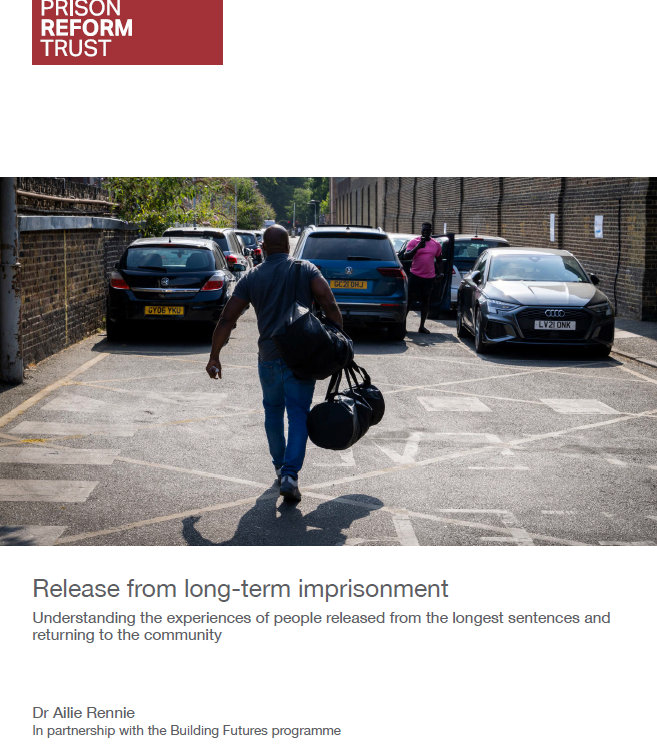
By Ailie Rennie In partnership with the Building Futures programme
This report forms part of the Prison Reform Trust’s Building Futures programme, funded by the National Lottery Community Fund, that since 2020 has been exploring the experiences of people serving longterm prison sentences. The programme has defined its long-term cohort to include men who spend 10 or more years in prison and women who spent eight years or more. This report is based on in-depth interviews with 20 people who have been released from prison and returned to the community after serving long-term prison sentences. This report aims to: • Understand more about the experience of release, re-entry, and resettlement for those who serve the longest periods in custody, including the challenges they face and their experiences of being on licence or under supervision. • Explore the availability of pre- and post-release support and assistance offered to people released from long prison sentences, highlighting both evidence of good practice and identifying areas for improvement. • Develop insights and ideas that will inform policy and practice through-the-gate in line with the Prison Reform Trust’s vision of a just, humane, and effective penal system. The report and its context Despite the common understanding that most prisoners – even those who are serving long-term and indeterminate periods of imprisonment – will eventually be released back into the community, there is currently very little known about the experiences of release for such individuals. We know strikingly little about the process of release itself as it exists in England and Wales, the challenges it presents, and the ways in which people begin to create a life for themselves after having spent many years separated from the outside world. Similarly, we know very little about what support might be available to assist people on their re-entry journeys or how the challenges they face might change over time. Given the increasing number of people subject to long-term sentences, the likely subsequent rise in people being released from them, and the staggeringly high current rate of recall, this is problematic as we may be failing to understand the unique re-entry needs of this population and providing insufficient support, setting them up to fail. The need to understand individuals’ experiences of release from long sentences is also particularly relevant given policy changes that have occurred in recent years wherein release and progression to open conditions have been severely curtailed. In 2022, for example, the then justice secretary Dominic Raab introduced controversial changes that limited the transfer of indeterminate prisoners from closed to open conditions and introduced new ministerial powers to refuse the release of the ‘highestrisk prisoners’. In effect, these procedural changes sought to keep a greater number of individuals imprisoned for longer by making it harder for specific types of prisoners to be released. Despite the reversal of Dominic Raab’s policy changes by Alex Chalk in 2023, many long-term and indeterminately sentenced prisoners are still denied the opportunity to access open prisons and progress towards release. For example, in 2024, more than 100 indeterminate prisoners were blocked from moving to open conditions by justice secretary Shabana Mahmood, despite their transfers being approved by the Parole Board.1 Without the opportunity to access the benefits of open conditions, including release on temporary licence, and to demonstrate how they have lowered their risk, more people serving long-term and indeterminate sentences are likely to stay in prison for longer beyond the expiry of their tariff, further increasing pressures on the prison population. The importance of these changes, for the purposes of this report, is to highlight the achievements of those who were granted release within this context, including participants in this study. Whilst most of the participants were released before these policy changes came into effect, just under half were released – or rereleased – in accordance with these frameworks. Those who were released prior to this, however, also experienced a series of policy changes both prior to and post-release which impacted their progress, including the declining use of release on temporary licence, Transforming Rehabilitation, and the increased length of supervision from four to 10 years. As the entire Building Futures programme has sought to demonstrate, being sentenced to and progressing through long-term imprisonment is a tumultuous process of navigating complex – and often contradictory – policy changes without knowing when they could change again. The intention of this report is to detail how the ‘rollercoaster’ of policy changes also impact the release and resettlement processes, continuing long after an individual exits the prison gates
London: Prison Reform Trust, 2025. 84p.